-
Halloumi: the Long Version
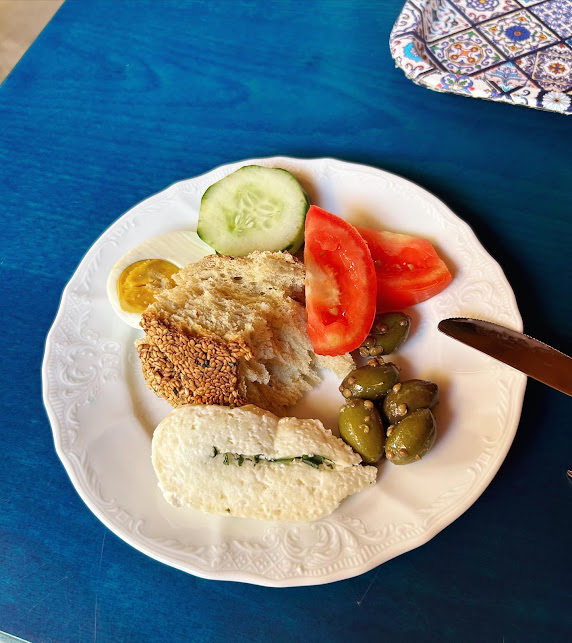
For our last field trip we journeyed into the mountains on my favorite kind of pilgrimage: seeking cheese.
I hadn’t been in Cyprus more than six hours before I was scouring the internet for food tours, looking to soak up the local culture in the most interactive way possible. Let me eat your food to understand you, my soul cries out. Make me fat and happy, catapult me through time, give me a bite of your history, explain part of your culture through taste. Food is shaped by economics, by technology, by cultural pourousity, by migration, by religion, by class, by necessity. Foodways are intrinsic to the human experience, and I wanted to experience Cyprus by eating my way through it.
And every single search result was the same: go on a halloumi tour.
***
Halloumi is a Cypriot national treasure. It’s on every menu at every restaurant in Cyprus. I mean it. Just try finding a place that doesn’t include halloumi in some way. Halloumi can be eaten plain, fried, or grilled because it has a very high melting point. Unlike, for example, mozzerella or gruyere, which are chosen for dishes specifically because of their low melting point (hence “melty cheeses”), halloumi holds up in higher temperatures. The downside, if you consider it a downside, is that the heat tolerance and “squeaky” texture of halloumi makes it a poor cheese for including in sauces or crumbling on salads.
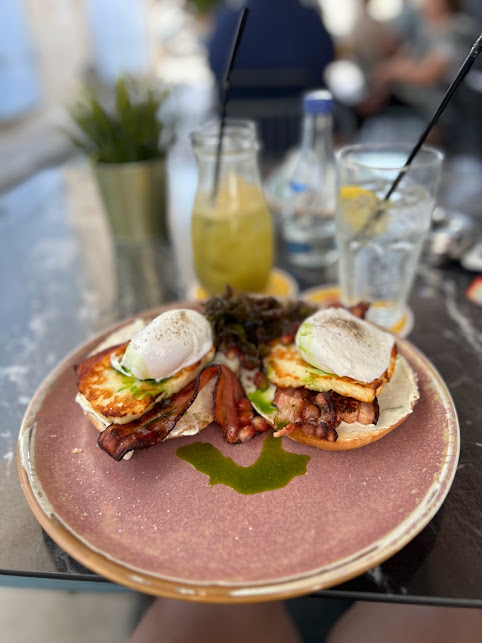
Halloumi on an eggs benedict And to go even further, halloumi is the national cheese of Cyprus. According to Cypriots, it was invented there and legally, it can only be made in Cyprus. It’s protected in the EU as a “geographical indication,” or GI, meaning that it’s only made from certain ingredients in a certain place. Like champagne, which can only legally be called “champagne” if it comes from the French region of Champagne made according to specific appellations using chardonnay grapes, halloumi comes exclusively from Cyprus. There was some messy legal back and forth in the early 2000s about including cow milk in the production of halloumi, which traditionally can only be made from sheep or goat milk. The international demand for the cheese, however, made industrial production at scale nearly impossible without using the more readily available cow milk, so today halloumi can be made of any one of those three types of dairy. Whether made of sheep, goat, or cow milk, halloumi must be produced in Cyprus to carry the coveted title.
Cheesemaking in general is both a very primitive and yet very sophisticated scientific process. The basics are the same across the board: heat some dairy, introduce some enzymes via rennet, drain, heat some more, and shape. Voila: cheese. Age if desired, smoke or brine to increase longevity, add some herbs and spices to taste, and enjoy. But the science behind it is deep molecular biology: rennet is a complex enzyme that affects the protein chains in milk, essentially shifting the water molecules in the milk, which is itself a complicated mesh of molecules. There’s something about lactic acid. To be honest, I don’t entirely understand it, and I spent many days trying to wrap my head around anything more complicated than the kid-friendly videos. In simplest terms, the rennet acts in much the same way yeast does in bread and beer and wine; essentially, milk undergoes a kind of fermentation in order to become cheese.
But humans have been making cheese for a long time without understanding the science that underlies the process. The general consensus for the first cheeses sounds a lot like the general consensus for the first breads, beers, and other fermented foods: discovered by accident. Hunters probably caught a kid (baby goat) who still had some of its mother’s milk in it’s belly. The rennet naturally present in the stomach lining of the kid probably coagulated the milk into something like a soft cheese– and from there, we’ve been making cheese in seemingly endless varieties.
***
The halloumi made in Petros Nikolaou Basketry Workshop & Museum is made the old fashioned way. Petros is really, really into basketry, but produces halloumi from the milk of goats and sheep raised on his farm. First he heats the milk and introduces it to heated water for up to three hours. Then a vegetable derived rennet (from the cardoon flower, native to Spain) is added to the mix. The curds are strained, set for 30-45 minutes, and then broken up by hand before being put into a traditional basket mold, where the whey is pressed out. Then back into a pot of water to cook, where the shape of the halloumi firms up. The whole process concentrates the protein in the cheese, which is why halloumi (and other cheeses) have been prized throughout history as valuable sources of semi-stable (depending on the variety) little protein pouches. It’s also why halloumi is so popular as a meat replacement in things like sandwiches and kebabs.
Once the halloumi is setting, Petros works fresh and dried mint into the cheese before folding it over and there it is: fresh halloumi, ready to eat. Mint, it turns out, is another particularly Cypriot flavor. From cheese to sausages to sweets, mint showed up in so many unexpected dishes. We were served this fresh halloumi with fresh sourdough bread crusted with sesame seeds, marinated olives, fresh tomatoes and cucumbers from Petros’ garden. We also got to taste Anari cheese, made from the whey byproduct of halloumi. It’s a lot like ricotta, and it was served to us with a dusting of cinnamon (another common Cyprus flavoring) and a generous drizzle of honey.
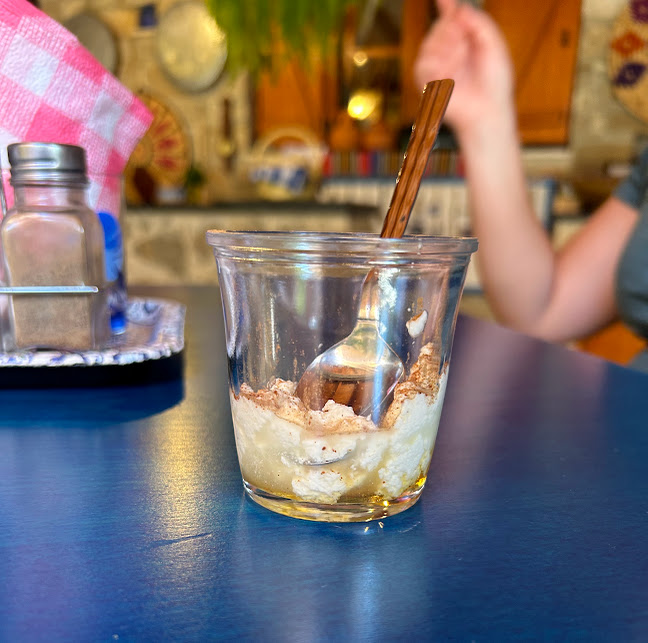
Anari with cinnamon and honey The fresh halloumi was, yeah, a little squeaky, kind of like mozzarella balls. It was slightly salty, slightly minty, and dreamy on the fresh sourdough. Of course I went back for seconds and, once surreptitiously checking to make sure that no one else was going back for more, thirds. It was wild to actually feel the change in texture as the cheese cooled, becoming firmer in between bites.
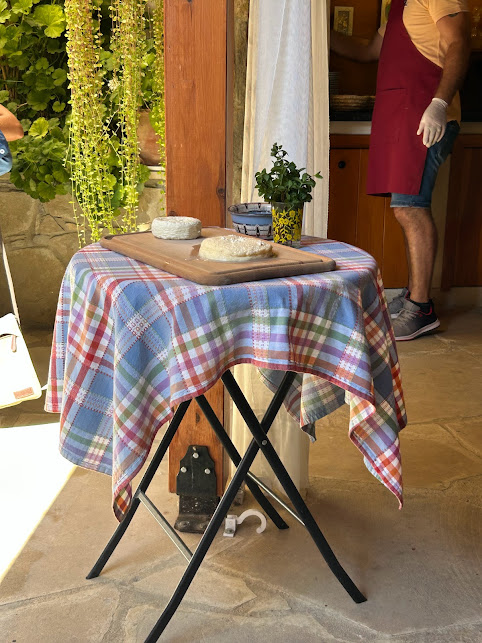
Fresh halloumi, ready to be massaged with mint ***
While not an exhaustive lesson in halloumi making– I would have leapt at the chance to make halloumi from start to finish, getting up early in the morning and dunking curds into boiling water for hours– it was still one of my most treasured experiences in Cyprus. It felt like a curtain had been pulled back and I got to take a peek at the soul of the place. Cringe, I know, but it made me bubble with happiness.
So for a taste of Cypriot history going back thousands of years, do yourself a favor and take the halloumi tour.
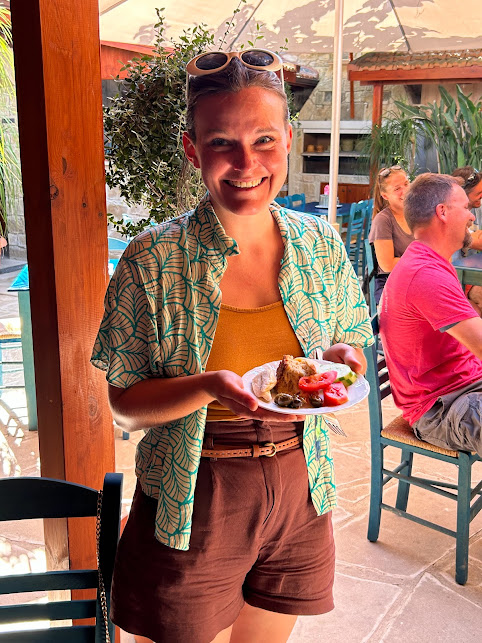
Me, in my happy place: with a beautiful plate of food in hand –Miki H
-
Donkey Milk
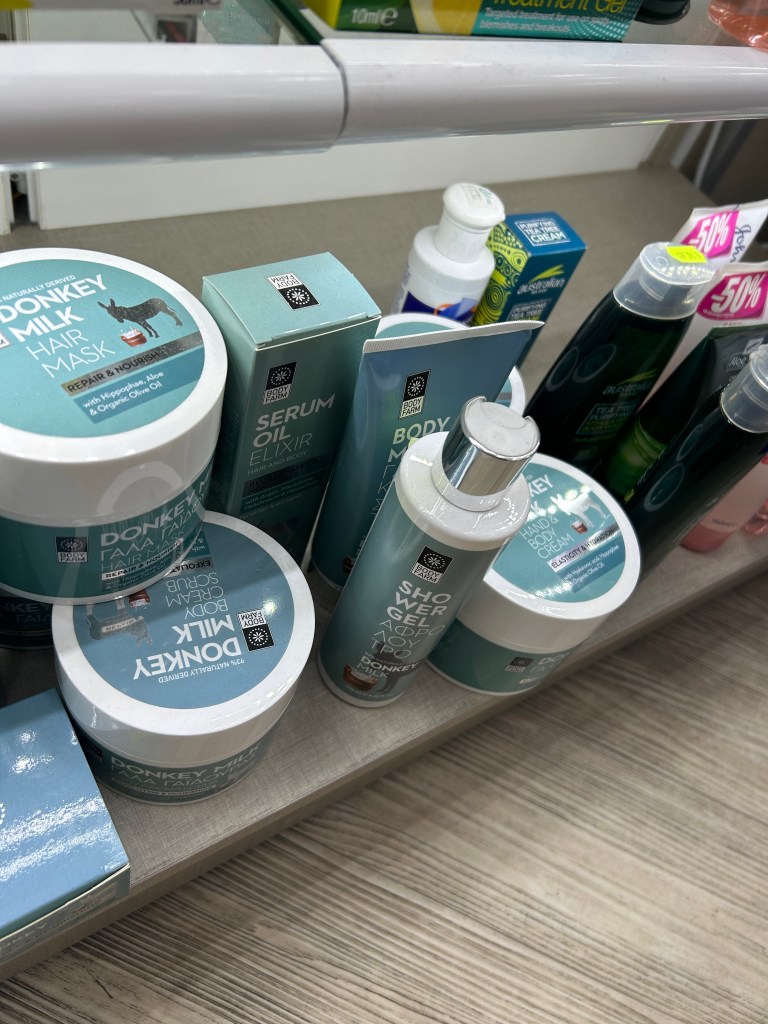
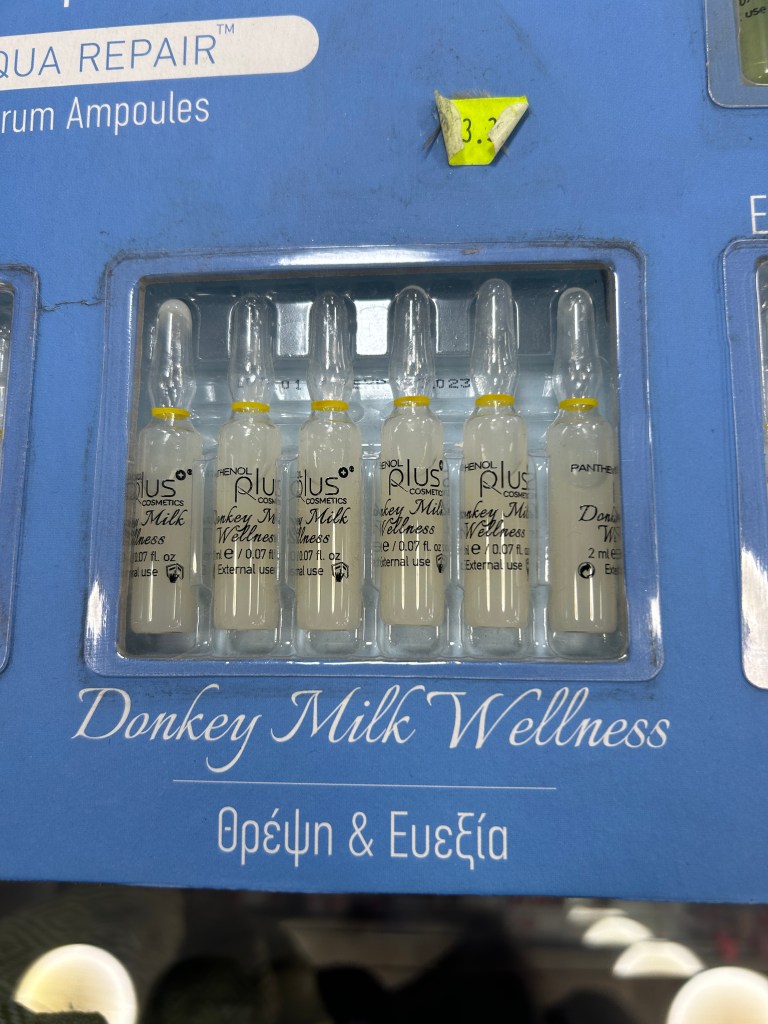
As I have explored Cyprus, something I have noticed all over is the prevalence of donkey milk products. The stuff is everywhere! At pharmacies and mini marts I notice it in soap, liquors, and hair products, the sheer quantity of it and how normal it seems to be is shocking. I wondered why there was so much of it, and what the historical context of this excess of donkey product could be.
According to my small bit of research, donkey milk is said to be antimicrobial, anti-aging, to boost your immune system, and seems to play a large part in the tourism of the island. In fact, donkeys have always been an important part of Cypriot life, from prehistoric times through the late 20th century. Traditionally, donkeys played an important role in agriculture on the Karpaz Peninsula, hauling olives from the groves and cereals from the fields to the mills. Even coming into more modern times, particularly in rural areas of Cyprus, households often had one or two donkeys.
Then, in 1974, the Turkish Invasion happened, and whole villages of Greek-Cypriot farmers fled the northern part of the island, leaving their donkeys behind. Now those hundreds of donkeys live in a feral state, abandoned and forced to live on their own after centuries of domestication. Experts estimate there must be around 2,000 of them today, roaming the hills of the remote Karpaz Peninsula. Since the 70s, various farms and sanctuaries have been founded to house and take care of the donkeys, and they have become a large part of tourism on the island now that they are no longer involved in agriculture.
Annika Schramm
-
Yes, I Played Pokémon Go in Cyprus
“Are you actually playing Pokémon right now?” One of my roommates asked me as I casually caught another poliwag with a great throw.
“Yes. I absolutely am.” There was zero shame in my response.
Pokémon Go is hopping in Larnaca. Our hotel, the Blazer Residence, was basically on top of two Pokéstops, three if you walked out of the suite and down the hall. The beach promenade is lined with Pokéstops and Gyms, and Raids were easy to walk to.
Why, you must be wondering, am I writing a blog post about the history and culture of Larnaca, and talking about Pokémon Go?
Well. I’m glad you asked. First of all, you do a ton of walking in Larnaca. It’s a really navigable area that we stay in, with shops, restaurants, coffee, bars, churches, monuments; everything, really, within close distance.
In Pokémon Go, walking confers several benefits. 1. You hatch any eggs that you’re incubating by walking a certain number of kilometers. This has the added bonus of making it easier to adjust to kilometers as a measurement of distance for Americans. 2. As you walk, you earn your pokémon buddy their respective candy, which you use to either evolve them or increase their stats. I was finally able to take my Noibat and evolve her into a significantly more powerful Noivern, a feat requiring 400 candies (roughly 900 km– I did not walk that much in Cyprus, it just helped push me over the needed edge).
Secondly, Pokéstops are located at points of interest. You spin a Pokéstop, and a little picture and blurb pops up about what that location is. For example, the Armenian Church next door to the Blazer has a stop and a nice little explanation of the church’s history. This might not seem like a big deal, but it was through spinning Pokéstops along the beach that I found the Armenian Genocide Memorial. Could I have read the plaque of every statue I came across while I was in Larnaca? Sure. But that’s a little unrealistic. It was sort of forcibly brought to my attention via Go, which piqued my interest and gave me a nudge to look deeper into the recent past to understand more the relationship between fleeing victims of the Armenian Genocide and the Republic of Cyprus.
Thirdly, it’s fun. It’s a fun thing to do, walking around, getting coffee, seeing what kind of Pokémon are catchable by the beach, in the mountains, and at seemingly every archaeological site on Cyprus. Really. I was astounded. Paphos, the Sanctuary of Aphrodite, Kition– there were Pokéstops and even Gyms at Kourion. To me this indicates a robust interest from not only tourists, but locals who put up the Stops and Gyms.
So yeah. Go ahead and play Pokémon Go while you’re here in Cyprus. Find some buddies and go out and Raid, or make friends with the local teens clustered around the same Raid Boss, scrolling furiously on their phones.
–Miki
-
Where to Eat in Larnaca
So you’ve made it to Larnaca after a series of long flights. It’s probably been a fraught journey, with weird connections, maybe a pre-dig trip, and possibly a night spent in a foreign airport during a layover. You’re tired and hungry, and you need some good recommendations, and maybe a little help avoiding the tourist traps.
You’ve been warned in many a blog post about how long it can take to eat in Cyprus. Dinners are leisurely things, and it takes a while to make that adjustment. You end up feeling very American when a meal taking more than an hour has you crawling with anxiety.
Here’s the hack: pretty much anywhere will do your food to go. If you just want to get a quick bite, this is your best option. Most places have their menus online, but some are still pretty old school and don’t really have a functioning website, so you have a chance to be ready with your order. As a warning, a ton of businesses in Cyprus still use Facebook as their main business site. Call the restaurant or, if you’re not feeling confident (or hate phone calls like me) and want to stretch your legs, take a walk to the restaurant in question. Hang out by the sign or posted menu, and someone will come by to seat you or take your order. Tell them you want to order takeaway, and voila! Your food will be ready in about or under 15 minutes.
That being said, you do owe it to yourself to have sit down meals out. If you’ve got a party bigger than 4 and its a weekend, call ahead to make a reservation– especially, especially if you’re taking the whole crew. Be prepared for disappointment if 9 or 12 of you show up somewhere on a Friday night at 7:30 and want to be sat immediately.
Without further ado, here are my recommendations for food in Larnaca.
In General:
- Chris’ Juice Bar: these smoothies might just change your mind about smoothies. Zenonos Pierides, Larnaca 6023, Cyprus
- Lokmakos. Lokmakos donuts are a modern twist on a classic Cypriot fried sweet, and you owe it to yourself to give it a try. I could wax poetic about these guys, but there’s definitely at least one other blog post that does that for me. Pavlou Valsamaki 30, Larnaca 6026, Cyprus
Vegetarian: Most places have vegetarian options, but fewer vegan places are available. For a guaranteed experience, check out:
- Falafel Abu Dany. A Lebanese-run, small scale falafel joint with vegan and vegetarian options that are just killer. You have to try the Arruba broad beans– I know, it sounds like a stretch, but as a non-vegetarian, I was amazed by how bright and lovely the sauce these Cyprus staples were drenched in. AKAMIA CENTER, Grigori Afxentiou, Larnaca, Cyprus
- Mingle Cafe. Connected to a super cute hotel, Mingle has incredible breakfast and lunch options. It also qualifies as a great brunch spot, but their vegan and vegetarian friendly options earned them a place on this list. Especially good if you’re craving a decent hamburger or some American pancakes. Ermou 153, Larnaca 6022, Cyprus
Cypriot
- To Diaforetiko. Upscale, but not too expensive (honestly, by American standards, even the upscale restaurants are super affordable). Has a lovely brunch. Zinonos Kitieos 5, Larnaca 6023, Cyprus
- Valtou Rigani – Souvlakopolio. Like a lot of places in Cyprus, you order a la cart, so load up on kebabs and saganaki. Salads here are bulky and delightful. 106 Ermou street Stoa Kizi, Ermou-shop 15, Larnaca 6022, Cyprus
- GRILL CHEF. I highly, highly recommend going here at least once and maybe earlier in your trip. Ordering the Cyprus Platter is a great introduction to Cypriot cuisine. Pavlou Valsamaki, Larnaca, Cyprus
- Special Kebab House. Yes, I’m recommending two restaurants basically right next to each other. Skip Souvlaki.gr and head to either Grill Chef or Special Kebab House. The moussaka is cooked to order (not a good takeaway option) and diabolically good. Some of the best gyros I had in Cyprus. Pavlou Valsamaki 31, Larnaca, Cyprus
- Edesma Cyprus Taverna – Souvlaki Place. The vibes are great and the back patio is beautiful. Go Friday or Saturday night for the special: tender lamb that’s been roasting all day. Λόρδου Βύρωνος 50, Larnaca 6018, Cyprus
- Ithaki Garden. You really do want to dine in for this one. The garden patio looks just like a fairy tale and the food is great. Zinonos Kitieos 64, Stoa Kouppa 6022, Larnaca, Cyprus
- Glykolémono. Good pizza, good wine, great kunefa. Zinonos Kitieos 105, Larnaca, Cyprus
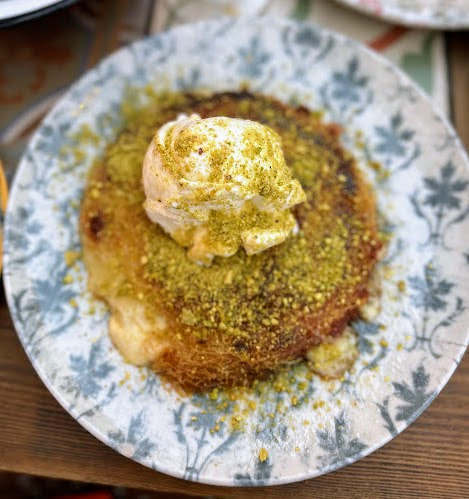
Glykolémono 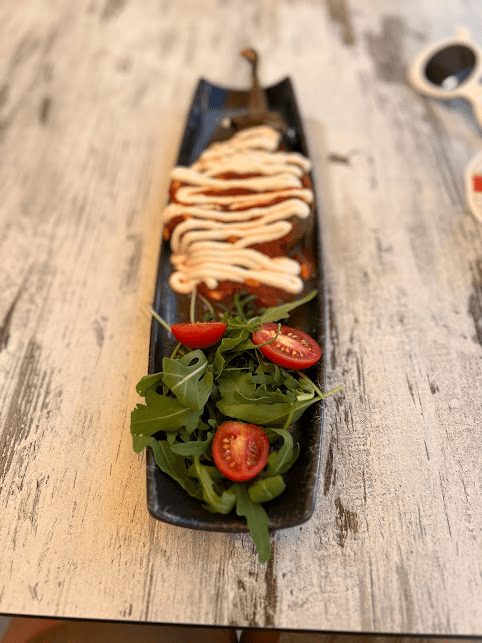
To Diaforetiko Brunch
- To Kafe Tis Chrysanthi’s. Juices that make you feel like you’re a fancy grown up, and affrogato served in a coup martini glass. Nikolaou Rossou, Larnaca, Cyprus
- Edem’s Yard. This is the only place I’m recommending that I didn’t actually eat at, and while normally I find that an unacceptable proposition, it was recommended to me by several different coffee shop owners, so give it a go and report back in your own blog! Evanthias pieridou larnaca CY, 4021, Cyprus
- Onar Larnaca. Just a really great brunch, literally around the corner from the Blazer. Try the shakshuka, which has just the mildest kick of spice. Megaron, Zenonos Pierides 1, Larnaca 6023, Cyprus
- Hobo Cafe. This is sort of an unusual choice for me, since it’s right on the main beach strip, but damn, their avocado toast. Eat and watch the waves. WJ7Q+V2H, Larnaca, Cyprus
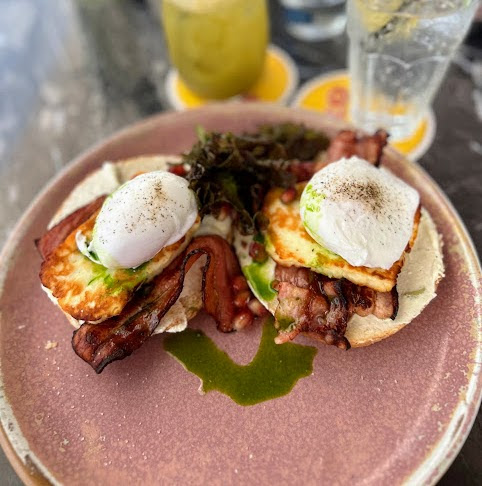
To Kafe Tis Chrysanthi’s 
Onar Larnaca 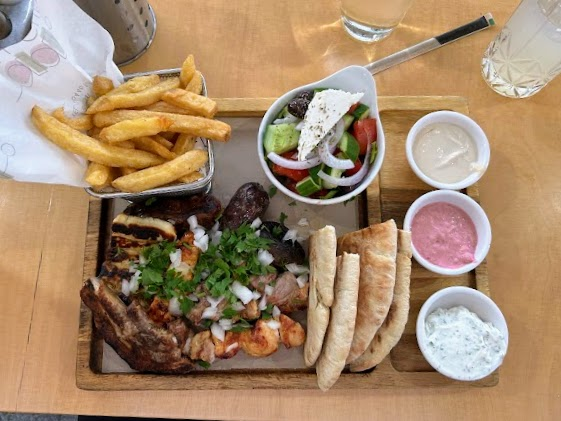
Grill Chef And the winner of my #1 recommendation, favorite place I ate in Cyprus is:
Maqam Al-Sultan. This Lebanese restaurant on the promenade is right next to the medieval fort, and I have been thinking about it nonstop since the first time I ate there. The meze is incredible, and you must share, probably with more than the recommended 2 people. The dips, the chicken, the lamb, the fish, every possible thing they do to eggplant (aubergine on that side of the Atlantic), the vegetarian platter– I seriously cannot recommend this place highly enough. You will absolutely regret it if you don’t go. There’s belly dancing on Friday and Saturday nights, though, so if that a) isn’t your thing or b) didn’t make a reservation, think about going another night. Please eat here. Agkiras Larnaca CY, 6026, Cyprus

Maqam Al-Sultan As you spend time in Larnaca, you’ll find your own favorite spots– Capodecina was a huge hit and Dr. Stephens swears by the Cypriot Pizza Hut — but this list will at least be a place to start.
I didn’t cover bakeries, coffee shops, or bars, but I’ll let you enjoy discovering the multitude of options on your own.
–Miki H.
-
Mall Rat Moment
One day, Hannah, Paris and I decided to take the bus to the recently developed Larnaca mall. We’d heard from the professors and a few locals that the mall was kind of the place to be, and that it had become the only place in Larnaca for certain shopping opportunities. Navigating the public transit system was an interesting experience, but nevertheless, we persisted and found our way to the mall, and walking inside felt like stepping back into 2009.
The arcade was lit up and bustling, the food court lines long, and gaggles of teens and families filled the wide hallways. Going to the mall in America has increasingly less and less of this “mall magic”, the hustle and bustle, the sights and sounds and greasy snacks that people wanted to partake in with friends or family, not even to shop, just for the environment. Malls in Cyprus, on the flip side, are growing in popularity and many shops, particularly chain stores, that used to fill the streets of Larnaca moved locations to the mall. Walking around and shopping in Larnaca, we encountered many shop owners who complained about this very change in culture, as many of these shops used to make the area more populated and lively moved to the mall, and took the business that they provided the area with them.
While I certainly appreciated the chance to be a little mall rat once again, it felt so much more right to keep my business local for the rest of the time in Larnaca.
Annika Schramm
-
Working Hard or Hardly Working
This month has taught me a lot of things. I never thought of myself as a hard worker, honestly. I know I’m smart and I know I can get things done when I have to, I’ve always held it against myself that I don’t feel like I work as hard as I could, or should. I was scared going into this trip that I wouldn’t be able to do the work asked of me and I would fail. But that’s not what happened. Instead, I showed up every day to the best of my ability and had a good attitude and genuinely wanted to work. I didn’t even have to push myself, because it just felt like it made sense. Not to say that it wasn’t hard work, of course it very much was, but I have to say that the feeling of picking and hacking away, then realizing you’re finding something and switching into careful mode is exhilarating enough to make it feel like the only thing that matters in the moment. In those moments when the focus took over, I got to feel like the archaeologist I wanted to be as a kid. Hunched over, articulating a wall or a piece of pottery, I almost couldn’t stop even when I knew it was time.
The dig was made up of little moments like that, every hour or so when something new came up, I got to invest myself in bringing it up and understanding its story. Each little moment made the process so worth it. What I may have loved the most though, was standing back and seeing what we had spent the month doing. Doing the stratigraphic drawing and looking hard at the each layer of the baulk dug all the way down to bedrock, seeing each little moment tell the whole story, and getting the satisfaction of turning it into data and measuring correctly and marking it correctly and seeing those millennium that we just dug up translate onto the page was so exciting to me.
Annika Schramm
-
Composite Vessels
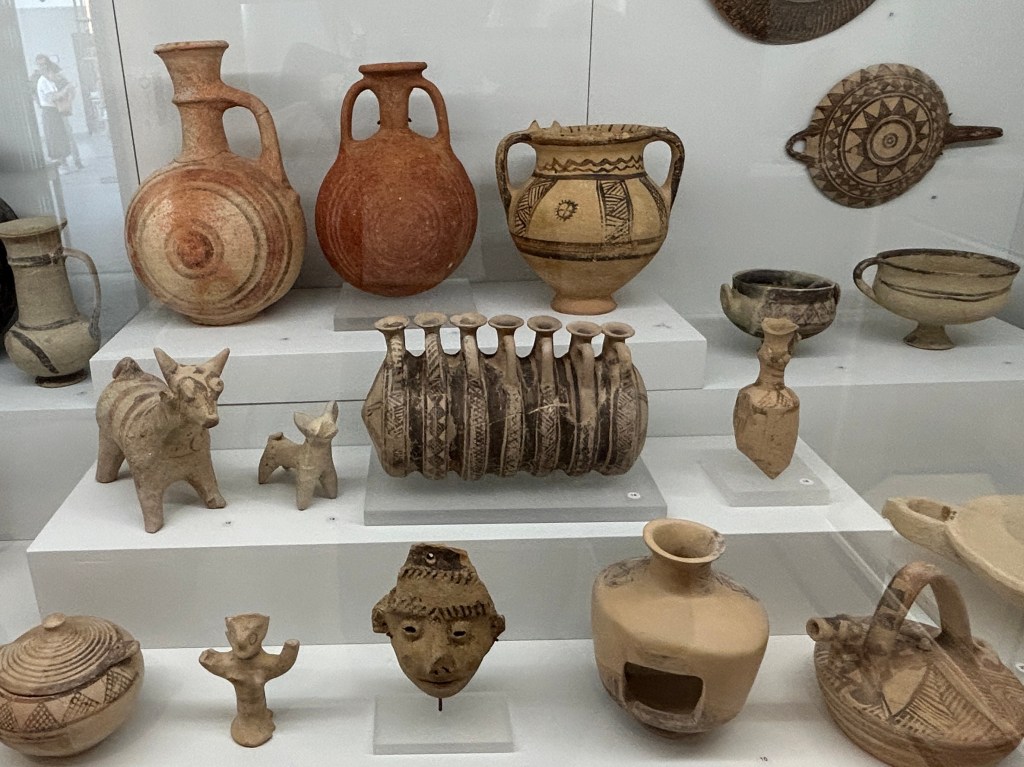
One thing that has continued to jump out at me at the various museums we have visited on Cyprus, including those in Nicosia, Paphos, and Larnaca, are the unique Cypriot creations dubbed ‘composite vessels’. There are composite vessels of all different shapes and sizes, a common example being a vessel made of bowls conjoined at their sides, with a handle of sorts protruding from the center of the amalgamation. One of my favorite pieces I’ve seen in a museum thus far was a vessel comprised of seven jugs smushed together to create one large jug with seven openings and seven handles (photo attached). This piece in particular sparked my interest in these unique objects, I’d never seen something like it before, so I started poking at Drs Stephens and Tom to see what they knew. I learned from them that this type of vessel is a style that is uniquely Cypriot, that nothing like them has been found anywhere else, but also that they were otherwise unsure of the vessels’ function or why the ancient Cypriots designed and created things in this way. So I took it upon myself to do some research, which has proved to be frustrating. Almost no information seems to exist on the internet regarding the composite vessels, at least not accessible to me.
Because no one can tell me explicitly, I have to imagine what the people who were creating these funky pieces were doing, and for what reason! Perhaps they were modern art, for decorative purposes, or possibly experimental kitchenware to serve their own unique needs of the moment. When we first saw that seven-jug vessel in the museum, we joked it was made to pour a shotski, which was all in good fun, but truthfully I don’t think we were that far off. I think the composite vessels were a tool to serve your whole family, pour a drink for yourself and six of your friends, serve your olives, nuts, and grapes in one vessel made of three bowls. Though maybe not necessarily the most efficient designs, they look a bit awkward to use, I love to imagine how they might embody some of the eccentricities of ancient Cypriot life.
Annika Schramm
-
EU 23 – Vigla
I worked in the far-eastern excavation unit, numbered 23. I just want to make a quick blog post explaining how EU 23 fits into the archaeological context of Vigla.
Well first it should be noted that, compared to EU 20 and 24 finds in EU 23 were quite minuscule, with maybe two exceptions. Despite being part of the fortification, EU 23 didn’t return very many military-related finds. However, on the other hand, personal items such as beads and a bronze fibula were found. To me this implies that this was the domestic barracks of the fort. A place where they lived. But there is also the chance that this is a storage area.
One thing supporting the storage room theory is the existence of the ashlar. Underneath the ashlar there was some weaponry and it would appear that these were purposefully sealed for whatever reason.
Another important thing to note is that there are two different occupation levels/two floors. In the earlier/lower level a Cypro-Classical/Hellenistic sherd was found, giving us a supposed time period. This would mean that the later level of occupation must be hellenistic era, it is unlikely to be from pre-hellenistic eras.
Another interesting thing about this EU is that, due to the ashlar, many of the SUs are contemporary. SUs 8506, 8509, 8511, and 8512 are all contemporary.
On the search for bedrock (SU 8513), a charred root was uncovered in the sieve. This would be the third root sample found in EU 23 this year which is quite neat. Charred roots will help with carbon dating and eventually dating this site.
So to conclude, EU 23 brings a level of domesticity to the hypothesized fort!
Hunter Powell
-
A Day in the Life
This is the day in the life of me (Hunter Powell) as an archaeological student.
4:00 – wake up when my alarm goes off, but go back to sleep because I think I’ll wake up on my own again.
4:30 – wake up when my roommate wakes me up, hold a grudge.
4:55 – all dressed and ready to go, feeling like i’m missing something
5:00 – load into the vans to get to site
5:10 – stop at Zorbas and get a donut, a large water, a monster energy, and some fruit.
5:30ish – arrive at site, but oh no! i forgot my knee pads,,, oh well.
5:30-9:00 – archaeological work!! Taking plenty (maybe too many) breaks because I get bored and tired and dehydrated easy.
9:00 – second breakfast, although i never even had a first breakfast, enjoy my fruit. (at this point the donut and the monster energy are already gone).
9:30-11:00 – rest of archaeological work for the day, still talking plenty of breaks, but less as i am rejuvenated from second breakfast.
11:30ish – arrive at home and here’s where the day splits off. i can either go take a 2 hour nap or go for a nice walk in the sweltering heat. usually i choose the latter for some reason.
From here on out my average day is so hectic that there would be no point in recording it! In any circumstance, this is going to be the future student’s basic daily routine (save for some time changes regarding archaeological work). Make sure you save enough time for the rest of your day to do things like homework. But of course have fun!
-
Textbook Stratigraphy
In the eastern half of EU23, my team in the trench excavated a stone ashlar at the same (ish) level as the bedrock. The supervisors speculated that it may have been a work stone or placed there covering an intentional deposit, but didn’t have enough context initially to feel ready to say for certain if it was intentionally placed or not.
As we moved down around the flat slab of stone, we discovered a distinct ash layer directly beneath the ashlar, which was so clearly concentrated under the ashlar that so we chose not to remove any of the stone or ashy soil until we had dug around a little more and garnered an understanding of what the purpose of the ashlar may have been in context with the layers beneath it. This is a strategy we employed a few times on site, choosing not to remove something from its resting place until we could gather more information on why it was there. As we dug slowly around the ashlar, keeping it in place, the layers of ash, soil, and collapsed cobblestones beneath it became unbelievably clear, the layers distinctive enough to be an archaeology textbook photo.
Melanie, Dr. Tom, and Dr. Olson all crowded around and concurred that the layers were remarkable to see, all commenting on how such clear stratigraphy is something rare to see in actual archaeology. Seeing such clear layers is a useful and almost surreal way to imagine the story of the site, it makes it much easier to see what may have happened and the order in which floors were built, covered, when walls collapsed, etc.., like looking at hundreds of years happening all at once.
Noting each layer gave us a much clearer picture of the chronology of the things we had been finding layer by layer, including the ashlar and the secrets that lay beneath it. Getting to peek through time and hearing my supervisors remark on the intrigue and the abundance of this site makes me incredibly grateful for the opportunity to learn at and experience Vigla.
Annika Schramm
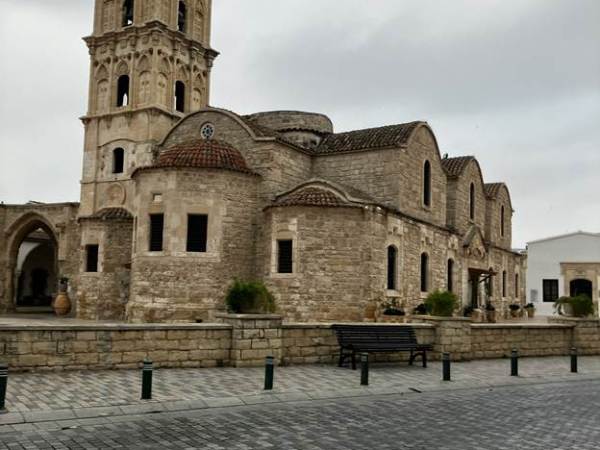
Study Abroad in Cyprus
By: Arthur Pino Coming to the Old World is a new experience for me. I can say that, besides the luxuries and brands similar to those in America, it is quite different. This land has been inhabited for at least 4,000 years, according to the sign outside the Agio Lazaros (The Church of St. Lazarus).…

House of Dionysus
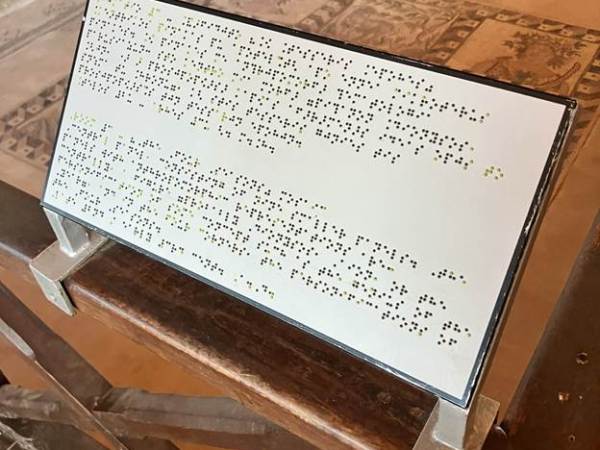
By: Arthur Pino On a field trip, we went to Paphos, where we were able to visit a “World Heritage Site.” This would be the second opportunity I have had to see one in my life within the last year; the other was Chichen Itza in Mexico. It was a very hot day, and walking…

A Big Discovery!
By: Arthur Pino Today was another hard but rewarding day. It was the first time I had worked in the trenches three days in a row, and I felt it. This day, in particular, revolved around hands. My hands themselves, and an accessory for hands. As usual, I did not wear gloves to start…

