-
Funerary Traditions and Remembrance
I have always been fascinated by funerary traditions and the way people remember and honor their dead. It’s seen throughout time and throughout different cultures, humans want something nice for their loved ones after they pass. This week we visited Amathous and the museum in Limassol. The museum contained a variety of burial artifacts from Amathous. These included funerary stele and tomb markers, jars from a cremation cemetery, goat/sheep knucklebones, a variety of tomb offerings, and even a cast of a cat burial. All of these items bring to mind similarities between people then and people now when it comes to death. Humans have always felt the need to remember those they love who have passed and they’ve always done what they could to send their loved ones off well.
One specific example of sending their loved ones off well found in Amathous is the goat/sheep knucklebones. According to the plaque at the museum, the knuckle bones were used in games of both luck and skill and also considered to be protective. It is possible that either someone was buried with these for the purpose of protection or because the person buried in the tomb enjoyed playing the knucklebones games. Either way this is likely an example of ancient people doing their best to give a loved one what they’d need for the afterlife. To me this calls to mind people who leave beloved toys at children’s graves or bury family members with their favorite jewelry.
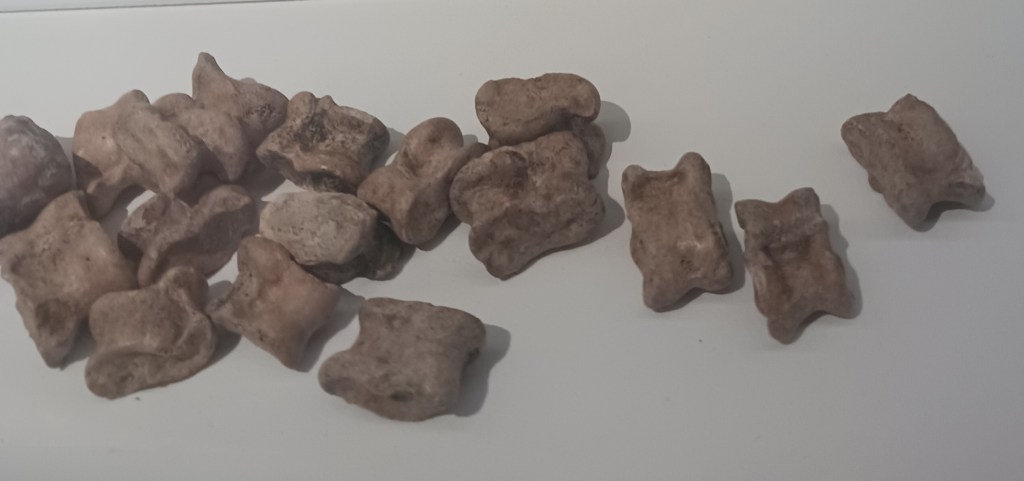
Goat/Sheep Knucklebones found in Amathous There are also the cases of the funerary stele and tomb markers that bring to mind similar practices today. The first is one inscribed for an eight year-old named Aphrodisia. It states she “was deeply adored for her pleasant allure, leaving mournful agony to the parents, which Hades surely doesn’t take into account.” This reminds me a lot of inscriptions you see on headstones today that speak to the character of the person buried below. It also makes me feel a great connection to the people of the past, as I’ve lost several young friends and understood this grief completely. It does do something I have not really seen in modern gravestones and address possible passersby stating “But you who are present here, say ‘farewell charming Aphrodisia’ and you may continue happily on your way.” This addition made me feel even more of a connection to the people of the past.
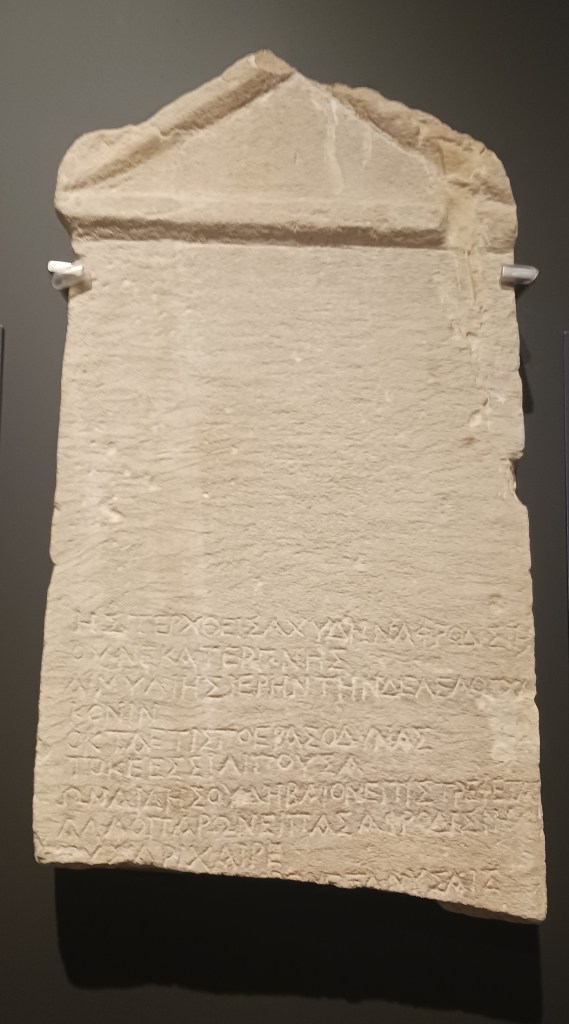
Funerary Stele found in Amathous People have always felt a connection to their dead and it’s hard not to feel the same connection to people of the past when you see the ways they dealt with death. The funerary practices found in Amathous touched me deeply and I really enjoyed the opportunity to see the artifacts in the museum in Limassol.
~ Apollo Blue
-
Buyuk Han
When we went over to the Turkish side of Nicosia, I saw some beautiful architecture. One of these beautiful buildings was the Buyuk Han, or the Big Inn. This inn was built during the Turkish period in 1572. It is located in a traditional market center and was commissioned by the governor-general at the time. It was originally built to provide a place for travelers to stay. It was originally called “The Alanyalilar’s Han” but when another, smaller inn was built the local’s began calling it Buyuk Han. The inn was built very similarly to those in Anatolian cities, as Anatolian travelers were an intended consumer base. The Buyuk Han is a two story building with 68 rooms that open to the courtyard in the center. The han also contains 10 shops that open to the streets outside the han. There is a fountain in the center that was previously used for ritual ablutions, an Islamic procedure for cleansing parts of the body. The architecture of the han includes many archways, including the doorways and windows on the first floor rooms and the doorways of the second floor rooms. All of the rooms also include a hearth. On top of beautiful architecture, the Buyuk Han gives and interesting look at the culture of the time, especially those from Anatolia.
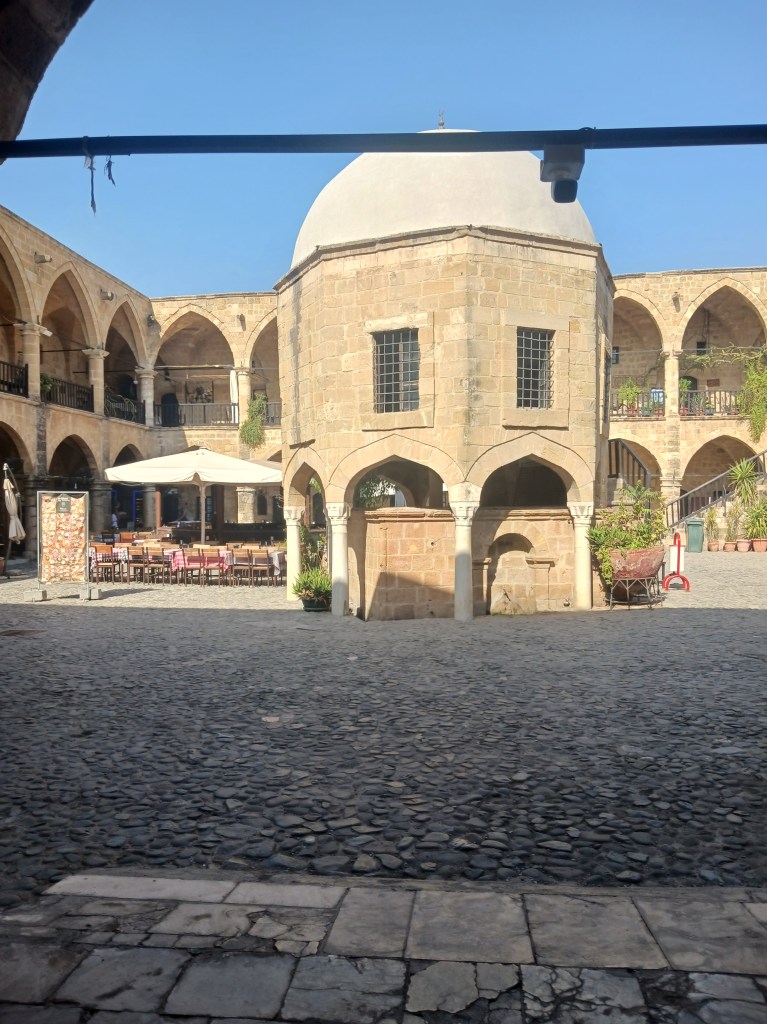
~ Apollo Blue
-
Wheelchair Repair Part 2
On our way to Larnaca from Nicosia, we stopped at a few shops in an attempt to get my wheelchair tire repaired. The first place we stopped was a bike shop. The man working at the shop informed us he might be able to order the correct tube for the tire but it’d have to wait until after the weekend. We stopped by another shop that told us they couldn’t help but they gave us an address of a mobility aid shop. I stayed in the car but my travel companions were in the mobility aid shop for awhile and I got hopeful. Unfortunately, they got similar news at this shop, they might be able to help but it’d have to wait until they could get ahold of a tire repair guy after the weekend. I’ve noticed, Cypriots are very protective of their off time. After that, we decided to save this problem for Monday.
Monday came and went with no word so one of my classmates called the first bike shop to follow up and we were informed their bike repair guy was not in so we’d have to wait. On Tuesday, we heard from the mobility aid shop, they couldn’t help. On Wednesday, Dr. Stephens, my travel companions, and I, went on an adventure to solve this problem. We started with the first bike shop we’d gone to on our way back from Nicosia. The bike shop employee was not happy to see my companions again. It seemed as if he was hoping we forgot. He was rude and kept asking the same questions. It was clear my accessibility was not an urgent concern too this man and he did not take it seriously. He finally told us there was a shop in Limassol that had tubes that would work and that he could get them ordered. We decided that this was a big priority and decided to drive to Limassol to get the tube, even though we were warned they closed in 2 hours. The address written down by the man at the bike shop was confusing and not entirely accurate so we just drove the street hoping for the best. We finally saw a bike shop with a free parking spot right in front. The man in the shop immediately knew who we were and was ready to repair the tire. He offered me a seat while he put the new tube in. As he worked he informed us that this was not his first time repairing a wheelchair tire as he helps service tires for the Apollon Wheelchair Basketball Team. This man was super helpful and sent use home with an extra tube, a repaired tire, and a free patch kit because he knew how far we drove. Thank you to Biker Bike Shop for the great service and to Audrey, Hannah, and Dr. Stephens for all their wonderful help problem solving.
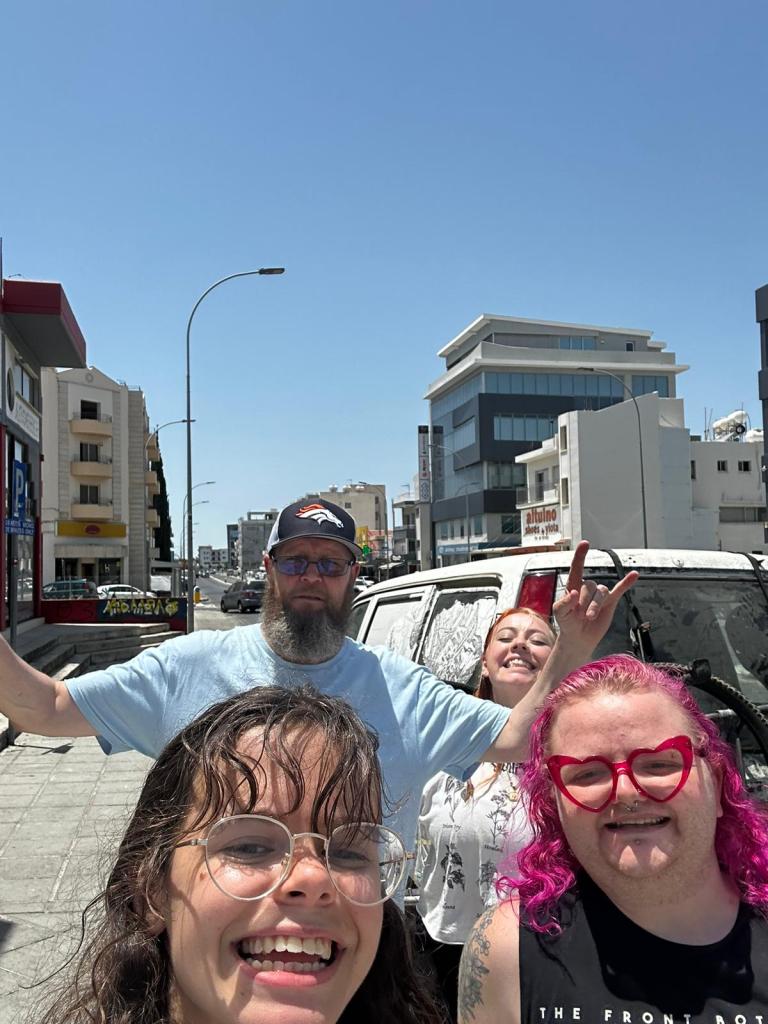
A celebratory selfie after finally repairing the wheelchair tire ~ Apollo Blue
-
Yoga By K.
Before traveling to Cyprus, I was doing yoga 4-6 times a week. A recent knee injury was preventing me from running and yoga became the next best thing. I wasn’t sure if I would be able to find a yoga studio in Larnaca. Most appeared online as closed or poorly advertised. I found a studio called YogaByK which has several reviews and photos. The website was also updated minus one of the time slots on Tuesdays. I walked 1.3 miles from the Blazer to attend a 10am class. Once I arrived at the location, I could not find the actual studio. I looked around for about 10 minutes and by this point class had started. I messaged the studio online explaining what happened. They responded with, “Hi class is at 18:30. Really sorry you came for nothing it seems it’s not corrected on the website. Time schedule is what’s it’s written except Tuesday morning 10am.” Which was good and bad news. I eventually found that I needed to be buzzed into an apartment building to access the studio. I decided I would try and attend the 18:30 class later that day. I made it and the class was very enjoyable and different from my typical classes in Denver. The movements included slow deep stretches that I was not used to. After spending 4 mornings in a row bent over in the heat digging, spending 90 minutes stretching my body felt great and well needed. For the remainder of the trip, I will be attending two yoga classes a week.
-
Wheelchair Repair in Cyprus Part 1
I arrived in Cyprus early with some classmates to spend a few days in Nicosia. Shortly after arriving, I realized one of my wheelchair tires was completely flat, damaged by the airline. My travel buddies and I were exhausted and decided this was a tomorrow problem. When we awoke the next day around 2pm, we began the challenging task of repairing a wheelchair tire in Cyprus. As my wheelchair tire is essentially a skinny bike tire, my classmates began by taking it to a bike shop. The first bike shop did not have a thin enough tube. The bike shop worker filled the tire, reporting that it did not have an obvious hole, and sold us some tube sealant. When they arrived back, we decided to take the tire to a gas station and attempt to seal the tube. My travel buddies and I walked to the gas station and began an attempt at fixing the tire. The gas station attendants were very helpful as we fought with the tube to get it filled with sealant.
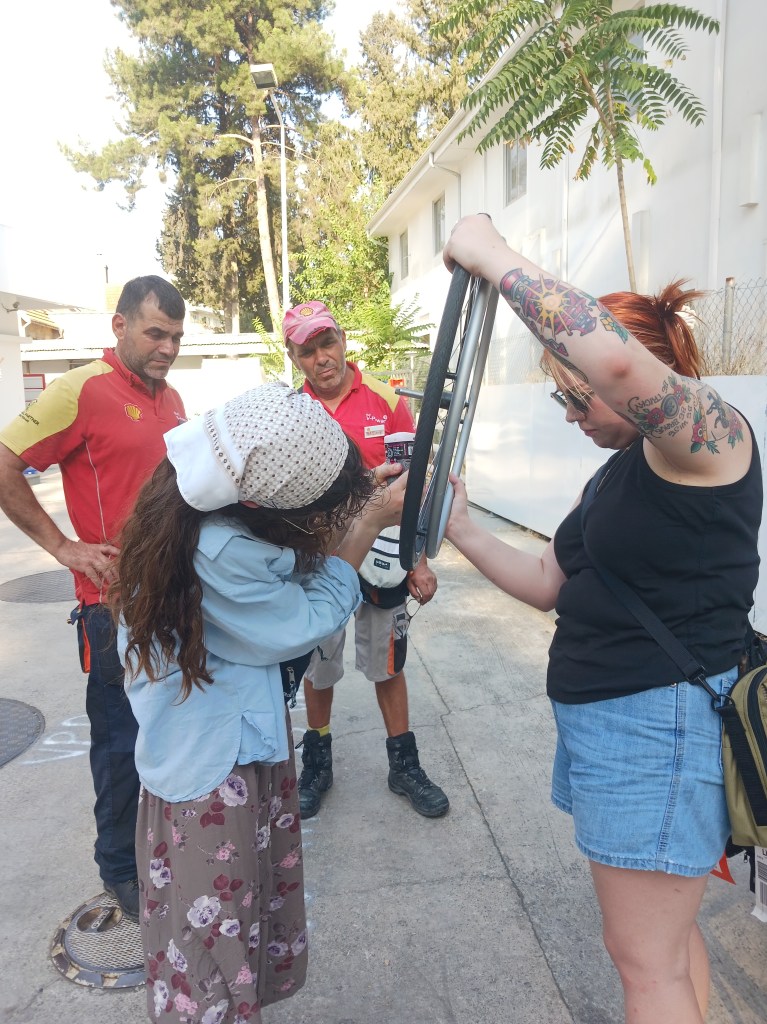
Unfortunately, as they began sealing the tire, the sealant was leaking out of the walls in many places and the air was streaming out of 5 gashes in the wall of the tire. As we were trying to patch the wall (with a patch kit containing dried glue), the gas station attendants informed us they were off and leaving, but they did make sure we knew how to use the pump first. Cypriots are very protective of their breaks, much unlike Americans. We realized we wouldn’t be able to solve this problem today and decided to wait until Dr. Stephens picked us up the next day.
~ Apollo Blue
-
Paphos Mosaics
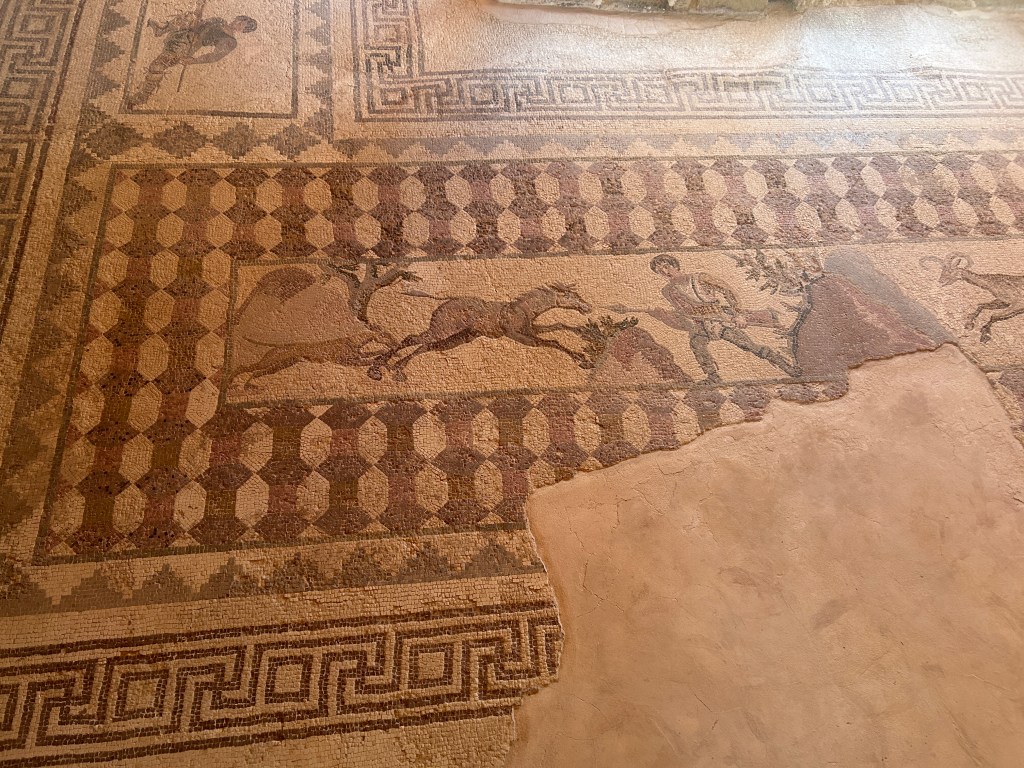
Paphos is known for its intricate and remarkably preserved mosaics, they are considered among the finest in the Mediterranean and form part of Kato Pafos, which we visited on our field trip to Paphos. The mosaics were discovered in 1962, when a farmer plowing his field came across one, totally unintentionally. From then on, systematic excavations were carried out, and led to the discovery of a group of large houses, the floors covered in mosaics, many of them incredibly intact. Archaeologists came to identify courtyards, dressing rooms, baths and other rooms and facilities of the houses. The houses were then named after the figures that adorned the floors, including the houses of Dionysos, Theseus, and Orpheus. The floor mosaics across all these houses depict various scenes from Cypriot life and Greek mythology. Some of the mosaics that stood out to me were the mosaics of the Bath of Achilles, the Four Seasons, and all the imagery of fruit and birds. The mosaic of the hunting scene also intrigued me, it felt more animated than the others. I think I found it interesting to see all the animals, running, not posed or sedentary.
Something about all of the mosaics feel larger than life. The amount of work it must have taken to do all of this painstaking placing tiles across the hundreds of square meters that are all covered in this park is beyond my comprehension. I have so much awe and respect for the people who spent their lives creating such beautiful and long lasting art. On a very different level, as an archaeologist of sorts myself now, I also have mad respect for the people who swept up all the dirt that was on these, I can’t even imagine getting into those crevices!
-
Aphrodite in Paphos
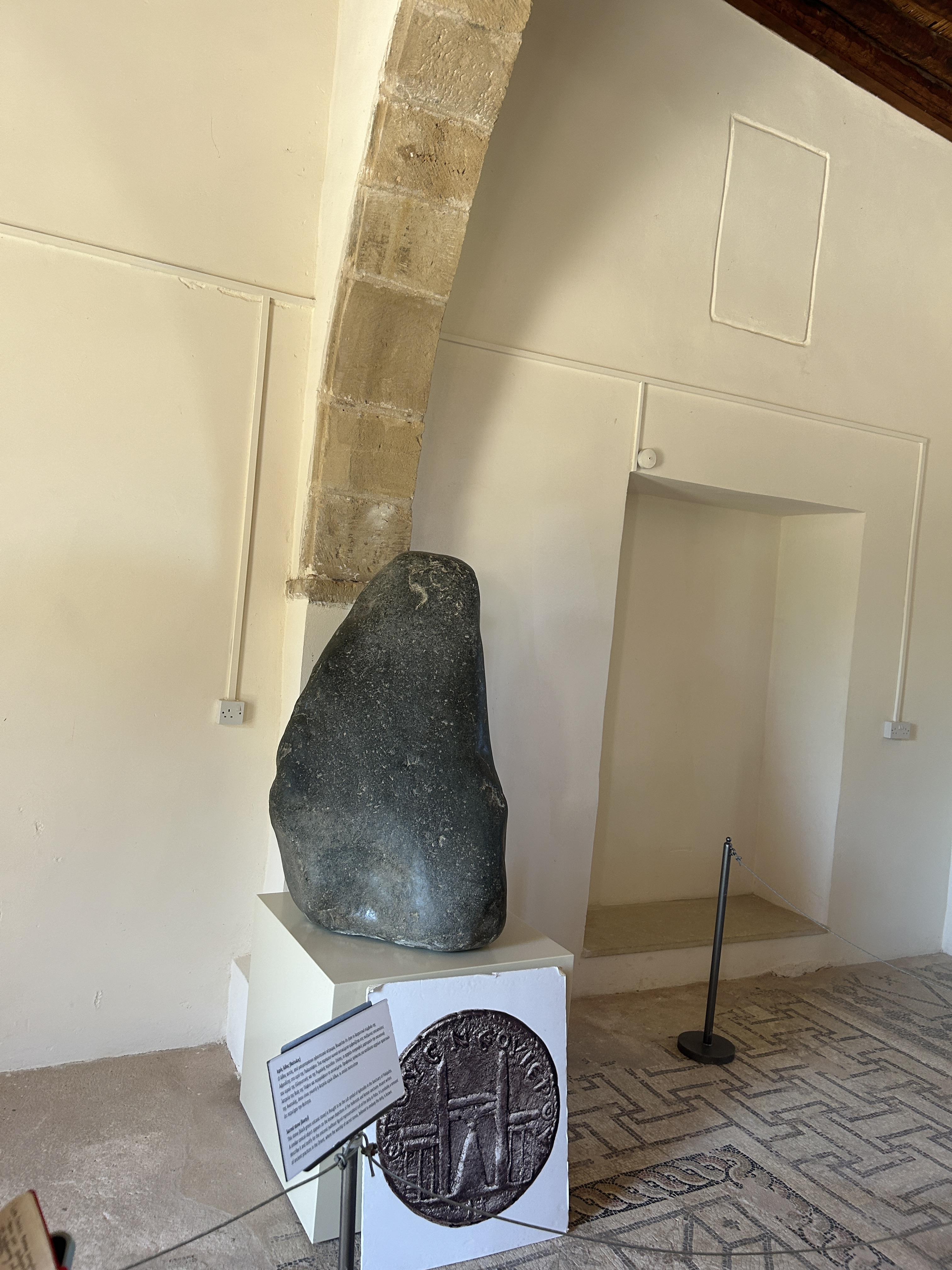
On our field trip to Paphos, I see why the Cyprus is referred to as the island of Aphrodite. In Greek mythology, this is told to be her birthplace, but it is clear here that her history on Cyprus runs deeper than even that. Before the Greeks arrived on the island in the 12th century BCE, the local people were already worshipping a fertility goddess, whom the Greeks gradually Hellenized over several centuries, until she became recognizable as Aphrodite around the 4th century BCE. During the Hellenistic Period Paphos emerged as the most prominent place for pilgrims to worship her. We visited the Temple of Aphrodite at the ancient city of Palaipafos, where veneration continued even long after the city of Paphos was moved. Central to the worship of the goddess was a large black stone, a cult statue which we saw on display in the museum at the Temple of Aphrodite site. This is indicative of a very different notion of Aphrodite than we associate with her today.
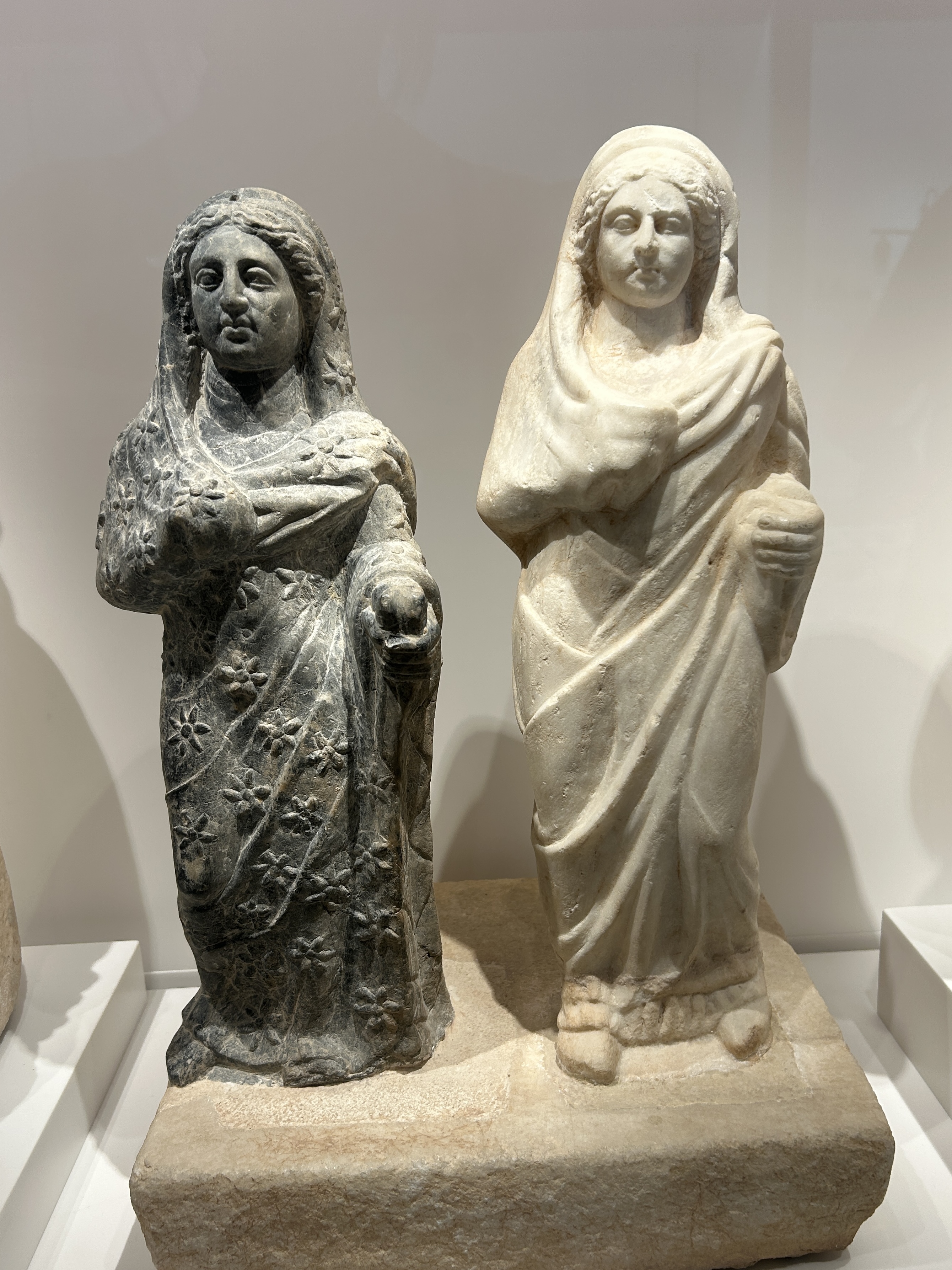
Originally the deity was worshipped for protecting Cyprus and fertility of the island, and only came to be associated with sexuality and love in time. Historians have said that her ancient cultic worship included sacrifice, divination of the future, the burning of incense, and ritual bathing and prostitution. Aphrodite is represented very differently on Cyprus, more raw and of the earth. One such representation, a statue depicting both her earthly and celestial forms caught my eye in the Paphos museum, and I have learned that there has been a continued duality to Aphrodite. In Greek literature, there is Aphrodite Urania (a transcendent, heavenly Aphrodite) and Aphrodite Pandemos (common, for the people). I wonder, but am finding it hard to research, if Aphrodite Pandemos stems more from the Cypriot Aphrodite, where her roots are a little deeper and feels more grounded. The celestial Aphrodite, Urania, seems to me to be the more Hellenized idealization of the goddess.
Annika Schramm
-
Being a Roadrunner
One thing I will always talk about is the culture of our dear Metropolitan State University. Having started my college experience at CU Boulder, I have seen two very different collegiate environments. At CU it often felt like people were there because they had to be, or as a means to the “college experience”. On the other hand, because of the fact that Metro is a commuter school, accepts anyone who wants to be there, and doesn’t necessarily have the reputation that CU might have, it feels like every person at MSU is making a very intentional choice to be there, and to be there to learn. Particularly in the anthropology department, I have met so many people who just care deeply about what they want to study and have come from all walks of life to dedicate themselves to learning about it. CU felt homogeneous, everyone blended together at a point. Because there are so many different kinds of people at MSU, students of all age groups and backgrounds, I have found the people to be notably kinder and more accepting. I think this kind of openness too each other and dedication to learning is something that all the MSU students brought with us to Cyprus.
I spent the month learning everyone’s life stories, their lore, as we’d say. Every one of us came from very different places, with different families, educational histories, even different reasons for wanting to be there, but the things we had in common brought us together. We all wanted to dedicate ourselves to working as hard as we could, learning as much as we could, and taking the experience and each other in. Through a difficult and complicated month, we took care of each other, so it’s always a great day to be a roadrunner in my book. 😉
Annika Schramm
-
Gratitude
As Rachel and I sit at Terra Umbra, hunched agonizingly over our brightly colored plastic basins, feverishly scrubbing away at millennia-old sherds of amphorae and cookware, I can only think of the last hands to hold or wash this pottery, and how the people who last touched the very things I hold in my hands now likely held their washing basins on their hip to fill it, and scrubbed their wares, in just the same ways I am now.
In the trench, speculation about soldiers making friendship bracelets and cows building shoddy walls makes me giggle, then we genuinely ponder what the ancient people could have been doing here, in the very spot I stand, centuries upon centuries ago. Was this a cooking space, were these bones and olive pits leftovers from a feast enjoyed shortly before the site was abandoned? I don’t always clean up perfectly after a big meal. Some of the dishes show visible paint strokes, and fingerprints made before firing. Some of my favorite dishes I use are the ones I painted myself. I bet they giggled with their friends here too.
I can’t help but be constantly overwhelmed by the feeling of oneness with the people who were here before me, using these things for the last time before we’re holding them now. Nothing makes me feel so human as seeing and touching the raw, unearthed lives of people who were just like me. People have always been people, and though the technology changes and the ways we do things is so different now, I know that there is something eternal and beautiful about the human experience, and I KNOW that I am lucky to be here to know that.
Annika Schramm
-
Mustaches: A Short Visual History
Once you notice them, you can’t unsee them: the statues all have mustaches. Well, the pre-Hellenistic statues do. Let’s take a short look at some of the best mustaches in the Nicosia Museum of Cyprus.
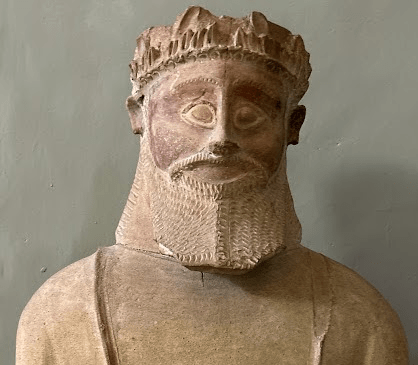
Semi-connected mustache. Elegant, geometric, works well with this statue’s bone structure. 8/10
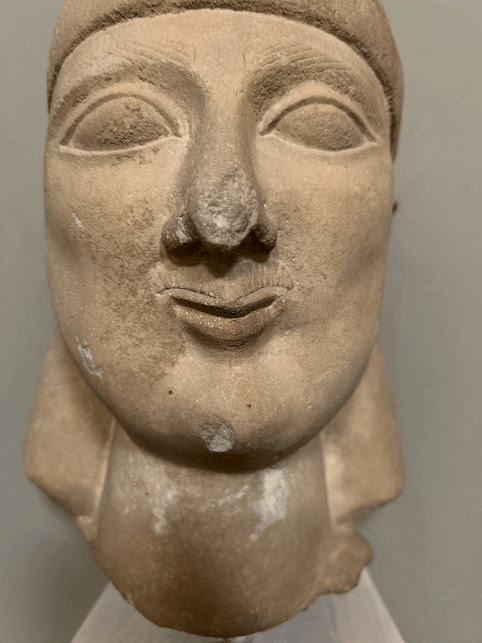
Thin with clean jaw. Poorly considered with bone structure. Still a statement. 4/10
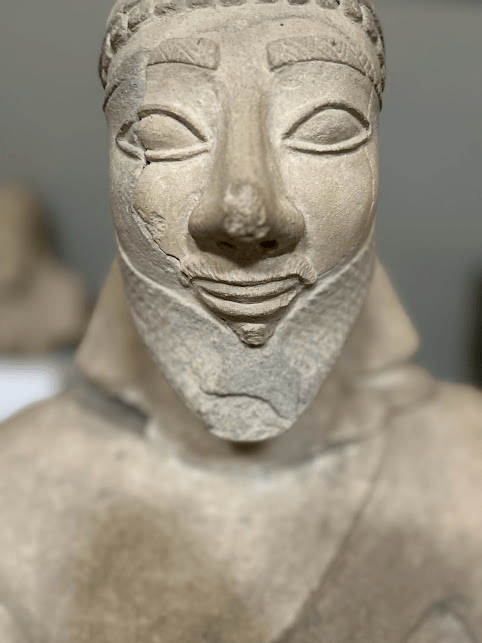
Same style as above, but bushier. Lovely curvature. Disconnected from beard. Clearly finely brushed. 5/10
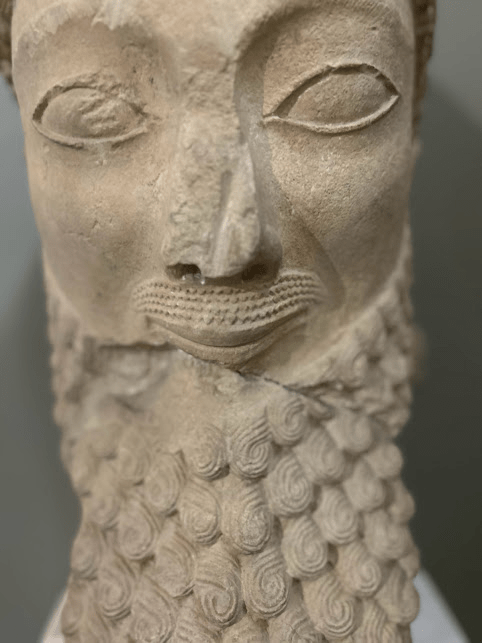
Curly, disconnected from heard. Take into consideration bone structure and curly beard. 6/10
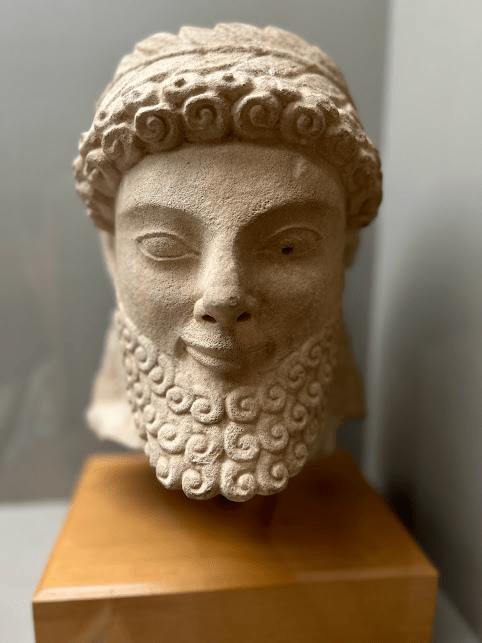
Understated, but clearly following the trend. Very distinct disconnection from beard. 7/10
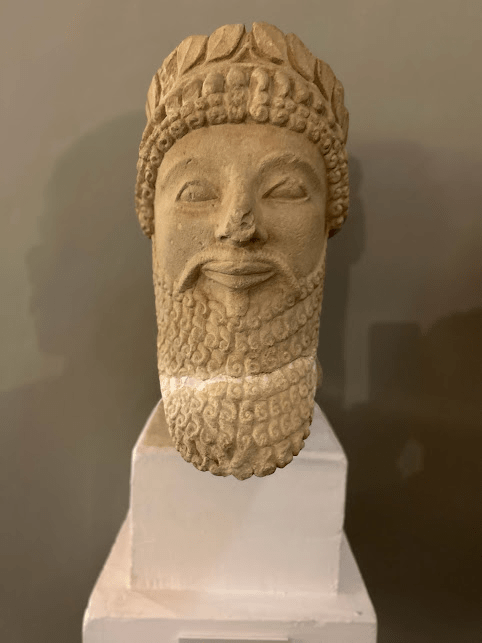
Back to this elongated shape. Thin on top, but long on the sides. Disconnected but overlapping beard. 7/10
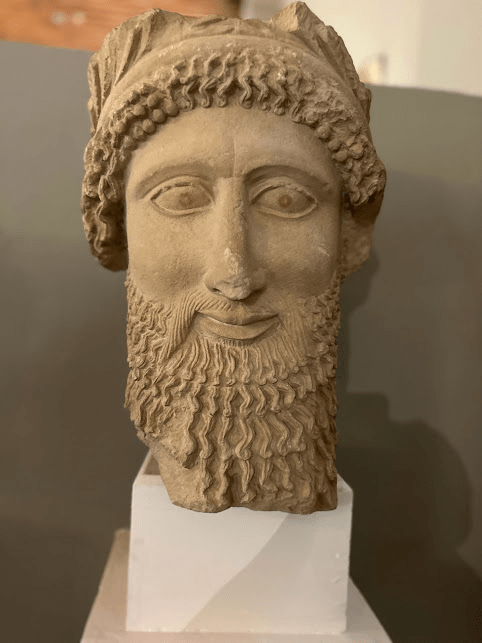
What a statement! Long, curled, clearly waxed to define the difference between beard and mustache. 8/10
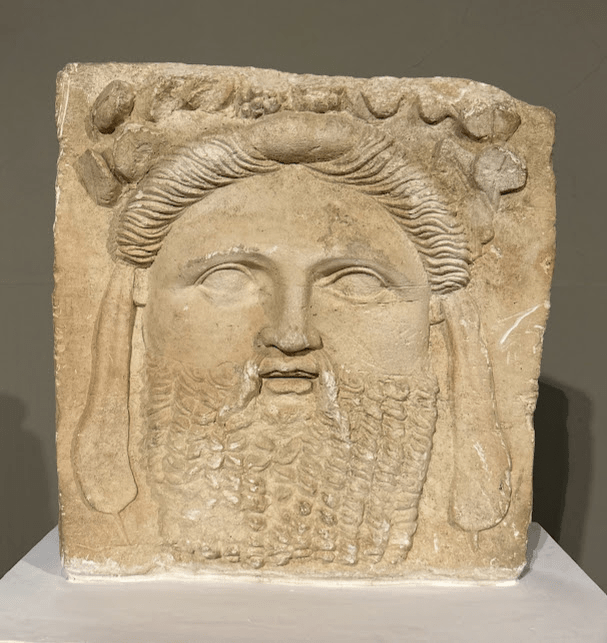
Luxurious, curled, slightly disconnected but matches the beard. Dionysus gets 10/10
–Miki H.
Study Abroad in Cyprus
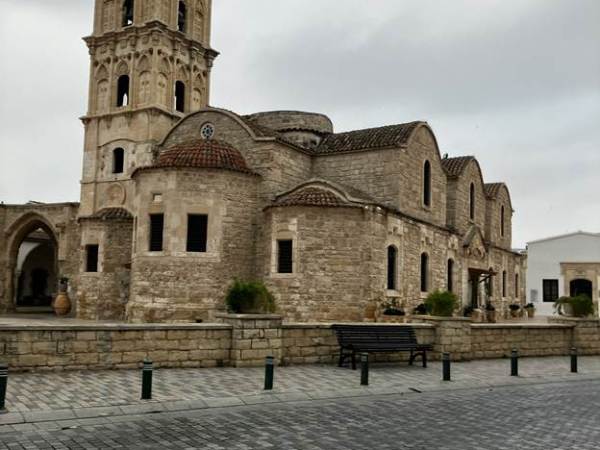
By: Arthur Pino Coming to the Old World is a new experience for me. I can say that, besides the luxuries and brands similar to those in America, it is quite different. This land has been inhabited for at least 4,000 years, according to the sign outside the Agio Lazaros (The Church of St. Lazarus).…

House of Dionysus
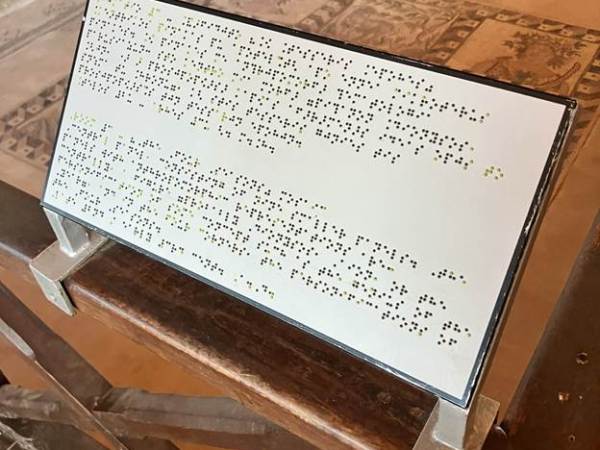
By: Arthur Pino On a field trip, we went to Paphos, where we were able to visit a “World Heritage Site.” This would be the second opportunity I have had to see one in my life within the last year; the other was Chichen Itza in Mexico. It was a very hot day, and walking…

A Big Discovery!
By: Arthur Pino Today was another hard but rewarding day. It was the first time I had worked in the trenches three days in a row, and I felt it. This day, in particular, revolved around hands. My hands themselves, and an accessory for hands. As usual, I did not wear gloves to start…
 Vigla Archaeological Project