-
Museum Work
Have you ever walked into a museum and truly sat down for a second, not to admire the art, but to admire the museum itself? How much went into it? Oh, how long must it have taken? Well, neither had I before this summer abroad.
From an archaeological stand point, just getting a find to a museum is a lengthy process involving different governmental offices and cooperation from a museum. There are four different (basic) ways for a museum to acquire an object. These are purchase, gift, exchange, and field collection. The first three are legal transactions.
There are many things that can stop this from being just a simple transaction though. One of which being: is it an object that requires a special permit? If you don’t have the correct permit you could get in serious trouble before one could even dream of transferring an artifact to a museum.
Another road block is museum capacity and curation. Where would this find fit into the museum? Is it important enough? Is it unique enough? Is it intact? These are all things considered by the museum curator.
Next time you’re in a museum think about how long it took for that huge statue to be a) dug up, b) cleaned, c) catalogued, d) processed, e) curated for viewing. And don’t forget to check the aesthetic and fluidity of the museum walk. Viewing it like this will give you a new sort of respect of archaeology and museum curators.
Hunter Powell
-
Americans in Cyprus
As I have spent time in Cyprus introducing myself to locals as an American archaeologist, I have been received differently than I ever expected to be. I’m not sure what I expected really, maybe some animosity towards me as an American, but perhaps the fact that I had come to study and celebrate this country’s history would win me some points. However, people have reacted to me in almost the opposite way. I’ve never received any negative responses to the fact that I’m American, only questions and surprised looks, it doesn’t appear that many Americans end up in Larnaca. And regarding the dig, the people we meet ask countless questions in sheer amazement that we’ve come all this way to dig and study here, they ask where we’re working, and why, and seem to genuinely wonder if there is anything worth digging for here on their little island. Somehow, before coming, I thought the locals would at least know that the island has archaeology happening on it consistently and that there is so much history to unearth. Instead, people wonder why we would choose to come here and doubt we’ll find anything of interest.
I know archaeology is a complex and sometimes controversial field, and sometimes it feels odd to be an outsider taking up this space. The people who live and work here deserve to know about the history here and the and have the opportunity to learn from the archaeology as much as we do as foreigners coming here on a field trip. In some way, I hope our presence lets people know the possibility is there, and perhaps the things we learn and find at Vigla will add something to the rich story of Cyprus.
Annika Schramm
-
Curious Copper at Kourion
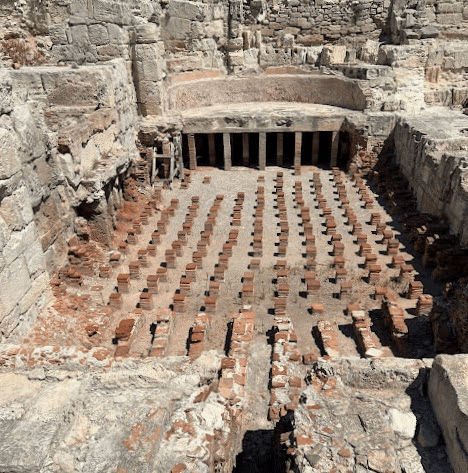
As we were touring the baths of Kourion, we passed a string of excavated underground rooms with short rows of what looked like stacked clay pillars.
“What,” someone asked our supervisor, “are those?”
It’s weird the things that stick in your brain. I studied Classics a decade ago, and am I any use at reading Latin? Nope. Do I have a handle on the dates of the Peloponnesian Wars? Nope. Can I name more than one of the Five Good Emperors? Nope. Do I remember what these weird stacks are? Absolutely.
“They’re copper plates,” I interjected before the supervisor could even get a word in. “They’re heated from below and the copper conducts the heat to the bath. It’s a caldarium. Like a hot tub.”
Pretentiously, I remember what these are because I had the same question a decade earlier in Paris. The Cluny Museum, now the Musée National du Moyen Age, is housed in a mansion built into an older Gallo-Roman bathhouse. Imagine you’re young Miki, desperately searching for the famous Lady and the Unicorn tapestry, only to discover that it’s on loan to Tokyo. You’re disheartened, you turn a corner, and there it is: an underground pit full of stacked copper columns. Imagine you spend ten minutes finding the explanatory plaque in English and wonder why the one Roman historian at your small not-yet-university college failed to mention this bizarre sculptural art piece when they were covering a thousand years of Roman history.
But the caldarium underneath the museum in Paris is nothing like the one at Kourion. That was only one small room while the one at Kourion was easily three times that size– and there are two bathing complexes. The bath at Cluny, then, was a smaller balneae, while Kourion houses the much larger and grander kind of bath called a thermae. The baths were probably fed water by a complex set of waterworks, drawing from the nearby springs and transported by aqueducts and pipes to the bath, again a more elaborate and involved process than for a smaller balneae.
Roman bathing was central to social life. Roman patrons would meet their clients at home before heading to the baths. Ordinary people left their tenement homes to enjoy the baths. Baths were open to the public, providing a necessary sanitation need* and a place for discussion, gossip, and exercise. Baths were a sign of civilization, Roman superiority, and the generosity of whomever sponsored or maintained the facilities. The thermae at Kurion is, then, a political as well as practical structure.
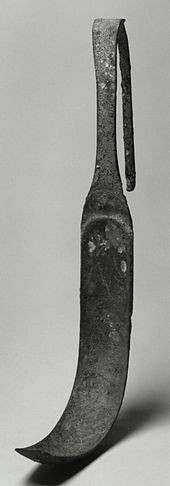
Strigil A visit to the baths went something like this: you arrived, changed, and then exercised in the palaestra. From there, a dip in the very hot caldarium, heated below by fires kept lit by slaves (a bath complex the size of Kourion’s must have required an immense amount of slave labor). After the caldarium, a good scraping down of the skin with a strigil, which removed dirt and sweat, and acted as a kind of rough exfoliation. Then the tepidarium, cooler water, and a final plunge into the frigidarium, full of extremely cold water.
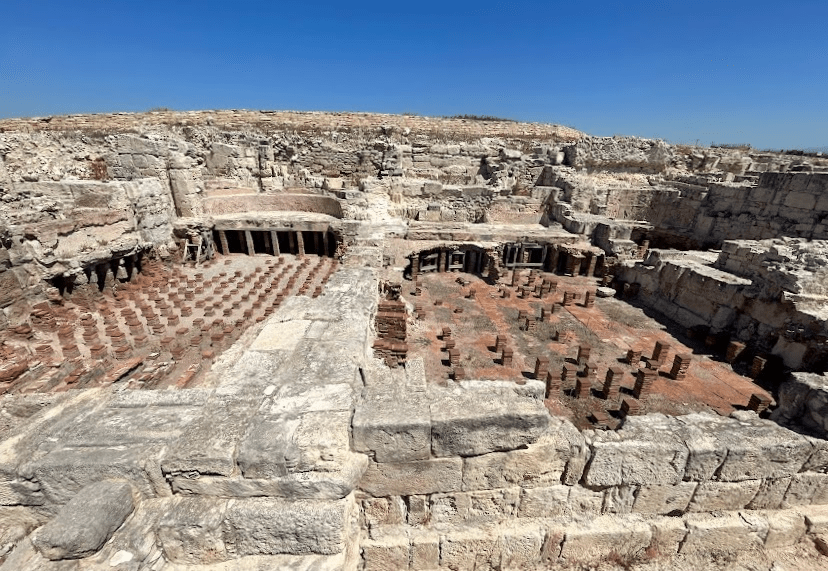
Caldarium on the left and tepidarium on the right The copper that made this whole operation work was probably mined in Cyprus. The wealth of Cyprus has long been connected to the copper-rich Troodos mountains. Copper flowed down from the mountains through port cities like ancient Kurion, making them prosperous city-states and even petty kingdoms. The very word “copper” comes from Cyprus: cyprium aes, metal of/from Cyprus, became cuprum, became copor, became copper.
The copper plates at the Kourion baths are more than just curiosities, though the site is certainly peculiar if you’re not expecting it, but a window into the very role of Cyprus within the ancient and Roman world. Wealthy, civilized, and complex, Kourion boasted a central role in Mediterranean history.
–Miki H.
-
Criteria for a UNESCO site
While traveling around with my peers and family, it seemed like everywhere we went was considered a UNESCO World Heritage Site. I found myself curios as to what the even means. Upon further research, the UNESCO site states,”There are ten criteria for a historical site to be deemed important enough to make the list. These ten criteria are, to represent a masterpiece of human creative genius, to exhibit important interchange of human values, to bear a unique testimony to culture or tradition,to be an outstanding example of architecture, to be an outstanding example of a traditional human settlement, to be directly associated with events or living traditions or universal significance, to contain superlative natural phenomena, to be an outstanding example of ecological or biological processes, or contain the most important significant natural habitat of conservation.” Reading through these criteria made me feel very connected to the sites deemed important enough to make the list. The UNESCO world heritage sites criteria are formed on the importance of conserving all that is human. It makes me feel at home in a way, that the things we are seeing have been decided to be so human that they join a list of other things that are just as human, and they are still being enjoyed by humans today.
-
Ktisis
While wandering through and looking at the mosaics, there was one dedicated to Ktisis in the house of Eustolios. Never having heard of this before, I decided to do more research, because there wasn’t much of an explanation of who she was, or why she was there. Researchers hesitate to give her the status of goddess, however what she represents is almost Christ like. In Ancient Greek, Ktisis is the act of becoming, or coming into being. She is often depicted holding a measuring rod, which symbolizes the act of building. Not only is this clever because she represents creating something that wasn’t there before, but by creating these mosaics, what she stands for is happening in active practice. Ktisis appears after the majority of the empire was already Christian, which means she is not a Greek god or deity. She was popularized by philosophers during the early Christian era, and it boggles my mind that she was being represented the same time as Jesus Christ, and yet I had never seen or heard about her before. She represents creativity and creation, and is such an inspiring personification, it’s saddens me that she was not carried further into Christianity. She is also found to represent donation, generosity and foundation in other depictions of Ktisis. She if often covered, with jewels to showcase this. While she may not be considered a goddess by historical standards, she remains a goddess in my heart.
-
The Coat of Arms at Kolossi Castle
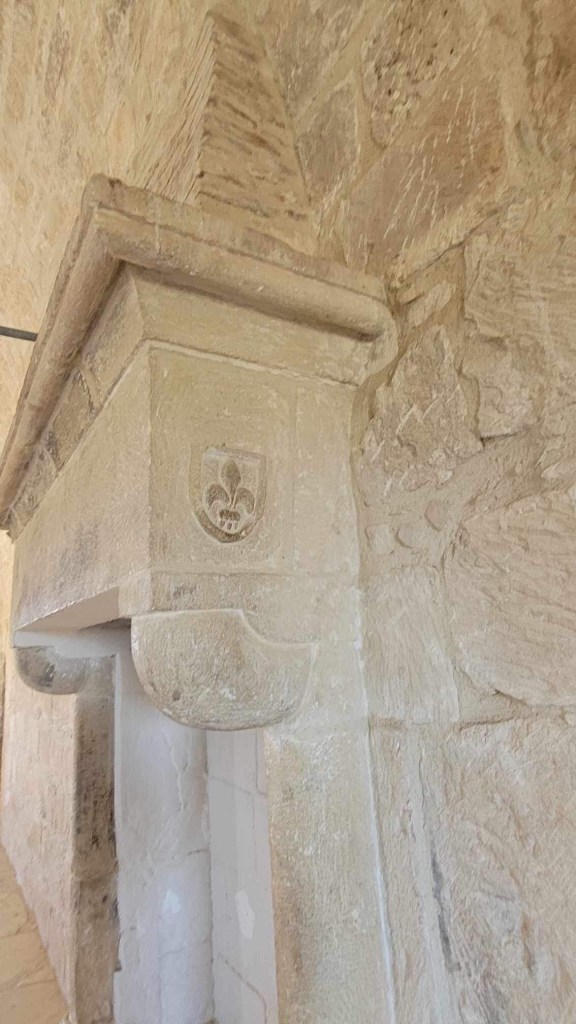
When we were touring Kolossi castle, I noticed a four sector coat of arms on one of the outer walls. The multiple sectors is what caught my eye. It’s is a marble slab, in which four shields can be seen. The center coat of arms contains four quadrants, also called escutcheon. The center escutcheon depicts the coat of arms of the Lusignans of Cyprus. The upper left section, depicts the emblem of Jerusalem, which is a cross with four smaller crosses in each quadrant, the same crest cane be found at many other churches, included the church of Saint Lazarus. (See my other post). In the upper right section, depicted is the coat of arms of the old Lusignan, which is a rearing lion and striped rectangle. Finally, the bottom two emblems represent Cyprus and Armenia. The four together symbolize unity, because when built around 1393, the king of Cyprus was also the king of Jerusalem and Armenia. On the sides of this center shield, there are the coat of arms of two grand masters of the order of Saint John of Jerusalem. The right side is the coat of Jacques de Milli, and on the right, of Jean de Lastic. Finally on the bottom is the coat of arms of Louis of Magnac, who was the Hosptallers commander when the castle was built. You can find his coat of arms carved into the castle walls throughout the castle as well. I found them On the fire places, and when returning with my family it became like an Easter egg hunt to see where else we could find them.

-
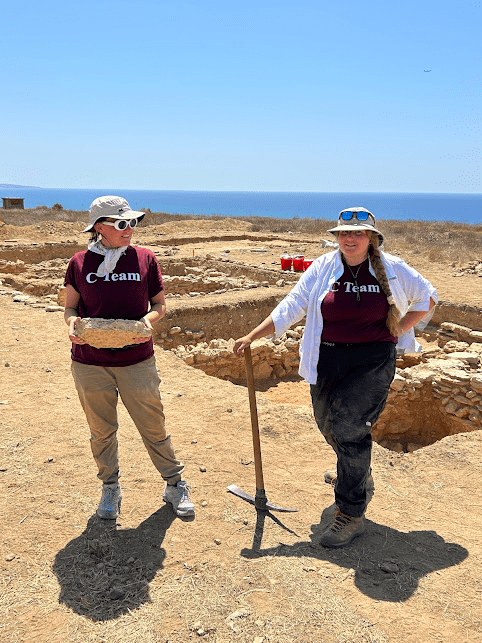
A Confession From C Team
There are a lot of unglamorous tasks required on an archaeological dig site.
In my mind I had various movie portrayals of archaeology: beautiful and chic people crouching elegantly over bones that they gently dusted free of the earth with small, precise brushes. Our supervisors were chic, yes, and everyone on site developed a solid archaeology core aesthetic, and yes, we did get to use small watercolor paintbrushes to coax horsecow’s jaw out of the mudbrick, but for the most part, archaeology is a lot of basic hard work. In order to reach the kinds of things they show in movies, you have to move all of the stuff on top of it out of the way.
Our first day on site was a day of manual labor and wonderful surprises. Handfuls of (totally useless for chronology) pottery shards, a beautifully articulated wall, the barely visible clear curve of a basin. Some awful things as well: a scorpion bite, an enormous tarantula. The uncertainty of social dynamics. But everyone was on the same page that first day, everyone lifting and moving and scraping, getting tired and sunburnt and dirty. The movie archaeology, I thought, would surely come.
And that’s what I was worried about. I wasn’t trained for this– and that’s the point of Field School. With the exception of the graduate students and a few classmates, no one on site had done this before. These other students were my peers, and after the first day of moving things, I felt a lot of that impostor syndrome ease up. I was good at clearing debris and rubble, could turrae gracelessly but effectively, and even turned out to be wonderfully, aggressively good with a pickaxe. I could do this archaeology thing. When I went to my first pottery shift, I felt positive about my chances of clambering down to a spot in one of the trenches.
The next day, though, everyone had kind of hunkered down in a chosen trench. I tried not to feel left out. I defaulted, in a kind of blank reaction to not knowing where to go, where to be, to Restaurant Miki Mode and instead tried to make myself as useful as possible, doing laps around the site, familiar work phrases sounding in my head: “If you’ve got time to lean, you’ve got time to clean.” “How’s your sidework going?” “Hands in, hands out.”
This I could do. This I was familiar with. I hopped around each trench, a kind of chipper offer of “hands” if anyone needed anything. “Trout Amandine to table 32, fresh red buckets to EU 20.” “Table 54 needs bussed, trade someone out in EU 23.” “Check on drinks for 12, sieve some of the buckets from EU 24.” I could do this archaeology thing. I felt good about it. I felt sure that I’d get my turn the next day, or the next, to do some cool “real” work.
Until it was time for trench assignments.
Letting go of ego is rough. I wish I could say that I genuinely felt, when trenches were assigned, that I was just glad to be there. Of course this was an incredible experience, one that I’ll treasure for a lifetime, and one that I really was just glad to be there. But all that moving around, all that trench hopping, all that too many bodies for the spaces we had, meant that I was relatively unattached when supervisors were “picking out” their trench crews.
It felt like middle school gym class. Mel, I’ve cleared so much of the topsoil from EU23, I found that basin rim, pick me! Brandon, I pickaxed the hell out of your trench, I’m great at sieving, pick me!
But. Only so many people will fit in a trench, and most people had already settled in. So. I was not assigned a trench. I’d be working, I was assured, with Dr. Olson when he arrived, for sure, for sure I’d be in whatever trench he’d be digging. When he got here, I’d definitely, definitely be assigned a trench. In the meantime, I was Officially Trenchless.
I’d like to say I didn’t feel the sting of tears, the renewal of the fear that I had no business being there. I’d like to say that I jumped at the opportunity to just be helpful wherever help was needed. But ego is a hard thing to let go of.
But I wasn’t by myself. Like I said, only so many people can fit in a trench and work safely. I knew that Madi and Ren were probably feeling the same way that I was: back in gym class, last picked. Maybe they felt differently and I did a lot of projecting. I decided, almost panicking with my own hurt feelings, to make it into a kind of joke, a way of owning my sense of loss and rising self pity.
So what if we weren’t picked first, or even second? We might not be the A Squad, or even the Second String, but C Team was going to be the underdog story of digsite. We would be proud. We would be helpful. We would do the unglamorous jobs, and by god, we would do them well. We were C Team.
***
You haul a lot of dirt. You pick up stray stones. You swap out buckets. You make sure people are drinking water. You sift through buckets and buckets of dirt. You clear trash from the shade tent. You get sand in your eyes, dust up your nose. You’re swabbing dirt out of your ears with a qtip at the end of the day. You remind people to eat snacks, take a water break. You swap out on pickaxe duty when someone starts to wobble.
The further into the dig you get, the more realistic you, and everyone around you, becomes about their needs. At first you don’t know what your limits are. Are you just tired because this is the first time you’ve done anything like this, or are you tired because you are actually at your limit? Do you need to drink water? The answer is always yes, you do need to drink water. But can you push through for five more minutes? Or are you being stubborn? Are you feeling the raw newness or the raw tiredness of it all? It seems like every few days your body needs something different. You stave off headaches. You bring something different for second breakfast. You learn when to ask for help.
And then C Team jumps in.
C Team picked up rocks. We swapped out buckets. We swapped out people. We sieved. We encouraged. Someone always needs a water break. Something always needs to be carried from one place to another. There’s always a place for hands, and C Team was ready and happy to provide them.
This is important work, but it isn’t the kind of work I imagined when I thought about what I’d be doing when I started digging. Was I a movie star archaeologist? Sometimes. Was I more often an extra in the background? Absolutely. But that’s how the job gets done. Is everyone in a restaurant a chef, the bartender, headwait? No. Archaeology isn’t a one-person job either, and if you get hung up on what you think you’re entitled to — I should be articulating, I should be finding artifacts, I should whatever– you’ve doomed yourself and your team.
I’m really proud of C Team. I’m proud that we took something that could have been, even though it was never meant to be, disheartening and turned it around. I’m proud that we helped make the dig happen because what we were doing was important. I’m proud of my calluses, my sore back and arms and thighs and butt. I’m proud of everyone in the trenches, and every incredible find we unearthed. I’m proud that we didn’t sulk and didn’t let ourselves feel left out. Even if all of those worries were in my head and my head alone, I’m proud that I was able to get out of my own way to be part of something bigger than me.
–Miki H, C Team
-
The importance of Blue
I see the blue everywhere I go. The ocean is a blue that parallels the sky, and much like the Cypriots, I am enamored with the beauty. I see blue in kitschy shops and evil eyes. The color resonates deeply within me. The doors and windows are Cobalt, electrified by the stark white stucco of the buildings. A bright signal, but what is it supposed to be telling me? I find myself asking, what’s the point? As we walk the streets, going to dinner, or even on field trips in different cities, the blue follows me. I see this most on painted shutters and doors. The whole island, seems to be spattered with this color.
Doors and windows themselves hold such importance in architecture. It’s your first impression and will relay the message of the rest of the building. The blue makes the buildings so inviting, even while closed. I was kind of hoping for a silly answer, like the blue paint was just popular or on sale, but the answer is much more mystical. In Greek culture, Blue has a belief to protect from evil. Sacred buildings like churches have all entrances and windows painted this beautiful blue to create “belts” of protection. Turquoise and Lapis Lazuli were used in weapon making, body adornment, and clothing, upholding the same belief. Blue holds such importance, that it is the main color of the Greek flag, and is even the color of school uniform sashes. Following the turmoil in Cyprus, an uptick of this color was seen around 1974, and houses have since been painted blue and white to celebrate being Greek, and to match their flag. This blue paint is comprised of Laoulaki powder and lime, which has created the long lasting reflection of the sea, the sky, and Greek pride.
-
Carbon Dating in EU23
Since arriving on site, I have been primarily working in trench EU23. I am very attached and want to know anything and everything I can about this trench. On Tuesday of last week, while cleaning a portion of sealed subfloor, a specimen of a charred root was found with much excitement to my trench supervisor (shoutout Mel), and the other supervisors. The specimen was wrapped carefully removed and wrapped nicely in tinfoil. With the background of all our other finds, I was interested in the enthusiasm. I asked what was so important about this find, and it was explained to me that the charred root was found sealed between two different layers of floor, and had been untouched until discovered. Since it was sealed, this meant the root itself could be carbon dated. I remember learning about carbon dating when I was younger, but any information on the process had been completely eradicated from my mind. I decided to research carbon dating, to have a better understanding of the excitement, and decided to share with all what I found.
Carbon dating, or better know as Radiocarbon dating is a process in which the age organic materials can be dated accurately. This scientific method was developed in the 1940s, at the university of Chicago by Willard Libby. Libby jump started his work off Martin Alamein and Sam Ruben, who discovered the carbon 14 isotope. Living organisms absorb carbon 14, and once they die, the absorption stops. The carbon – 14 slowly changes its make up at a predictable rate. Knowing this, scientist are able to measure how much carbon 14 remains in a specimen, giving an estimate of how long the specimen has been dead. In terms of EU23, This means that we are able to closely date the SU that this specimen was pulled from and based on that number, we can closely compare the surrounding SUs and have a better understanding of our trench as a whole.
-
The Conclusion
Deciding to take this opportunity was a choice completely on my own. I have been a history major the majority of my time at MSU. However within this time I have never been able to nail down exactly what I wanted to do. Being able to go to school for me is a privilege in itself, but I had never seen a goal in site. I had always imagined myself on the museum curation side. I was in school for survival purely, but I’m happy to report that this trip has changed my perspective. For the first time I have felt passion and drive behind what I am doing. I have felt purpose and understanding, not only in the work but in my peers. This trip helped me click all the pieces into place. The genuine connection made between me, my peers, and my passion has been more of a driving force than anything I have experienced thus far in my academic career. This experience has opened my eyes to what I would like to do the rest of my life. Even with no sleep, no food and sun sick, I couldn’t help but smile every day on site, and getting to experience this with amazing, like minded and like motivated peers, made it all the better. I found myself constantly learning from everyone around me. The exhilarating thrill of a find, the hard, unforgiving work, creating theories, and finding the evidence to support or refute them, all left me with a sense of purpose I have been searching for. After this trip, I have decided that archaeology is for me, and I cannot wait to continue down this road with my peers at my side.
Study Abroad in Cyprus
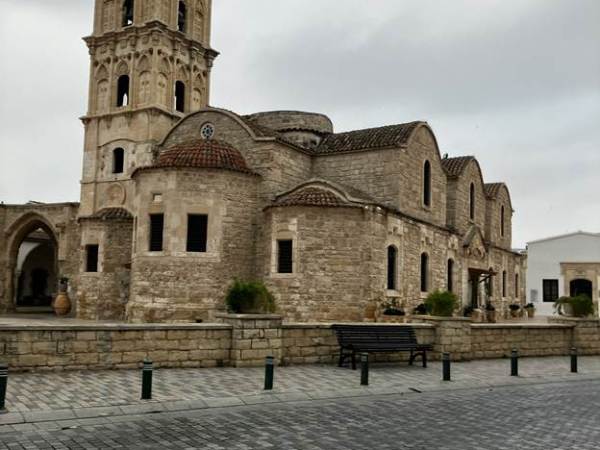
By: Arthur Pino Coming to the Old World is a new experience for me. I can say that, besides the luxuries and brands similar to those in America, it is quite different. This land has been inhabited for at least 4,000 years, according to the sign outside the Agio Lazaros (The Church of St. Lazarus).…

House of Dionysus
By: Arthur Pino On a field trip, we went to Paphos, where we were able to visit a “World Heritage Site.” This would be the second opportunity I have had to see one in my life within the last year; the other was Chichen Itza in Mexico. It was a very hot day, and walking…

A Big Discovery!
By: Arthur Pino Today was another hard but rewarding day. It was the first time I had worked in the trenches three days in a row, and I felt it. This day, in particular, revolved around hands. My hands themselves, and an accessory for hands. As usual, I did not wear gloves to start…
 Vigla Archaeological Project