-
Familiar Franchises
I am had the chance to travel to Cuba, England, France, Belgium, Luxembourg, Switzerland, Germany, Austria, Greece, and now Cyprus… and one thing that always surprises me the types of fast food brands that are abroad. Naturally you will find McDonalds everywhere. If you travel in Europe, you can always guarantee McDonalds to have wifi available and usually open very late. For a backpacker they can be a godsend to recharge your phone and get off your feet for awhile. The menu is often tailored to the expectations of the locals (price and quality) along with more native ingredients. I remember getting a breakfast McMuffin with eggplant and a small bottle of red wine in the McDonalds nearby the Palace of Versailles at 10am, which at the time seemed incredibly French to me.
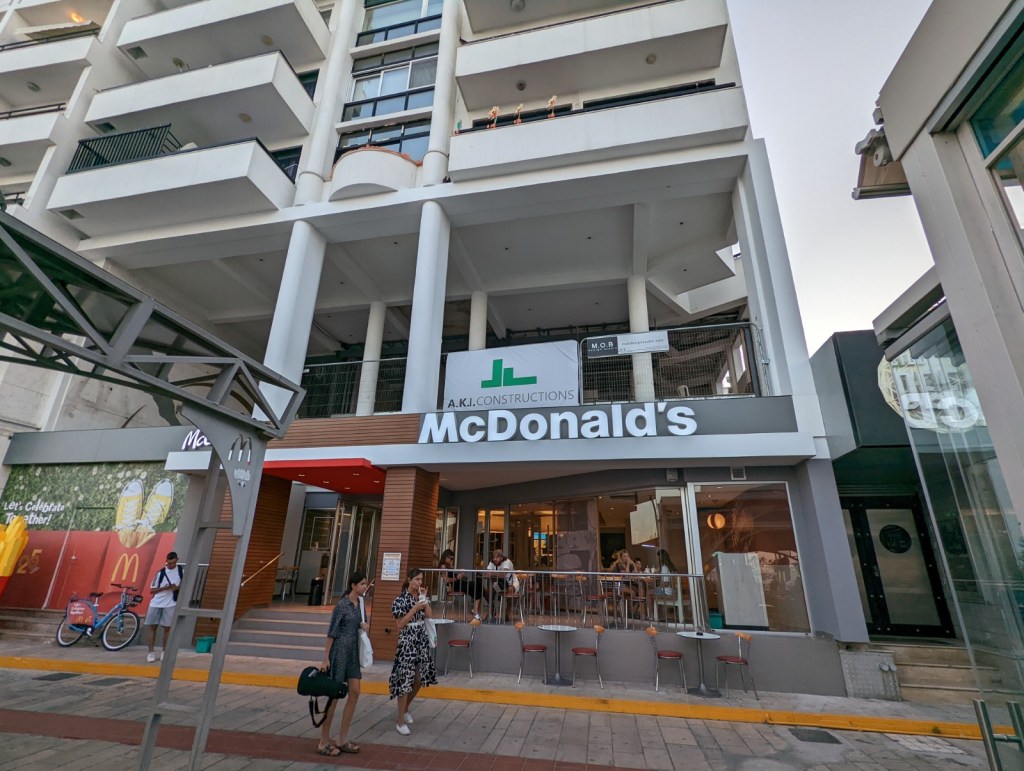
McDonalds by the beach, Larnaca. But there are a few more brands that surprised me. Sure Burger King is a worldwide brand, but I usually don’t see them as often. The menu had very Cypriot flavoring to it. Namely, they emphasized Angus Beef, Halloumi Cheese, and Mushroom. Sure beef and cheese would be standard in the U.S., but the particular types were unique, and I don’t think an U.S. fast food burger chain has mushrooms on the menu.
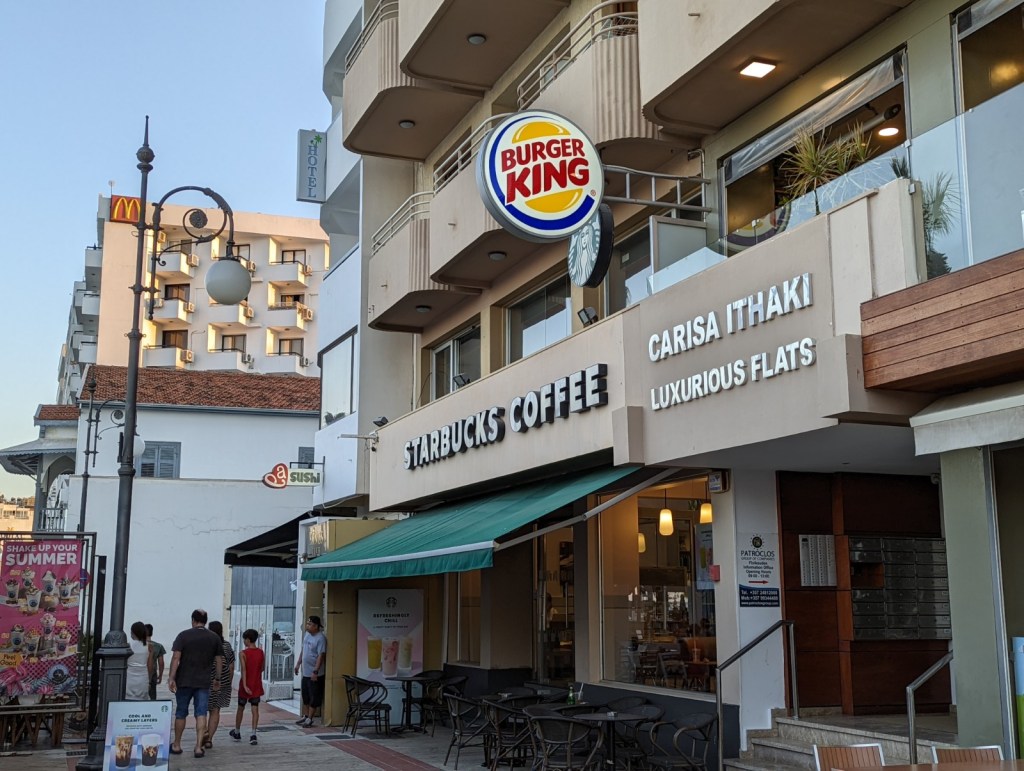
Larnaca. 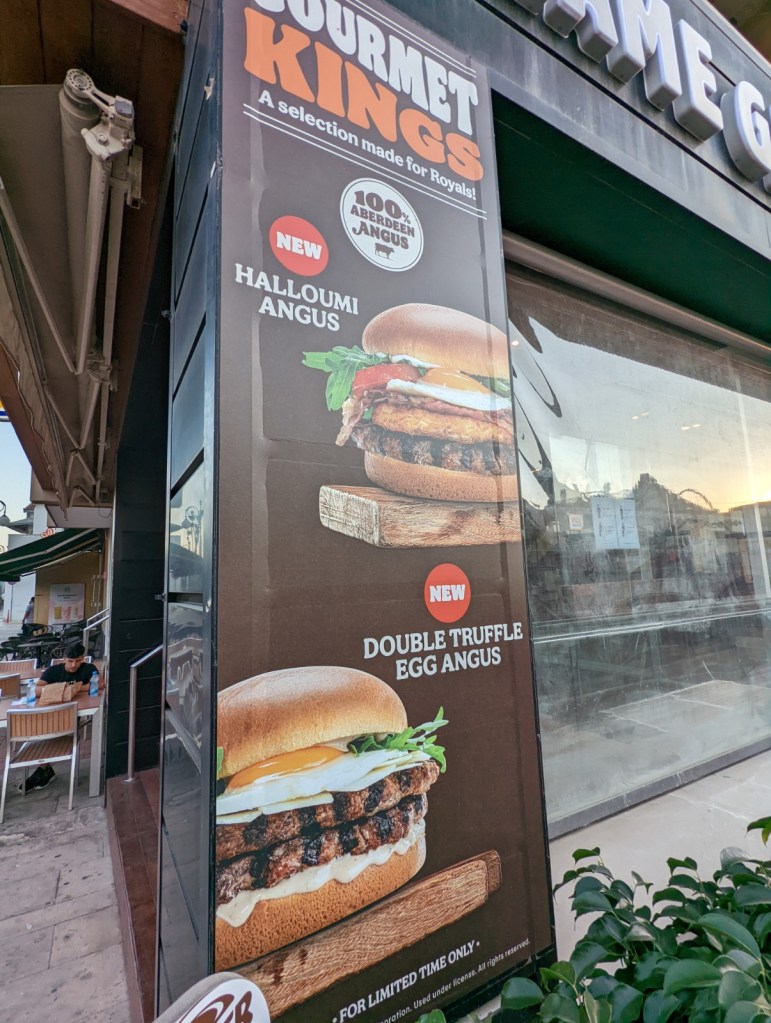
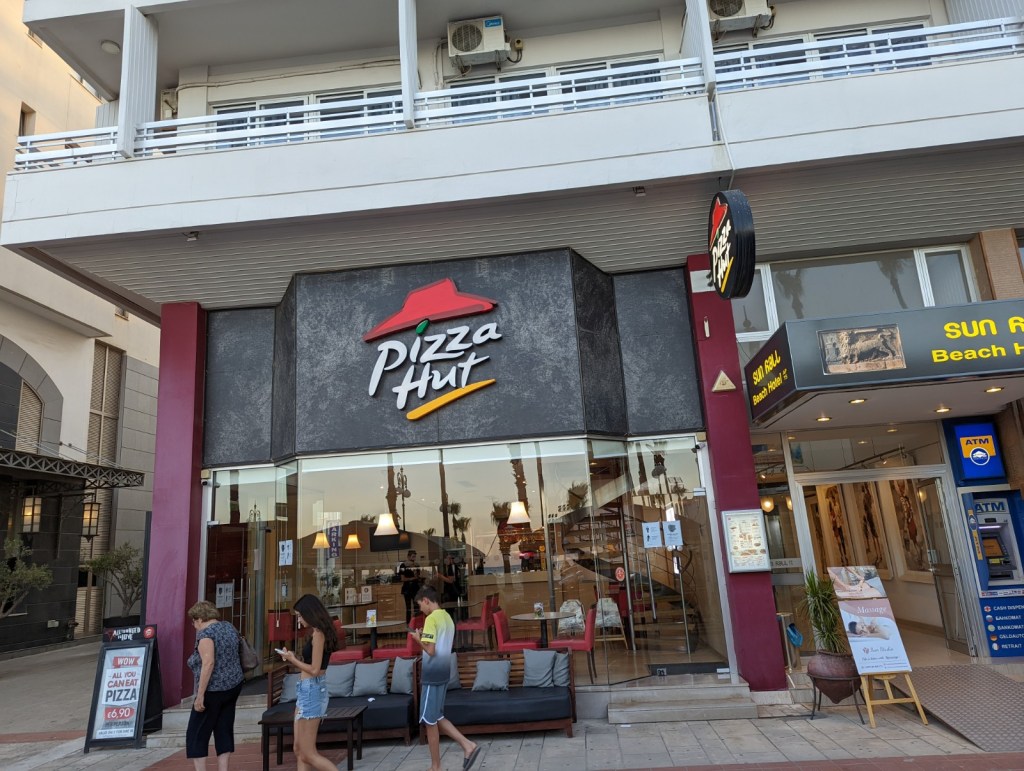
A Cypriot twist Even the cheese choices are different on pizza. The Pizza Hut along the beach had its own rather odd ingredients. You can choose Philadelphia cheese for stuffed crust I have my reservations about. Sweet corn would be another surprise topping, but the coconut based cheese for the non-dairy consuming folks out there seemed really out there… although I would not be opposed to trying it.
Larnaca But I would say the one that caught me the most off guard was not the KFC, but the TGI Friday’s that was next to it. I had zero idea TGI Friday’s was an international brand. I could only be more shocked if I were to find an Applebee’s in Athens. There are so many nice dining establishments all along the beach front, that TGI Friday’s just really stood out to me. You would be in for a better experience eating at any other locally owned place without a stone’s thrown away.
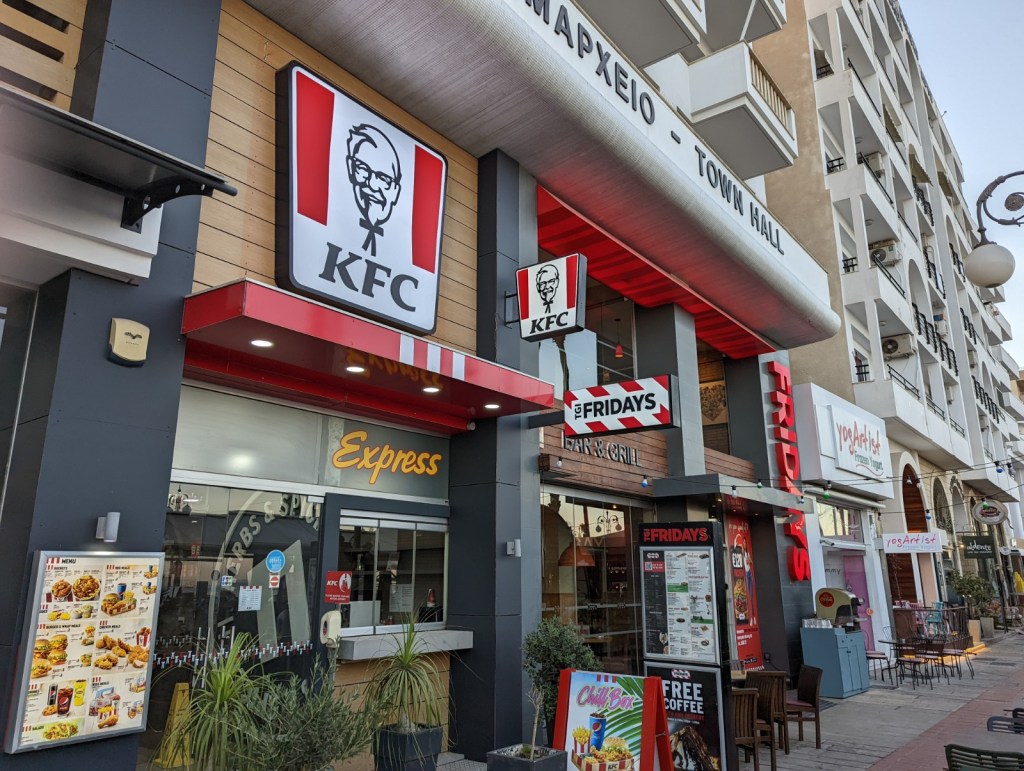
I guess the reason for this post is for future students who want to come out here during a dig season. If you are skittish about new foods or the unfamiliar tastes you might encounter, believe me, Larnaca is loaded with comfort foods like they are back home. I’ll even make a wager that these fast food franchises have better and fresher ingredients than we are used to the States. They are also generally cheaper. I make a habit of trying McDonalds in every country just to get an idea of what the locals expect from the most ubiquitous food chain in the world.r
Bon Appetit
-Adam E.
-
Cats of Cyprus
I could honestly have kept this blog post as just the title and a photo dump, but then I wouldn’t get credit for it. So, I’ll go on a 250-word tangent about the real highlight of this trip. When I was told there would be cats. I didn’t expect this many. Everywhere I go, I see a cat. Sitting down for dinner? Cat. Stumbling my way back to the hotel? Cat. I love cats though, so I get happy every time I see them. Much to my surprise, the cats here are as friendly as they are numerous. I’m also a certified cat whisperer so that probably contributes at least a little. The cats make me feel better about how much I miss my cat, Snoopdogg (see the introduction post). There’s one cat in particular that made me especially happy. After a long night of drinking water, I began my strenuous 10-minute hike back to the apartment. As I swayed down the sidewalk, a few other students and I noticed a very cute, very small kitten. In my water-induced state, I immediately scooped up this tiny kitten and cradled it. This kitten turned out to be the sweetest cat I’d come across the entire trip. It purred away, and even let us pet its belly. Although I had drunken enough water to deeply consider carrying this kitten back to the hotel, I hadn’t had enough water to actually convince myself that I could get it through TSA. But if I see this kitten again, water or no water, I’m taking it.
-Olivia R.
-
Flamingos
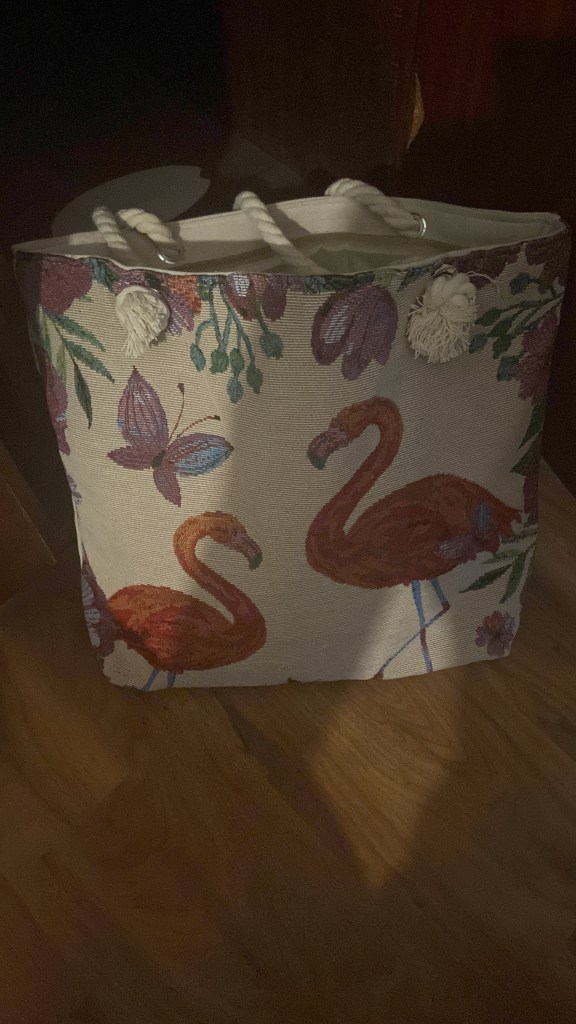
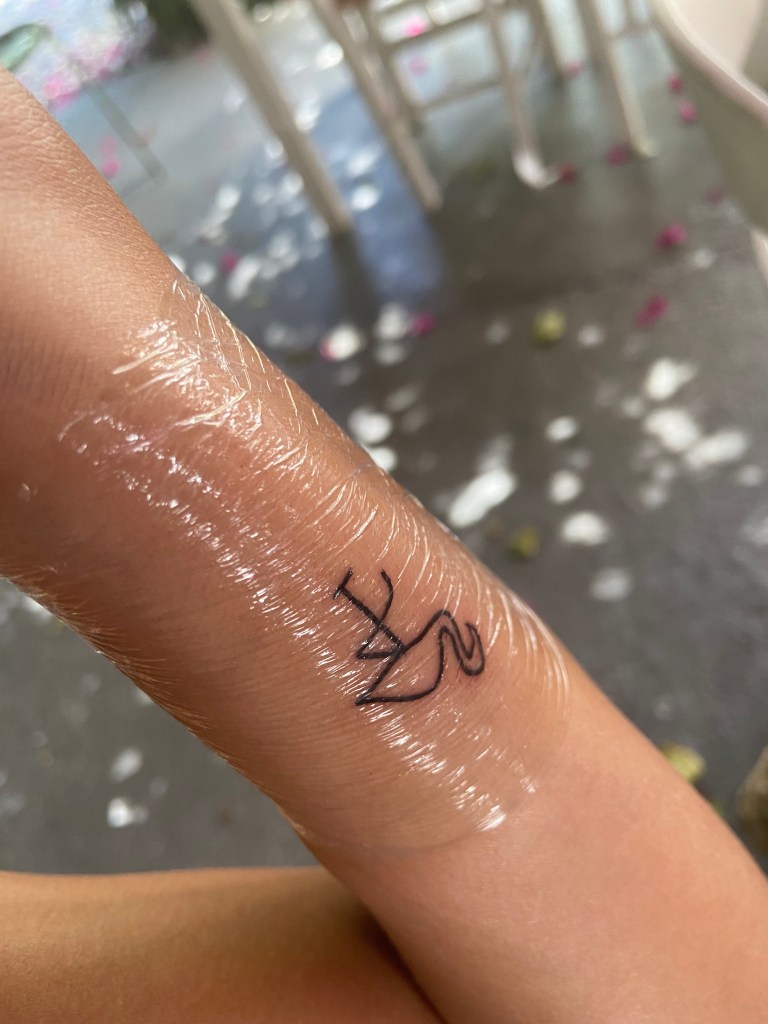
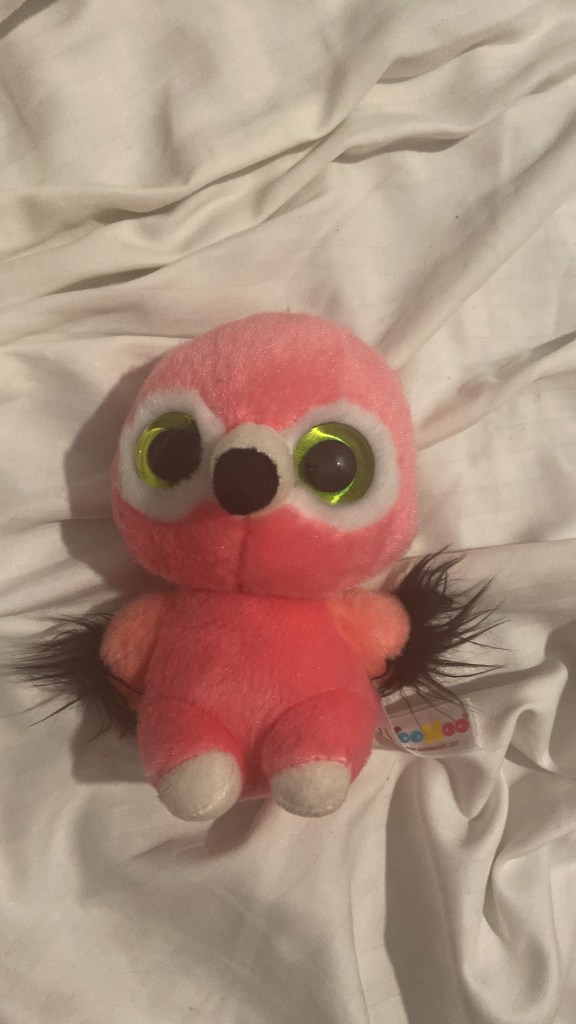
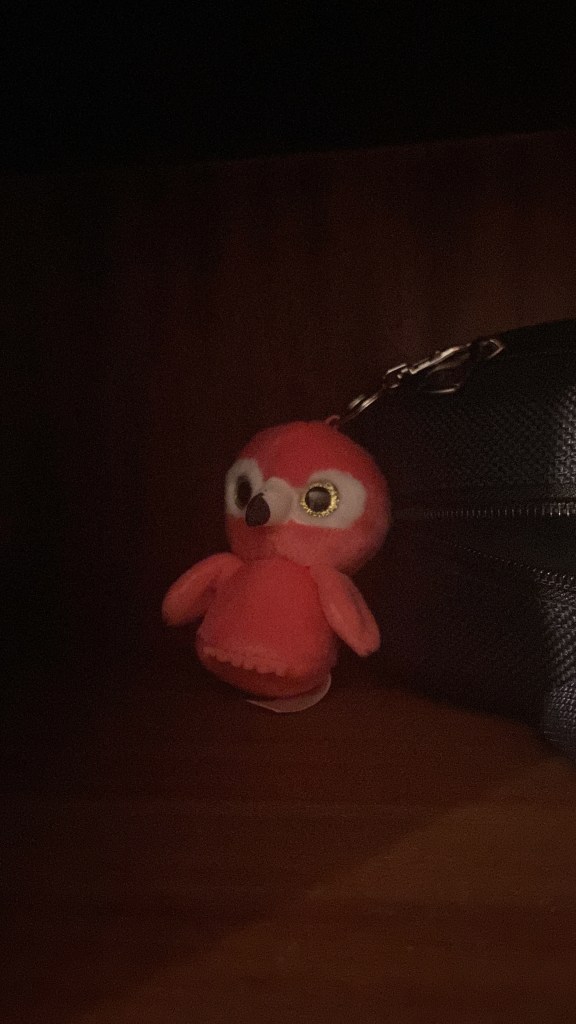
When I look back on my life at the top 5 betrayals I’ve ever experienced, few compare to what I’m about to say. There is a salt lake here that has a sign of promising flamingos. My favorite animal. When I saw that sign on my first day here in Cyprus, I stopped breathing and almost passed out in the car from the immeasurable elation I felt. All I could think about was seeing flamingos at the salt lake. However, I grew suspicious when I looked closer at the lake. It was dried up. Interesting. I don’t know of many flamingos that enjoy standing in a dried-up up salt lake, but I pushed my suspicions aside and basked in my growing excitement of seeing flamingos. Two weeks and zero flamingos later, I knew something wasn’t right. Despite being swamped with extremely critical, time-sensitive pottery washing, I decided to delve into deep research about the flamingos in Cyprus. And that’s when I saw it. November through March. November through March. November through March. Just typing those months fills me with dread. I bought flamingo merchandise (see below). I brought pink sunglasses from home. I got a flamingo tattoo. I always advocate for flamingos to be the best animal to ever exist. Yet, they refuse to make an appearance while I’m here. This is the ultimate betrayal. Regardless, I suppose I can still maintain some level of fondness for the Phoenicopterus ruber.
-Olivia R.
-
Cypriot Oddities
In Cyprus, door knobs mean nothing. I have yet to use a door knob for the entry of a domicile that had a mechanical function. It is just something to pull or push the door with. All doors with the purpose of securing a room are operated with a key, and the key is what works the latch to unsecure the door. I once broke a key off accidently in a lock tumbler inside a door knob, so I get anxiety every time I have to use the torque of a key to get inside the various apartments I’ve stayed at in Larnaca. This also makes it really easy to lock yourself out if you don’t have a routine in place when you enter and exit an apartment. I’ll tell you a secret: we have one key for four people in this apartment, so the door mat outside the front door is the communal hiding spot so no one will ever be trapped outside. But I have a hard time imagining Cypriots being the kind of people to enter your home without permission and with ill-intent.

The knob does nothing. There is definitely more history from me to look into on this next subject, but the general understanding I have about water heating in Cyprus is this: Hot water tanks are stored on the roofs of buildings, not on the inside. In the United States, we generally insulate our water heaters inside the homes as it is efficient at keeping temperatures high. But here in Cyprus, the roofs are generally warm to hot most of the year, so polyurethane tanks are used to store hot water on roof tops with solar panels to power the heating process. One of the isolation apartments I stayed in had a digital temperature gauge on the wall that took me awhile to understand why it usually read anywhere from 65 to 73 degrees Celsius. It was the water heater temp, and it dropped during the night. A lot of older buildings have a switch you need to hit to turn on the hot water to the bathroom where your shower and sink are. They do not always have hot water in kitchen sinks, because you have a stovetop or appliance to help you out if you need small batches of heated fluids. With the near constant sunshine during the daylight hours of Cyprus, hot water can easily be summoned to the pipes this way. No where else in the world that I have travelled does it this way, but I imagine it is not entirely uncommon in the Mediterranean.

The adjacent apartments from out balcony. I presume you can tell how many units a building has by counting the tanks. Further discussion on the topic of water: it is cheap here. For as much as I consider Cyprus pretty arid, they seemed to have little water concerns currently. While reading into the water heating tanks on the roof, I read anecdotes by a 20 year ex-pat in Cyprus who described a period of time where water was only piped a few days a week, so cold water storage tanks became common in homes for the days the water did not run. Part of this was several years of drought and the other part was no alternatives for fresh water. But this storyteller said after a few good ‘wet years’ and the creation of desalination plants along the coast (there is one just east of the Larnaca airport) the water problems seemed to be long forgotten. I can see off in the inland horizons the use of wind turbines and I wonder to myself if the islands renewable energy resources are enough to power the desalination process for fresh water. If it is enough, the island has near limitless fresh water potential. But if the renewables are not enough, then one would assume the cost of bottle water would have skyrocketed with the massively inflated hydrocarbon fuel costs in the year of 2022… which it hasn’t.
I just wish there were not so many plastic bottles being used here. (Seriously, 1.5 liters of delicious, refreshing water can run you like 75 cents, so water bottles are so much easier than refilling from the tap constantly as you consume huge amounts throughout the hot days). I really hope they have one hell of a separation and recycling program on the island for plastics. My inner environmentalist might never forgive me for my time here in Larnaca otherwise.
-Adam E
-
My Greek Tragedy in Larnaca
The very first full day of excavation work was hot, sweaty, and tiring. I was up for the challenge well before I arrived, but on that first day, as the hours under the sun trickled on, the others and myself noticed how sluggish and seemly unwell I was. It only kept getting worse as the work day came to a close. I jumped on the first transport back to our accommodations, figuring that I was just dehydrated, lacking in sleep from the night before (4:00 am wake ups are brutal), and needed some calories in my stomach. After some time passed as I laid in bed, I noticed I was not cooling off, I was starting to have cramps in my back, and the pit in my stomach was not subsiding. Then the vomiting began. I have medical experience and after thinking through everything related to signs of heat exhaustion and dehydration, I finally bit the bullet and pulled out a COVID-19 rapid test.
I managed to go through the entire pandemic without catching it once, even working in a COVID ICU in New York City during the height of the first wave. But I had to catch it on my first week of real archeology work. I was crushed. Thankfully, no one else ever tested positive or showed symptoms despite the proximity they spent with me in vehicles, apartments, elevators, and dining. Those vaccinations are pretty effective at shielding, not just reducing severity.
I had to isolate for the rest of the day in the room I was already in, forcing my bunkmate to live on the couch in the living room for the night. My professors arranged to have my move to a private studio apartment for several days, which was quite the chore to locate while masked up in 95 degree humid heat, lugging 45lbs worth of backpacks, coughing my lungs out, and feeling like a truck ran over me. My isolation was extended for precautionary reasons, but I had to switch apartments two more times, each one thankfully nicer than the last one. I had the chance to see the standards for hostel stays in Larnaca over this period of time, which made me realize how uniquely a lot of the refurbished architecture practices in Cyprus are accomplished. I will definitely follow this up with a blog post about those idiosyncrasies.
Several of the other students took pity on me and made sure to drop food and fluids off for me. They even kept in contact with me over Whatsapp which honestly really helped me get through the whole thing without losing my mind. That is the longest I’ve ever spent just trapped in a room. I’d never survive prison with my sanity intact. Thanks Tristan and some of the Reed College kids for making sure I didn’t feel forgotten. They even sent me a photo from when they went to visit my friend Petros and called me so I could talk to him on the phone. I totally didn’t have tears in my eyes from that, it was my sinuses burning up…
You’ve got to be flexible with the demands of a field school like this, especially so in a world that has COVID still rearing it ugly head. I missed out on some precious dig time, but that it just how the cookie crumbles sometimes. I hope, dear reader, if you join the 2023 PKAP excavation, you are living in a world where the daily concern and threat of contagious viruses is behind us. No COVID, no monkeypox, no <insert whatever is next>.
Take care of yourselves and get vaccinated.
-Adam E.
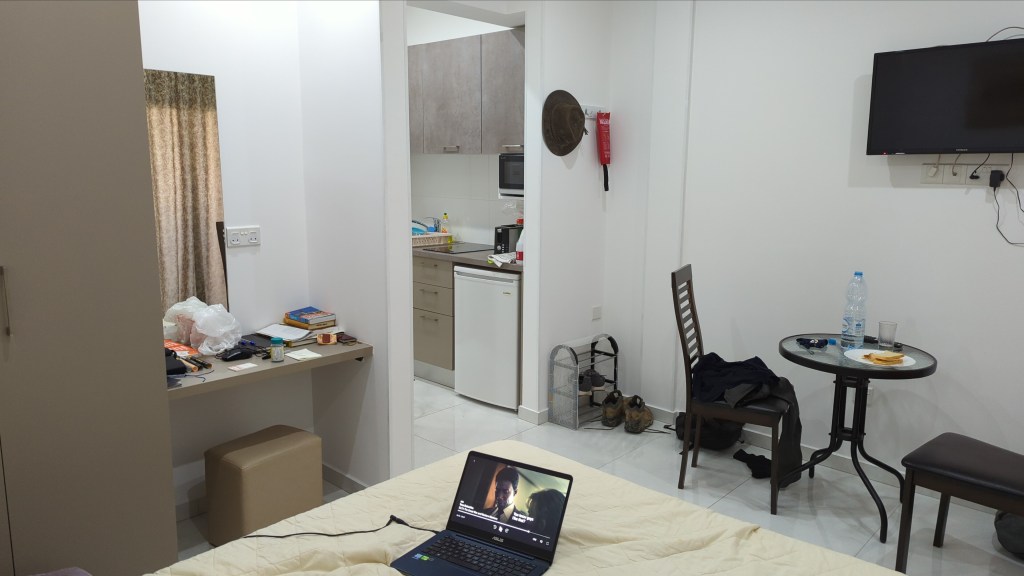
Isolation Apt #1 
Isolation Apt #2 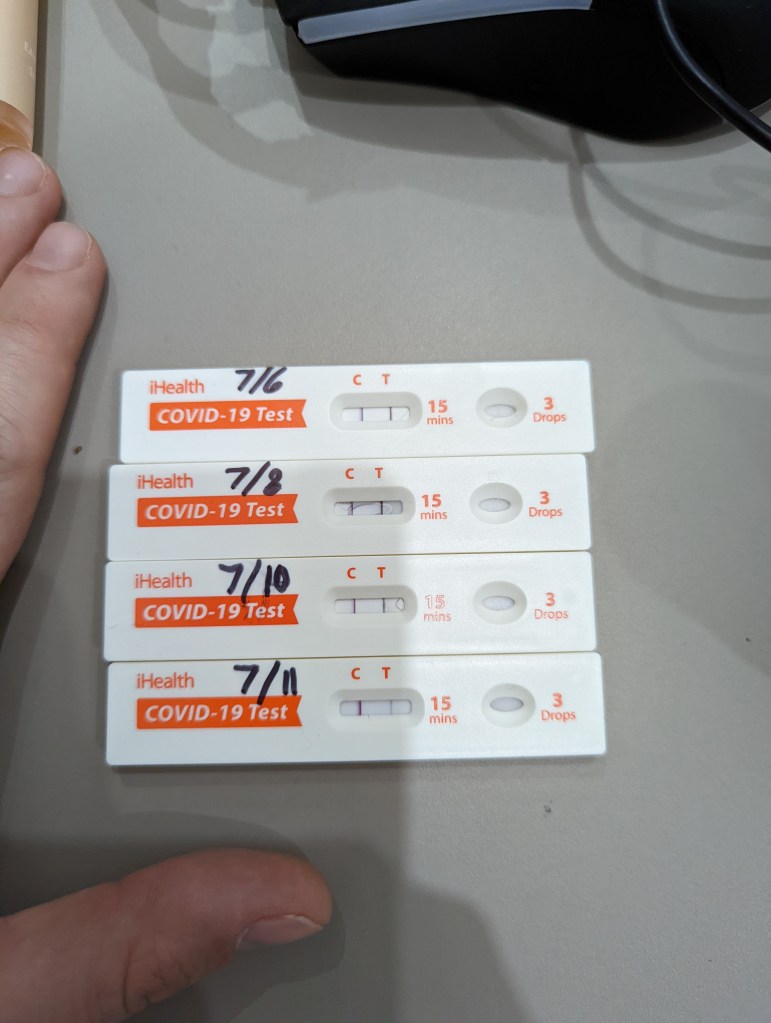
Forgot to photograph Isolation Apt #3, but this was my routine… reading, streaming something on my laptop, and waiting for the strips to show negative. -
Terra Ombra:
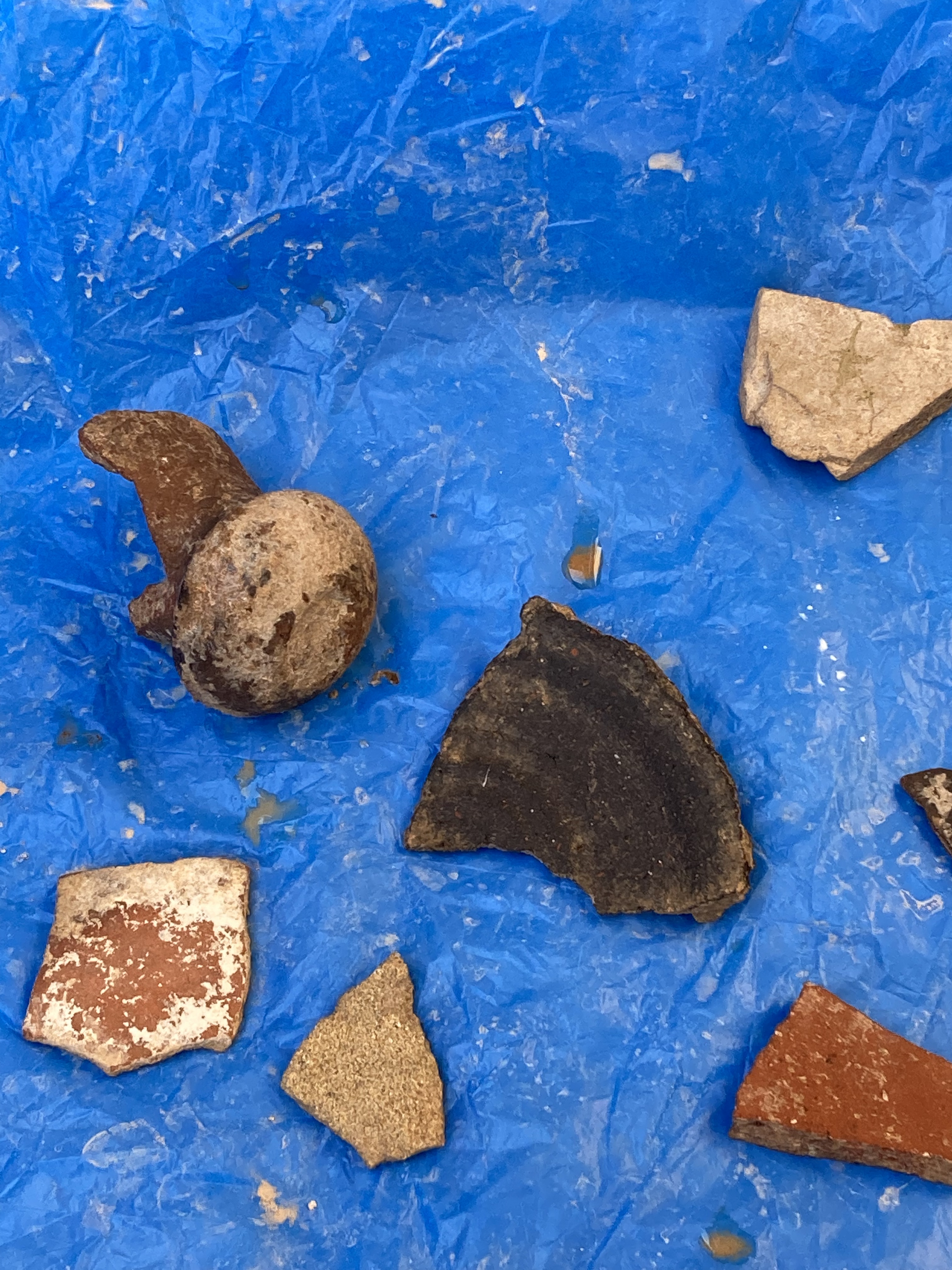
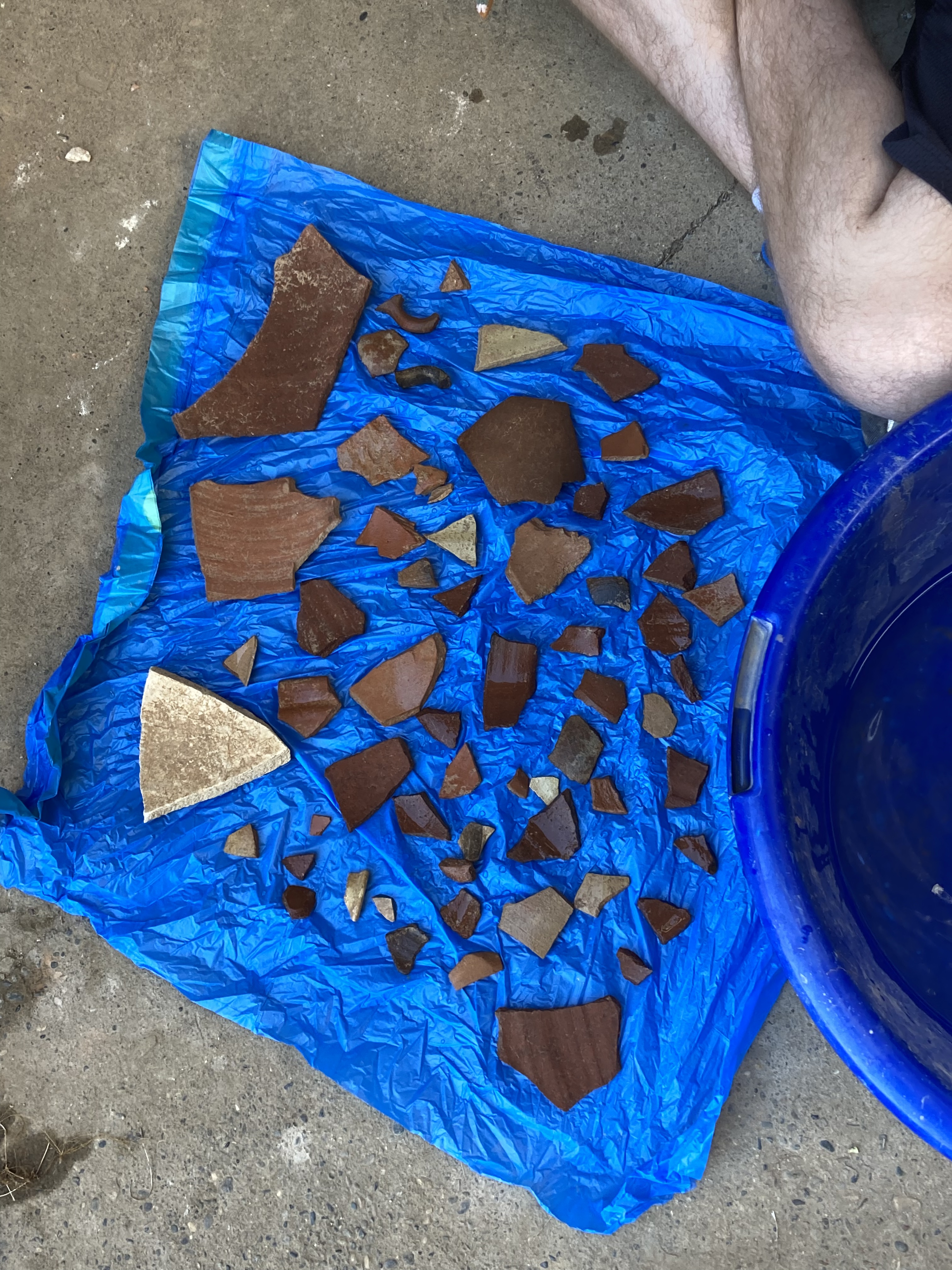
Although the majority of our time here in Cyprus has been spent at the dig site, our last week here has been spent entirely at Terra Ombra washing and documenting pottery. While washing pottery is far less physically grueling then the work we were doing at the dig site, we have very quickly discovered that after thousands of years of being buried the dirt covering the pottery sherds has largely calcified. Due to this calcification some of the sherds of pottery are very difficult to clean even after they have been left to soak in a mixture of lemon juice and water for over an hour. Despite the occasionally tedious nature of pottery washing I have mostly enjoyed my time at Terra Ombra as we get to hangout as a group and go out to eat at restaurants that we otherwise would likely not have discovered. The restaurants near Terra Ombra are specifically noteworthy due to their low prices and incredibly large portions. Our work at Terra Ombra has allowed me to begin to gain a wider grasp of the different types of pottery that were being created/used at our site and it has been very interesting to see the differences in the types of pottery we have been washing. Terra Ombra is also very interesting because the amount of pottery and sarcophagi that are stored there is absurd as they have multiple warehouses full of items that have been found at numerous dig sites across the island and I personally have never seen anything like it.
Tristan F.
-
Ex-Pats and Foreign Workers in Larnaca
Larnaca, and Cyprus as a whole, truly is a melting pot of European and Mediterranean cultural interactions. Anyone who knows me quickly understands I am a conversationalist. I can hang back and not say much, enjoy an evening in solitude surrounded by throngs of people going about their lives, but I also like to seek out deeper conversations with people. These conversations can be serious, absurd, exploration of ideas, sharing of world views, or an attempt to understand the wildly different life of another person. Larnaca has been my Mecca for conversation.
Thus far, as discussed in a previous post, I’ve spent time with Cypriots discussing life from the time of the war in 1974 to today. But I’ve had many many MANY conversations with non-Cypriots about their lives and what brought them to Larnaca.
I met three Scottish oil and natural gas pipeline workers at the ‘Meeting Pub’ along the beach. Initially, I just sat down with them to watch a couple of Rubgy matches. Over the next several days and weeks meeting up again, we covered topics about working for an international company living abroad, European versus American sports, the possibility of Scottish Independence, and even a three hour discussion on the best way to establish a pipeline from the polar caps of Mars and the engineering challenges to pipe water or ice to a permanent Martian colony. That last one caused quite the argument between two of the engineers over the pros and cons of positive pressure versus negative vacuum systems. I promise you, it was much more exciting than it sounds.
I also befriended an Athenian man who works at the ‘Meeting Pub’. I will save more about my friend Dimitris for a later blog post because his story is worth its own focus. The long and short of it is Dimitris (he likes to go by Jimmy) came to Larnaca to work and sends part of his money back home to his mother. As my friend Petros (the owner of the Bowler’s Pub) explained to me, Cypriots used to go to Greece for a better life, but nowadays, Greeks come to Cyprus since the 2008 economic crash. Also working at this pub is Anna, a 19-year-old Moldova woman who has lived in Larnaca since she was 7. She just came over with her mother and the rest of the family remains in Moldova. She told me about not speaking any English or Greek when she started school and the struggle it was early on. In addition to her Romanian native language she also speaks Bulgarian. John is the owner of the pub which he founded 33 years ago, but apparently has numerous business ventures all around the beach. You can catch him in their keeping an eye on things with his son who is there basically every night working. Occasionally you will see them play a quick game of billiards when there are few customers.
I met some Englishmen who lived in Cyprus for the past three years working remotely. They did not make much money by London standards, so they decided to come out to Cyprus to increase their ‘buying power’. Even Cyprus is slowing creeping up in expense, as these gentlemen just left Limassol for Larnaca to live cheaper. By most Cypriot standards, these men are living the upper-middle class life. Many other British islanders I’ve encountered did the same thing by retiring to Larnaca because their monthly pension takes quite good care of them compared to back home.
If you, dear reader, choose to join the PKAP excavations through your university, I desperately urge you to take the time to chat up others in the places you frequent. You’ll gain a whole new perspective on migration and economics we don’t often discuss in the United States.
Sorry, no picture for this post.
-Adam E.
-
Zeno
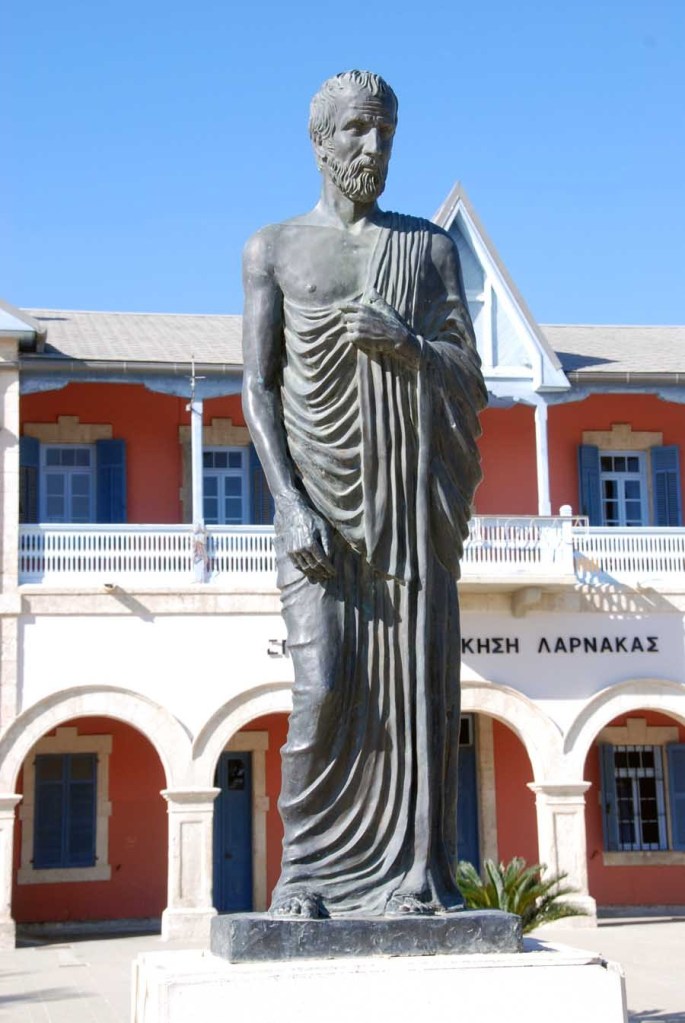
The very first group trip we took was a very short one around Larnaca, anchored around Finikoudes Beach. There we saw a Venetian castle later held by the Ottomans, the Church of St. Lazarus, the Jami Kebir Mosque, the statue of Cimo… but the very first site seen was the statue of Zeno.
Zeno was from Larnaca, then known as Kition, and followed in his fathers footsteps as a seafaring merchant. He managed to survive a shipwreck and found his way to Athens, and while passing the time he read a scroll discussing Socrates. He was immediate taken by the works of philosophy and asked the shopkeeper who owned the scroll where he could find these wise sophists. At that very moment one was walking by and the shopkeeper pointed Zeno over to this man. From that moment forward, Zeno devoted his life to learning the philosophies of the great Greek thinkers. He eventually came to form his own school of thought we call today ‘Stoicism.’
Now I am no philosopher. A lot of the great Greek tomes I confuse with one another and sometimes outright do not understand the point the author was trying to get across. However, Stoicism, when I do have the chance to absorb the philosophy, often speaks to me on a very personal level. Later stoic philosophers like that of Marcus Aurelius really honed in much of the details of stoicism that made it much more broadly applicable to the modern person. None of Zeno’s writings have survived throughout time, but those who succeeded him gave us enough of an understanding of Zeno’s original philosophies that we can attribute the new school of though to him.
Zeno’s philosophy was very Taoist, if we could compare it to a surviving religio-philosophic ideology. The balance and the ebb and flow of nature is what should be sought out to live a good life. The good life can only be found through virtuous actions and not that of pleasure or vice. Virtuous actions themselves were natural, thus to act naturally in accordance to nature, not to fight against it, was the way to achieve this good life. Again, I am not a philosopher, but Zeno often preached his ideas in a cyclical fashion. His chosen code of life to live by was effectively one of contemplation before acting and moderation in every pursuit of life. I think there is some solid ideas in taking a moment to ponder our words and actions before we respond and also making sure we are not underperforming or overzealously acting when we do chose to act. One of Zeno’s reported writings was one called ‘Republic.’ It had the same concept of Plato’s ‘Republic’ where it explored the idea of the perfect society, but Zeno’s was much more utopian. In fact, today we would call it outright anarchist. But it is a really good exploration of the philosophy of utopianism, to the point where virtue guides all human actions, thus laws are no longer needing to exist because everyone has figured out what they need and demand nothing more.
Zeno came to a very strange end according to a few ancient historians. Zeno tripped and injured his toe, hit the ground with his fist and cursed out loud as if he was acknowledging his own death, and according to different sources, he either held his breath until he died or strangled himself out right. Unlike the beautiful and poetic end that Socrates met, Zeno’s death was sudden, puzzling, and did not fit the image of a man so in control of his own mind and actions.
If you have the chance, read up on Stoicism. But if you feel stoicism is a little too detached from self-determination, you are more than welcome to join me in my other favorite Greek philosophical camp, the Cynics.
-Adam E.
-
Funerary Carriage
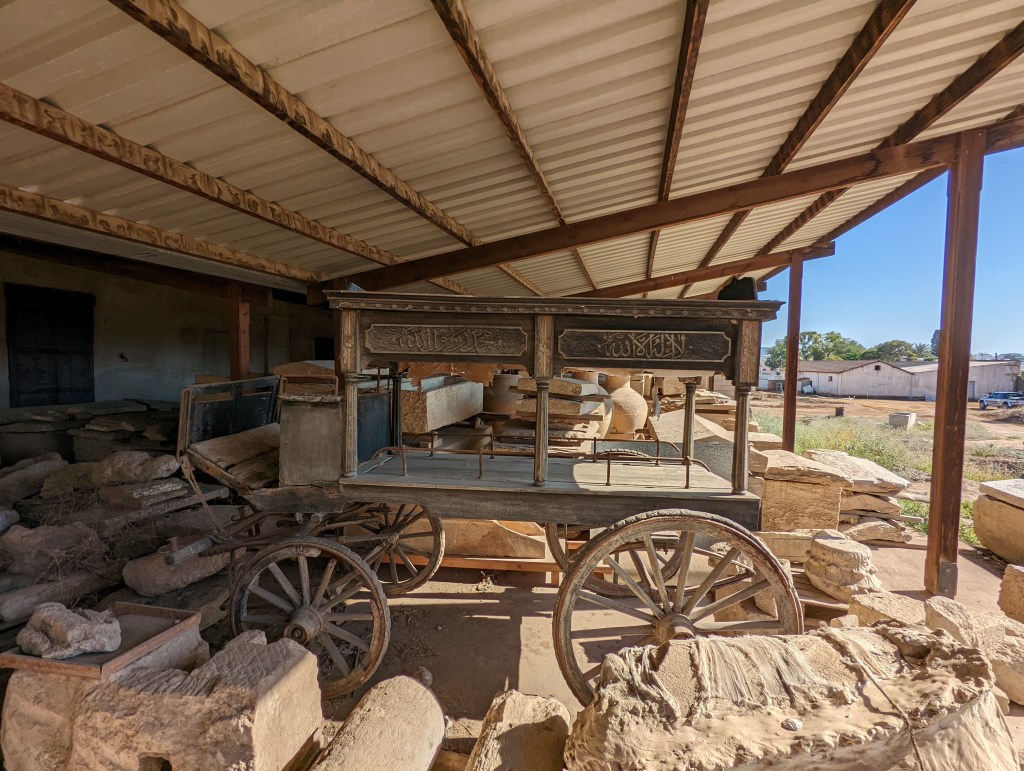
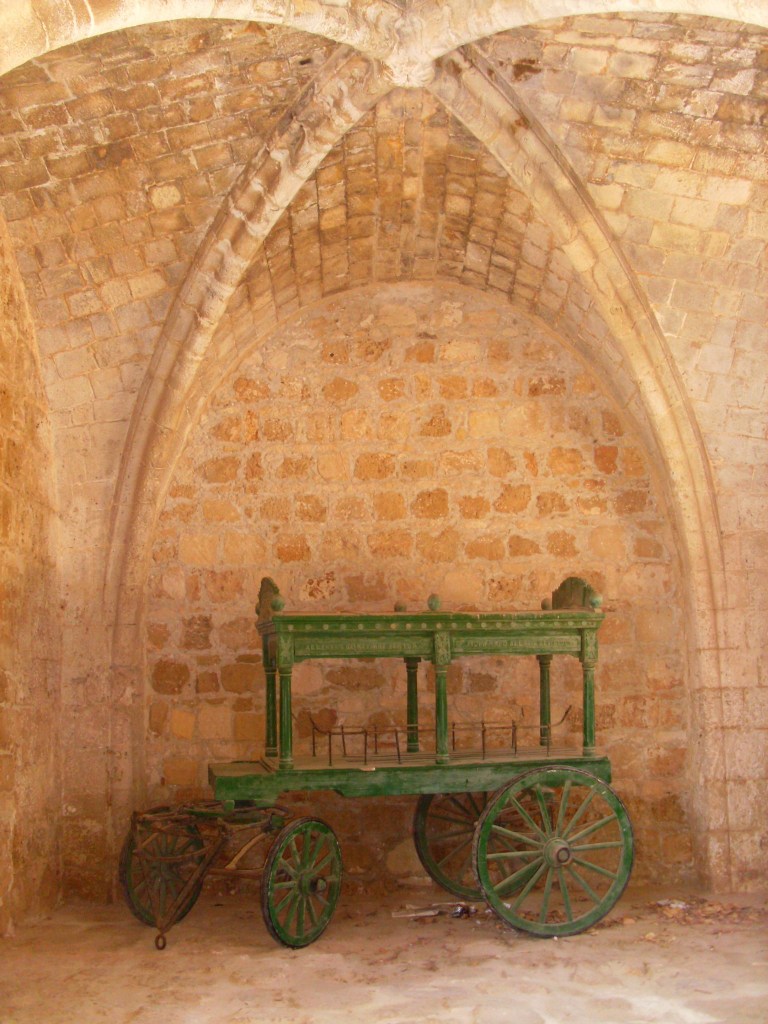
At the site we store our discovered material culture at (mainly pottery), they have a treasure trove of empty stone tombs stacked under awning and lean-tos. There was one unique item that did catch my eye, and it was an old wooden carriage. It had seen better days, but the decay of the wheel spokes and the frame had not proceeded far enough for the whole carriage to collapse. My first impression right away was it must be for transporting caskets. There was no room to sit in the back, too high lifted off the ground (around chest height), the Arabic inscription on the sides, and the framing of the back portion had carved flowers. This seemed too fancy for a simple merchant or farmers carriage to take their wares to market. I had to look into it more.
I was told 4th hand that it was found in this condition in someone’s barn. The mere fact it was being stored at the facility we used meant it had some sort of historical value. My mind immediately went to 19th or early 20th century Ottoman funerary practices on the island. The more I looked into that specific theory, the more frustrated I became because I could not find anything that seemed to explain what I was examining.
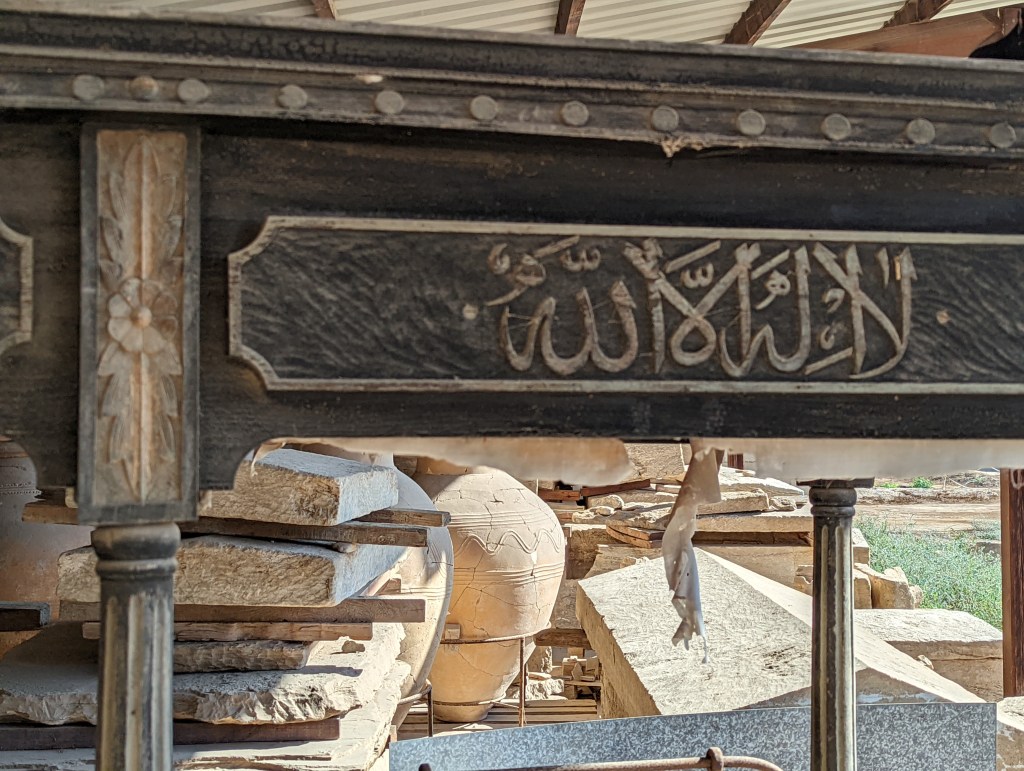
I took the time to verify the translation of the inscription of the casket by emailing a professor of mine who was fluent, and he returned back to me what was suspected by another professor who had some familiarity with Arabic. “There is no God but God” on the right and “Mohammad is the prophet of God” on the left. So we are very likely dealing with a device used in religious practices. I admittedly was patting myself on the back for guessing correct.
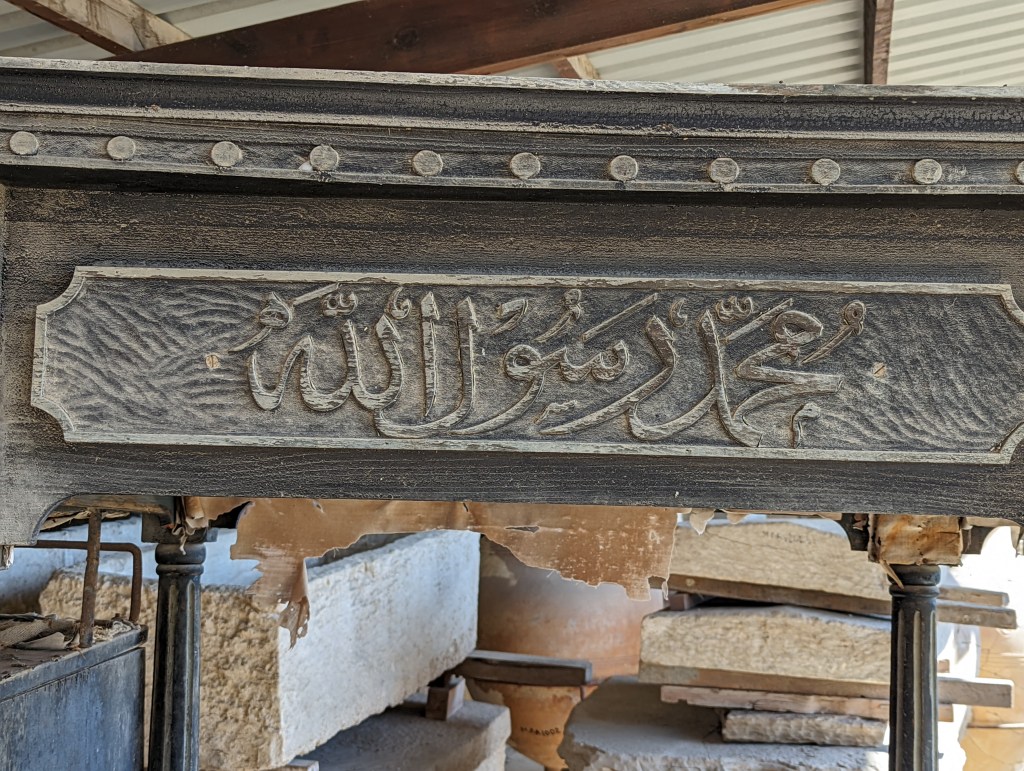
On a different day visiting the storage site, I looked at it one more time and started wondering about another feature of the carriage. The exterior circumference of the wheel had a material on it not of metal nor made of wood. After staring at it for a bit I came to the conclusion it was basically petrified rubber. But wait… rubber in 19th century Ottoman Empire? Organic rubber from tree plants could have been around back then, but I had never known or seen really old rubber last this long. Synthetic modern rubbers yes, they tend to last long periods of time, but that didn’t become commonplace until after the Second World War. The Japanese invasion of Southeast Asia was in part motivated by the need to access the rubber tree plantations for their war machine. The loss of this rubber supply chain pushed the further development of petroleum based rubber in the United States. With this new problem presented to me, I had to look into it further. My new guess became this funerary carriage was much more recent than I suspected. The minimal deterioration of the wooden accoutrements on the frame gave weight to this new theory.
After some searching on the internet, I was a able to find another carriage in located in Famagusta, Cyprus that had many of the same features. The person who uploaded this picture left an anecdote that they remember as a child watching carts like this being used in Cyprus all the way up until the 1970’s. I was kind of sad to find out this carriage was nowhere near as old as I wanted it to be, but there is a lesson in my search to prove myself right. All the details matter before you can start making a serious hypothesis and you should try to prove yourself wrong rather than seeking out the answers that prove you right.
-Adam E.
-
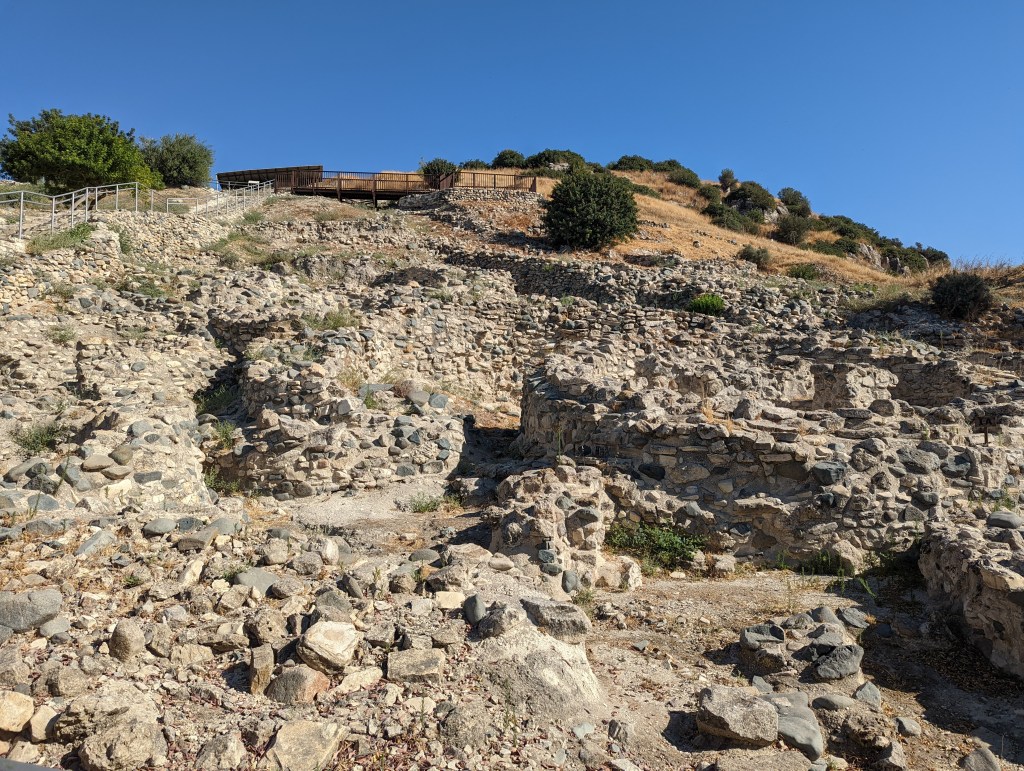
Neolithic Settlement: Choirokoitia
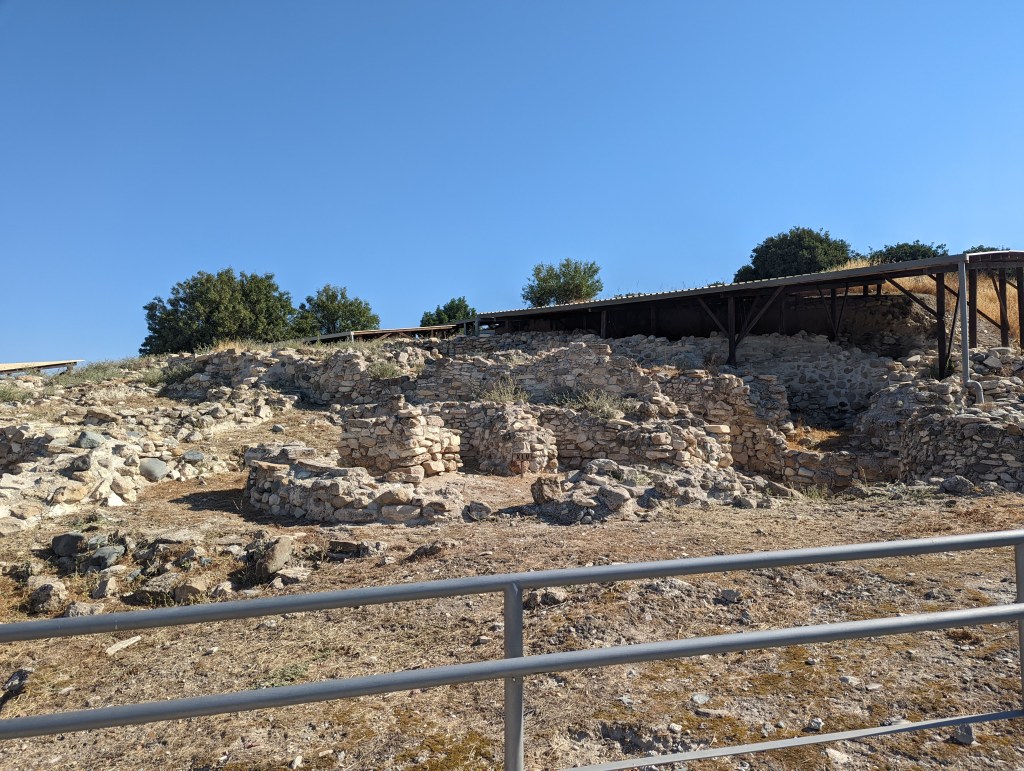
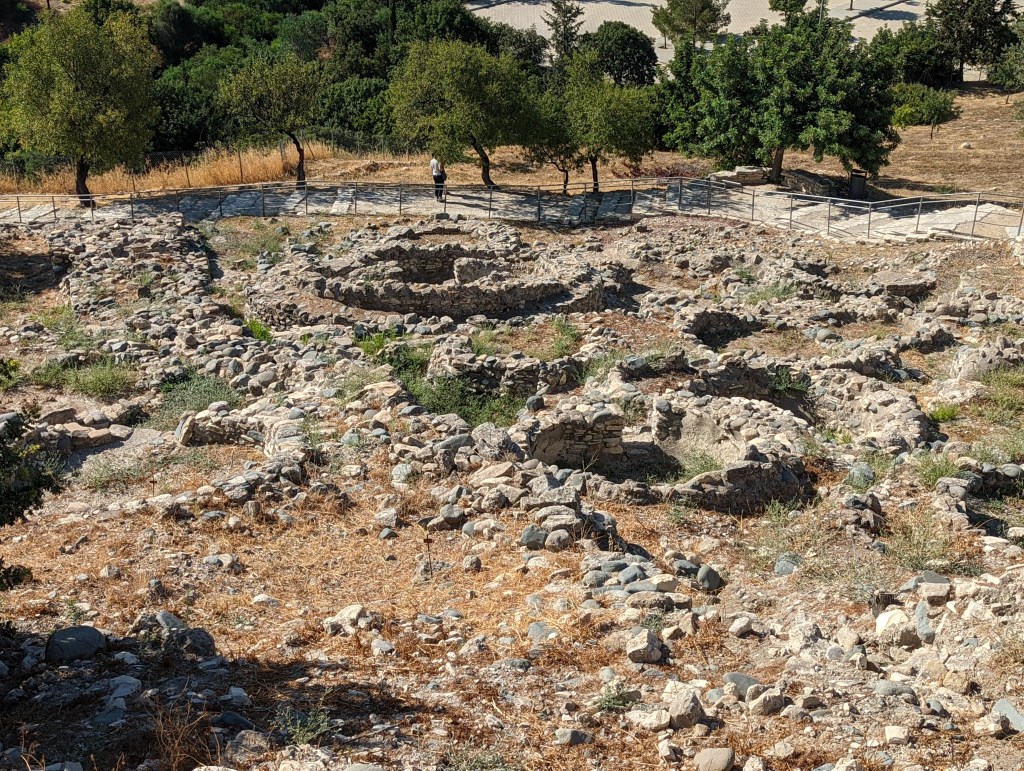
In between Larnaca and Limassol lies a Neolithic site of the earliest known culture on Cyprus. It lies a good distance away from the shoreline and is mostly enclosed by surrounding hills that a river wraps around through. These people were agriculturalists of cereal crops, gatherers of local fruits and nuts, but also subsisted through shepherding and hunting as well. This is known based on four types on animal remains that have been found in excavation: deer, sheep, goats, and pigs.
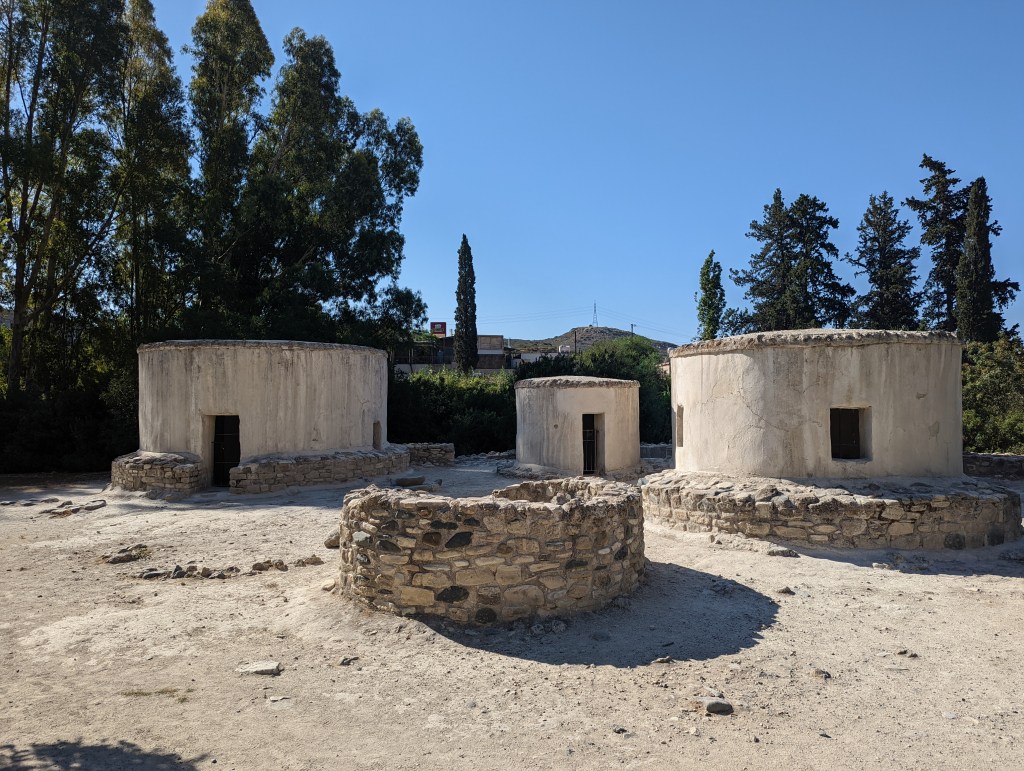
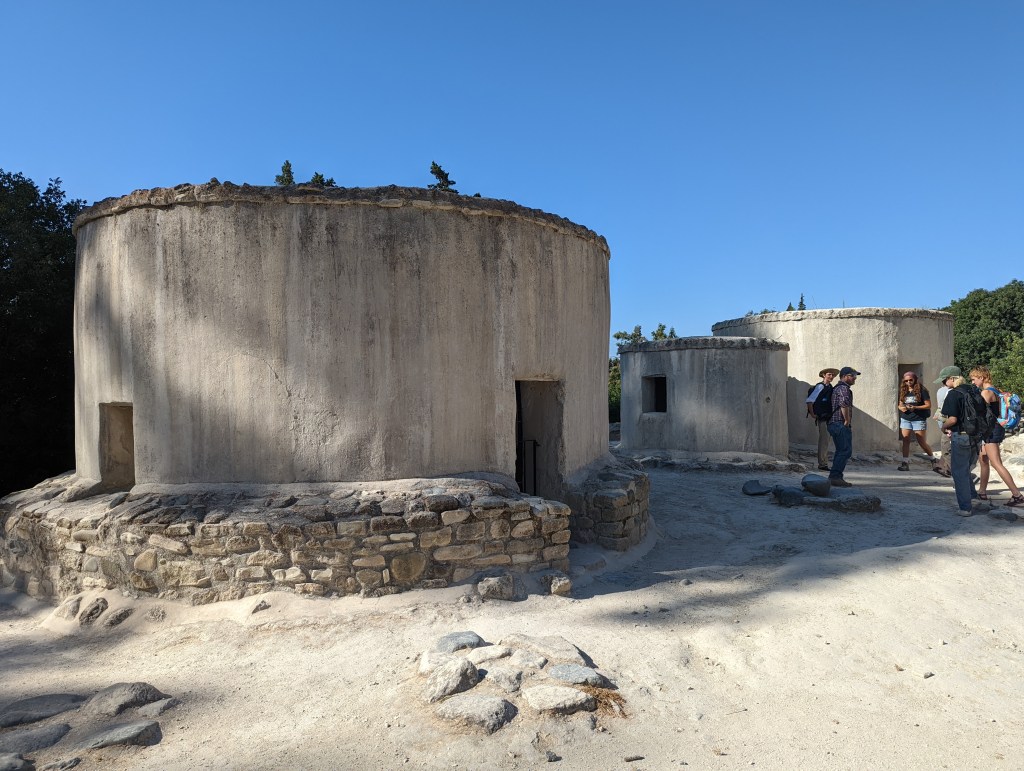
There are a few very distinctive details that makes these people unique, but also extremely significant to the study of anthropology. Their village housed anywhere from 300 to 600 people and was enclosed by a fairly tall and thick wall. This implies to me they had concerns of outside threats, but none is known at this time. Furthermore, the construction of buildings and domiciles were in a circular fashion rather than later squares or rectangles. I spent some time considering why one would construct circular buildings rather than polygonal ones and the best answer I could come up with would be the trading of square footage for the reduction of building material used. It was suggested by Anna, one of the graduate students, that the formation and clusters of rounded buildings would encourage airflow. What the climate of the location was like 8000+ years ago I can only begin to guess. Another interesting feature of this society was the burials of the dead under the floors of the home. They would not be the only peoples throughout time to do such a thing, but this funerary practices give clues towards the perceptual relationship between the mortal world and that of the afterlife. Rather than separating the deceased from the living in an isolated or even shared tomb or cemetery, they kept the dead close.
But the most fascinating aspect I learned when visiting this site, was that the society completely lacked pottery. There have been zero pottery sherds discovered. You, my future archaeology student, will quickly learn while working on a more recent site that pottery in the olden days is like the broken bottles of glass in the modern times. It is everywhere and unescapable. From my understanding, this site threw the belief that pottery manufacturing was a prerequisite for agricultural development right out the window. There are no signs of petroglyphs that remain, so I am curious about how the people here expressed themselves through material culture, because pottery was often the medium for artistic expression.
This is a trip not to miss. Especially if your interest in history or archaeology is focused in pre-history. In 1998 the site was designated a UNESCO World Heritage Site, and the caretakers have rebuilt mock examples of what they believed the structures in the village looked like.
-Adam E.


Study Abroad in Cyprus
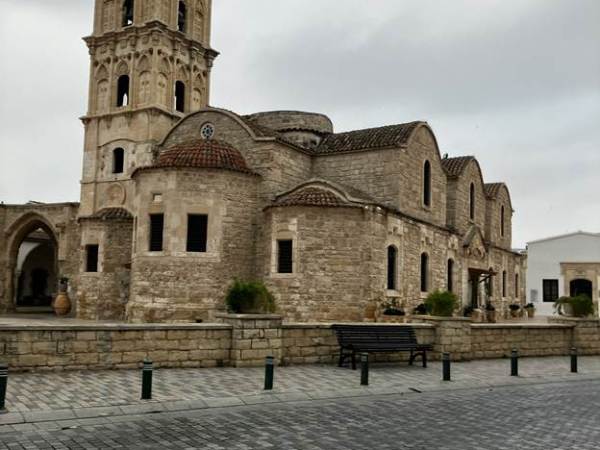
By: Arthur Pino Coming to the Old World is a new experience for me. I can say that, besides the luxuries and brands similar to those in America, it is quite different. This land has been inhabited for at least 4,000 years, according to the sign outside the Agio Lazaros (The Church of St. Lazarus).…

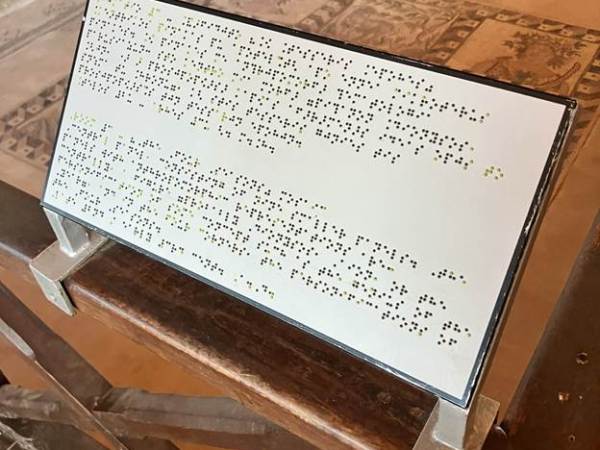
House of Dionysus
By: Arthur Pino On a field trip, we went to Paphos, where we were able to visit a “World Heritage Site.” This would be the second opportunity I have had to see one in my life within the last year; the other was Chichen Itza in Mexico. It was a very hot day, and walking…

A Big Discovery!
By: Arthur Pino Today was another hard but rewarding day. It was the first time I had worked in the trenches three days in a row, and I felt it. This day, in particular, revolved around hands. My hands themselves, and an accessory for hands. As usual, I did not wear gloves to start…
 Vigla Archaeological Project