-
Archaeology Workouts
Before coming to Cyprus, I spoke to a couple of professors and classmates who do archaeology, and they all gave the same advice: get ready for your body to hate you. One stated that the first few days are brutal, but once you get accustomed to all the squatting and heavy lifting, it’s not so bad. She says she is “ripped” at the end of every digging season. Naturally, my thoughts were, “what if the first few days weren’t so bad? What if I was already ripped?”
I tried to find a set of workouts online that would be good for preparation, but all I could find were various archaeologists talking about going from desk work eleven months out of the year to manual labor in the sun for a month, and how tough the transition is. This was informative, but not particularly helpful for my quest. So I decided to make my own exercise routine to get ready, and I think it worked pretty well for me. Now, before you get too excited, reader, I did not get ripped. I did, however, do enough that I think I saved myself from most of the brutality of acclimation.
Here is what I did: bought some hand weights, set aside fifteen minutes every morning, and did squats, curls, and crunches six out of seven mornings every week for a few months leading up to the trip. It’s still exhausting work on site, but it could have been harder! If you are thinking of going on this trip, save yourself the growing pains and lift some weights before you go!
-Rachel
-
Mr. Bricolage, for All Your Archaeology Needs
When I first arrived in Larnaca, excited to learn how to do archaeology, I realized that there were a few items I had missed upon packing. For one, I had forgotten my work gloves at home, and I knew I’d need some. Second, I’d only brought jeans to work in, and I learned on the first day that they really weren’t breathable enough, as I was getting too hot. Plus, I’d entirely forgotten to pack a hat for the sun beating down on my face. I needed so many things, but I was so far from home! What’s a girl to do?? Well, Mr. Bricolage of course!
After a day of being out on site, prepping the area, moving rocks around, and reopening last year’s trenches, the professors realized that we needed things. We needed more brushes for brushing, more dust pans for dust, and of course, lots and lots of buckets of every color. Where could they get all these things?? Why, Mr. Bricolage of course!
Mr. Bricolage is a hardware store in Larnaca that seems to have everything that any of us need for doing archaeology. This was actually a little surprising to me, but not because of the work gloves and construction pants. For some reason, I had thought that the tools we’d be using would be specialized in some way, or that there would be official purveyors of them. I didn’t realize that most of the equipment we’d need for excavation would come from an everyday hardware store. Even the sieves we were using were hand built by our professors from lumber and fasteners, likely bought at Mr. Bricolage. It’s been really impressive seeing how ordinary our tools are compared to how extraordinary the site seems, with the directors having still been able to put together such an excellent project. Thanks, Mr. Bricolage!
-Rachel
-
Hercules
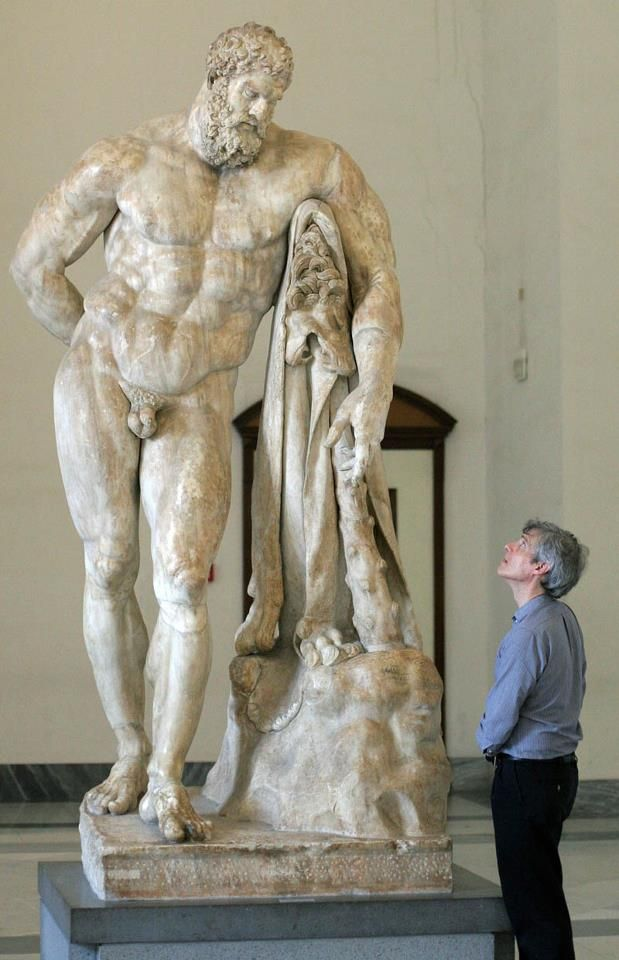
The Weary Hercules statue type is one of my favorites to paint and sketch so it was fairly easy to recognize at the Cyprus Museum in Nicosia. The Weary Hercules is a trend of statues during the Hellenistic and Roman periods that are copies of a statue done by the famous sculptor Lysippo in the mid-4th century BCE. Lysippo’s original statue would depict the Greek hero Hercules tiredly leaning down on his club after one of his Twelve Labors, still holding the apples of Hesperides behind his back. Draped over his club is the skin of Nimean Lion and the first of Hercules’ Twelve Labors. The Weary Hercules types would typically be found in gymnasiums or in baths and were reproduced by both Greek and Roman artists long after Lysippo died. I’d like to think they were placed in baths as a visual representation of what it feels like to soak in water after a long day.
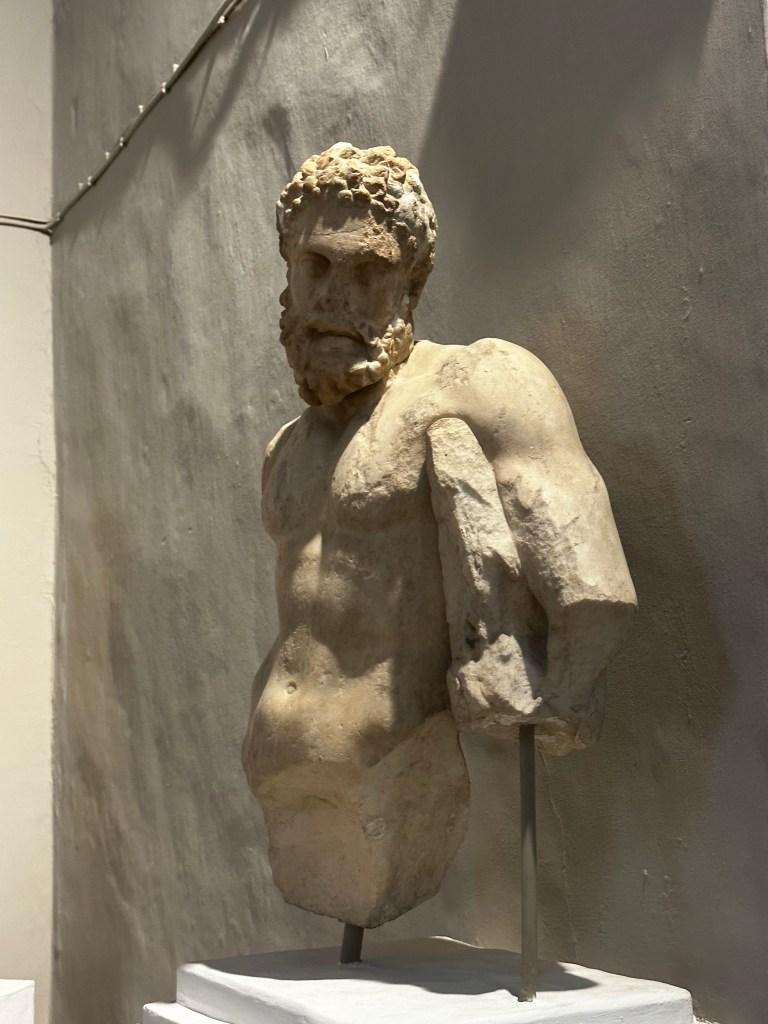
The most famous and complete copy of Lysippo’s bronze scupture is the Roman Farnese Hercules which was found in the Baths of Caracalla in Rome with the original bronze statue having been lost. The Farnese Hercules is impressive at almost 11 ft. tall with a heavy exaggeration to the figure’s musculature. The Cypriot Hercules was found in Salamis at a gymnasium and dates to the 2nd century AD, making it a contemporary of the Farnese Hercules. This particular Cypriot Hercules was a great deal more tarnished than the Farnese Hercules with it missing the lower half of its body and its arms, and it is a greatly less exaggerated being thinner and less detailed. Despite its roughed-up condition, I appreciate the forlorn and melancholy expression on the Cypriot Hercules. The Farnese Hercules is impressive and, more importantly, complete, but the Cypriot Hercules has a more thoughtful and worn expression. The Cypriot Hercules also appears more weary, both physically and emotionally, which I appreciate more than the Farnese version.
I wasn’t expecting to see it so needless to say I was stoked that day. I hope to one day see the Farnese Hercules in person, and I happy to have a comparison to make
audrey
-
To dig or not to dig?
To dig or not to dig? This was the question I turned over in my mind as the temperature continued to climb at Vigla this Saturday. Due to an unexpected change in the shooting practice schedule on the British military base we wound up with a rushed exit from site on Thursday. We came to find out that while digging on Friday was still possible, the coming week was no longer going to be available for us to dig. To make up for the missed days to come we wound up with MSU students digging on Saturday and the choice for an optional dig day on Sunday. This would mean a straight 7 days of waking up at 4 am and working hard under the blazing sun. This week has been exceptionally hot, with temps grazing 100 degrees Fahrenheit and humidity which thickens the air. While I am sure many archaeologists rarely get the option of choice, I think many have probably wrestled between discomfort and the rush that comes from an exciting dig. What is it that keeps those in the field coming back day after day, year after year? Is it passion for knowledge, the rush of discovery, the flood of hormones from a good workout? From what I can tell of watching our amazing trench supervisors, it has got to be at least a little of all three. I, at least, am certainly feeling all of this. And so, the decision has been made, I am digging! I honestly cannot wait to once again wake before the morning sun, to be drenched in sweat, turning the caked dirt on my skin to mud. It is a beautiful experience to do such physical work, and sometimes difficult to respect your own body’s needs. There must be days of restoration, to relax tired muscles and rehydrate dried skin. I think this is something that may be difficult for many of us to listen to and respect. After all, of course we want to be out there learning and finding what we look at as amazing things, even all those broken bits of tiny pottery thrill. Today my body feels strong and well rested, so digging is something I feel ready and able to do, but rest must come eventually, and that for me will be Monday, I hope this will also be the day that we all get to sleep in an extra hour or too, take our time sipping coffee, eating pastries, wandering around the city, or just staying in an air conditioned room. While the dig is amazing and I am so grateful to be here, I know to continue in the best state of body and mind mellow days must be taken, and I think most archaeologists must be very familiar with the need for this balance, and my hope is that most have had the opportunity to take it.
-Grace Simonsen
-
Apollon Kitharoidos
Apollon Kitharoidos at Cyprus Museum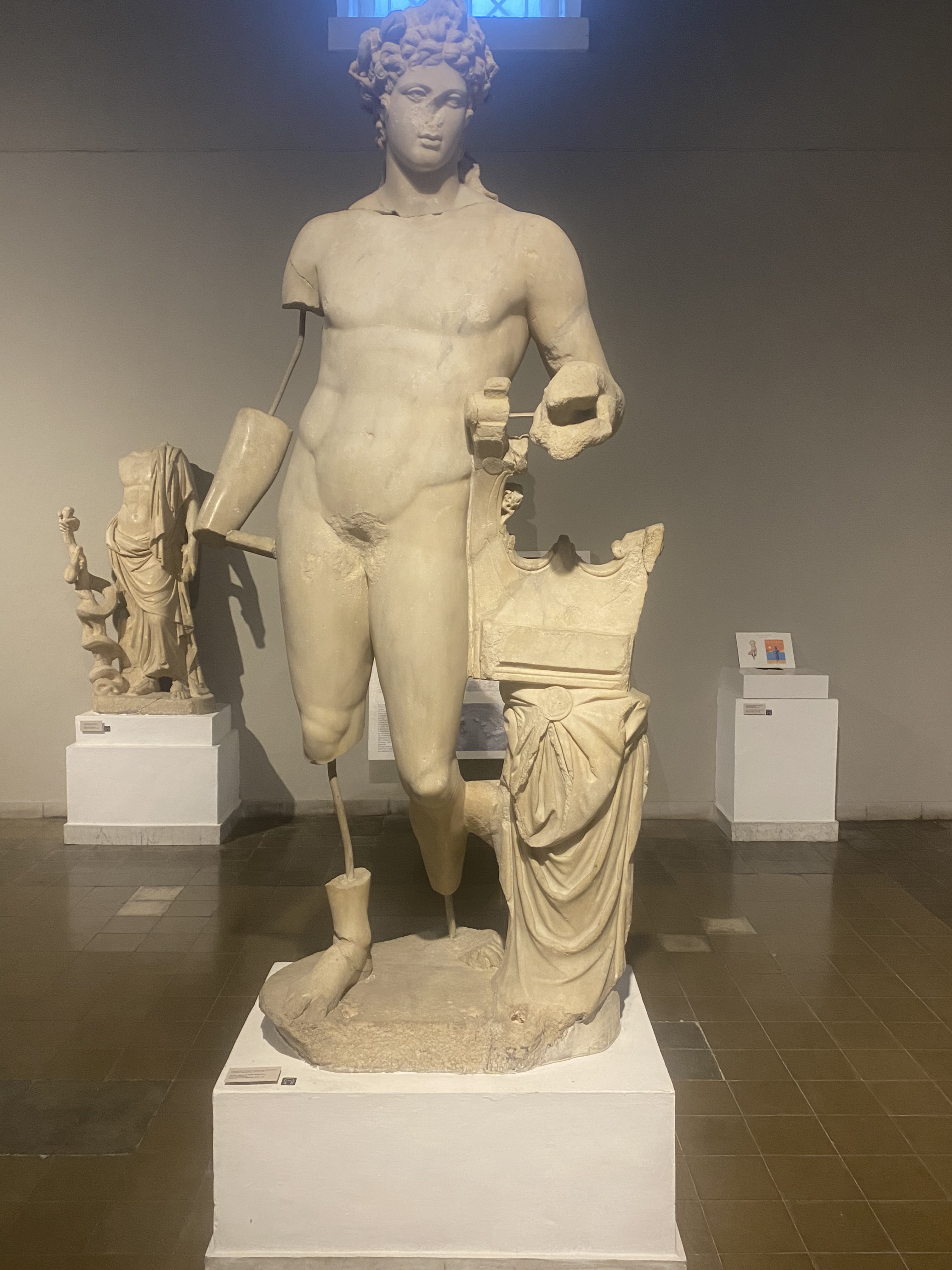
Last Saturday, as a school we visited the Cyprus Museum located in Nicosia. This museum is curated wonderfully as it takes you through the ages of Cypriot history and archaeology chronologically. There is even an exhibit entitled “Five” which introduces the visitor to the lives of five ancient people (this exhibit has already been written about by other students so I won’t go into too much detail). However, the room that stood out most to me was the room that focused on Greek deities.
Side note, Aphrodite was featured in various rooms and halls within the museum as she is important in Cypriot mythology and there have been many Aphrodite statues found in Cyprus. Other deities such as Apollo, Asklepios, and Zeus were only featured in one room.
The room’s feature is a statue of Apollo Citharoedus (Apollon Kitharoidos in Greek romanization). In the discussion of this statue I would like to touch on Greek mythology, the concept of titles and epithets, and, of course, the statue itself.
Firstly, the mythology of Apollo. There are two main misconceptions when it comes to the Greek deity Apollon. The first misconception is that he is the God of the Sun. There are very few attestations of Apollon being a sun god and they are almost always Roman additions. He is actually the god of light. The god of the sun is from the predecessors of the Gods, the Titans. Helios is the titan and personification of the sun. Apollon rules over much more than light. Plague, healing, music, prophecy, archery, and more. He is even the protector of young men, while his twin, Artemis, is protector of young women. Ruling over so many important domains, Apollon was certainly an important deity and is almost always considered one of the twelve major Olympians. The second misconception is that Apollo has the same name in both Roman and Greek, unlike many other Greek deities (i.e. Jupiter (Latin) versus Zeus (Greek)). His Greek name is more specifically Απολλων (Apollon) (please ignore that the Omega is capital, I guess wordpress doesn’t support a lowercase omega in this font) with an N at the end. The deletion of the N is the Latin spelling of Apollon. At this point in time, his name has widely been Americanized, pronunciation wise. In Ancient Greek, his name would be pronounced similar to ah-poh-lohn (IPA: [aˈpʰʌlʌn]). In the modern day, in America, his name is pronounced closer to ah-pah-loh.
Secondly, epithets. As you may’ve noticed the in title of this post, and the statue, Apollon has a second name. Apollon Kitharoidos. The second name is called an epithet; an epithet is an “adjective or phrase expressing a quality or attribute” of a person. Kitharoidos (Greek) or Citharoedus (Latin) means “of the kithara” which is now more commonly known as the seven-string lyre. Apollon has many epithets, likely due to the fact that he was a God of many things. His most important and most used epithet is Phoibos (bright) due to him being God of light. Titles and epithets can reveal much about deities we otherwise don’t know much about, as well as the direct translation of the deity’s name.
Fun fact: Apollon was not the creator of the lyre. Young Hermes was. The lyre was created from cow intestine and a turtle shell.
Thirdly, we should look back to the statue. The statue has clearly suffered some damage as we see the nose is missing, as well as parts of the arms and legs. This is typical for Greek/Roman statues as they are old and, obviously, somewhat buried in the ground, so these parts of the statue that stick out (like the nose) or are smaller/feeble (like the arms) break off. A statue of Apollon can be identified through his head. Specifically his hair/adornment. Apollo is represented as a beardless man/youth and his hair is often tied into a bow towards the front of his head. However, that’s not the case for this statue which brings us to the next step, head adornment. In this statue he has on a crown of laurel. This is an indicator of Apollon because he is actually the god of laurel. Another indicator that this is Apollon is simply the fact that he is leaning against his kithara. This is actually a Roman statue as it was found in the location where the gymnasium of Salamis was (city in Cyprus) and dates back to the 2nd century AD. Salamis was under Roman rule in the 2nd century AD. I can’t find any information on whether this statue is a Roman copy of a Greek original or if it is a Roman original.
Fun fact: Laurel leaves and Bay leaves are the same thing!
Well, I really hope everyone learned a thing or two about Apollonian mythology while reading this post!
Thanks for reading! – Hunter Powell
-
The Red Buoys
In two weeks of being on the island I have gone to the beach each and every day. When I first stuck a toe into the sea I was blown away by its warmth. The Mediterranean invites you in with its salty breath as its waves kiss the shore. I have never felt a body of water so reminiscent of an Epsom soak, soothing tenderly tired, overworked muscles. Some days though, by surprise waves are kicked up in the afternoon breeze and sand clouds the turquoise waters. Yesterday was not one of those days. The sea was calm and clear. So slowly, slowly I made my way out to the red buoys that provide me with a strange sense of security, like as long as I stay on the side nearest to shore, the Mediterranean will remain a safe space for me rather than a place which has claimed permanent ownership of many who set out with other destinations in mind. This is what I thought of as I made my way into the ever-deepening sea. For thousands of years people have been using the Mediterranean as a trade route, and Cyprus has played a crucial role. This is evident throughout the island with numerous ancient shipwrecks scattered all along the coast. For example, the Mazotos shipwreck dating to the 4th century BC which is located in the Larnaca district laying at a depth of 45 meters. This wreck consisted of dozens of wine amphorae and provides valuable information about trade routes and relations such as those between the Aegean people and those of the Eastern Mediterranean. Many more ancient wrecks like Mazotos fill the waters around Cyprus, and a great deal of resources and trained underwater archaeologists will be needed to really begin the process of scratching the surface of all that hides out beneath the stunning salty water. The next time I take a dip I will certainly be thinking about all that rests on the bottom of the sea and how much more we have yet to discover.
-Grace Simonsen
-
Enosis flag
Enosis, meaning union, is the political belief and movement that seeks to join Cyprus with Greece. I was aware of the concept before coming to Cyprus but I was interested to see that enosis was represented by a flag (blue-and-white flag pictured). I saw this particular flag flying in Nicosia right along the Green Line, and I didn’t recognize it. After some brief research, I found out it was meant to represent Cypriot unity with Greece. It was interesting to see so many of them in Nicosia right next to the Green Line.In my research for the enosis flag, I also came across a proposed flag for a united Cyprus which was proposed by a committee made up of both Greek and Turkish Cypriots. It’s a fairly simple flag with a small blue stripe at the top, a red stripe at the bottom, and a larger yellow section separating them. The blue and red are meant to represent the two largest ethnic groups in Cyprus, blue for Greek Cypriots and red for Turkish Cypriots. The yellow is a symbol of Cypriot’s abundance of copper which has shoved the island in historical importance for thousands of years (The name “Cyprus” could be traced back to the Sumerian word for copper). Unfortunately, the flag was rejected by Greek Cypriots, and both halves of the island continue to use their own flags.
audrey
-
Cyprus Coffee
Howdy! This is a post for all those who love to start, end, and fill in the gaps of their day with that sweet and bitter drink that perks us all up, coffee! Just a day walking around Cyprus and you will quickly see that coffee is available just about everywhere, but the coffee places you’ll see filling in the gaps between mini marts and kabab shops are rarely the cappuccino and latte menus were familiar with in the States. Here, the national drink of choice is Cyprus coffee. One of the first things I did when getting settled in Larnaca was go out and try one of these strong, dark drinks. I also knew when on the Northern side of the island I most certainly wanted to try a fresh brewed Turkish coffee. I accomplished both with ease, but to my surprise I could not tell the difference. Lo! I thought, Despite working in a coffee shop at home I have failed to tell these brews apart! But to my ignorant surprise upon a little digging, I found these coffees share nearly everything in common, all but their name, which did not come about until the split of the island itself in 1974. In fact, Cyprus and Turkish coffee share the same brewing process, both involving boiling a very finely ground bean repeatedly in a copper vessel, and being served in a small cup, which is slightly different than a traditional espresso cup to help keep some of thick sludge (not to be drunk) at the bottom. By some the remaining grounds are used to read fortunes. There are a few different ways to order your Cyprus coffee and you will likely be asked if you take your drink sweet, not so sweet, or without sugar. Cyprus coffee is meant to be sipped slowly and cafes will usually have at least a few chairs set out front. This is important because that coffee shop is where locals take time to gather, chat, gossip and both learn and spread news. You might notice, however, that most of the locals you see sipping at their brews are men. Coffee was introduced to Cyprus in the 1600s and coffee shops, known as kafenes, were and largely remain a male centered domain. This has of course changed as tourism has grown on the island and women’s rights have improved, however, you will still notice that it is men who are seated in the plastic chairs lining the sides of kafenes and women are largely far and few in between. If you want to blend truly blend in with the local crowd in Cyprus, grab yourself a Cyprus coffee, a cigarette, and enjoy the company of the local kafenes cat. I would totally recommend this drink in the early morning or as an evening dessert followed by a cold glass of water and a walk along the beach. Hope you find lots of joy in this long-standing ritual!
-Grace Simonsen
-
Washing Pottery and Getting to Our Roots
My first day of washing pottery made me feel a couple of different things. One of them was a sore back from all the hunching and scrubbing. Another was a deep connection to humanity, both past and present. Let me explain.
When my groupmates and I arrived at Terra Ombra, we were each given a bag of pottery sherds found at Vigla last year, and a wide, shallow, plastic bucket. Across the way was a metal water faucet coming from the ground where we could fill our buckets. We went and got our water, sat down cross-legged on a shaded section of cement, gently poured our pottery into our basins, and began scrubbing each piece. We sat in a circle. As we worked, we talked. “How was yesterday on site? How are you feeling? What’s going on in your life? What are your interests, your passions?”
It slowly occurred to me that we were doing what humans, often women specifically, have done for thousands of years: gathering water, sitting together, talking, and connecting while doing the washing. How many people before us have done this exact thing? Well, maybe not this exact thing. They were probably washing the clothing and maybe cookware of their family members, not other people’s old, broken dishes. But on our walk home, something that one of my groupmates, Annika, mentioned really struck me- how many of the women whose very dishes we were washing that day had sat and talked and connected in the same way that we just had?
Some things never change.
-Rachel
-
Doing Laundry in Larnaca
When you’re doing heavy manual labor 4-5 days a week for a month in a foreign country, it becomes necessary to figure out how to wash your clothes. Shaking them out on the balcony when you get home only helps so much- when you go back to grab them, they’re still covered in dust and sand, and more than a little smelly. Many of my classmates use the laundry service next door and, I have to admit, it looks convenient. The woman who runs it delivers your clean, folded clothing straight to the apartment lobby, often same day. She even wraps them nicely in a clear plastic bag; there may as well be a bow on it. However, the idea of someone handling my sweaty dig clothes kind of makes me want to die, and I had heard word of a coin operated laundry nearby, so I set out to find it and do my laundry myself.
My classmate Abby told me which shop it was close to, and sure enough, a place called Acropolis popped up on Google Maps a block away from there. Off I went with some 1 and 2 Euro coins and a bag of quarantined dig clothes. I hadn’t brought detergent because I had assumed there would be a way to buy laundry soap at the laundromat, maybe a vending machine with small packets of it or something. I was wrong. I went to a mini mart to see if they had detergent, and to my delight they had some vaguely laundry-looking bottle of liquid! I bought it, went back to the laundromat, and read the label on the bottle once there (helpful hint: most things are in English, but it turns out you do have to actually read the words). It was not detergent.
Okay, third time’s the charm! I went out to another mini mart, inquired with the clerk, and he asked if I was washing by hand or using a machine, as the soaps are a bit different. Everyone is very helpful here. After getting the right soap, I headed back to the laundrette, popped the coins in, poured the soap and the fabric softener (why not, I’m the proud owner now), and I had clean laundry ready in less than an hour! It was only 4 Euro. Drying costs 3 Euro but it’s honestly unnecessary. There’s a drying rack on the balcony, and the sun teams up with a light breeze to dry your clothes in no time. And now, after setting your clothes out there, you get them back clean!
-Rachel
Study Abroad in Cyprus
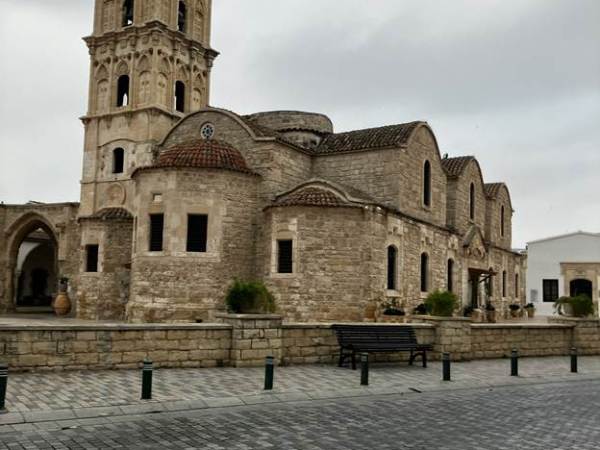
By: Arthur Pino Coming to the Old World is a new experience for me. I can say that, besides the luxuries and brands similar to those in America, it is quite different. This land has been inhabited for at least 4,000 years, according to the sign outside the Agio Lazaros (The Church of St. Lazarus).…

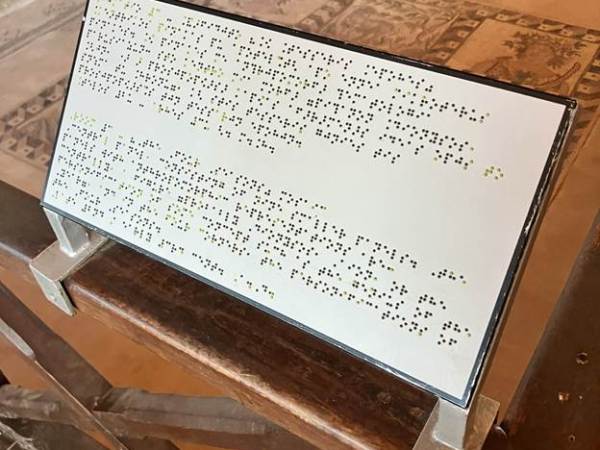
House of Dionysus
By: Arthur Pino On a field trip, we went to Paphos, where we were able to visit a “World Heritage Site.” This would be the second opportunity I have had to see one in my life within the last year; the other was Chichen Itza in Mexico. It was a very hot day, and walking…

A Big Discovery!
By: Arthur Pino Today was another hard but rewarding day. It was the first time I had worked in the trenches three days in a row, and I felt it. This day, in particular, revolved around hands. My hands themselves, and an accessory for hands. As usual, I did not wear gloves to start…

