-
A Puzzle Without a Box
Archaeological field work, especially when you are working on a new trench site, is much like putting together a puzzle without the box featuring a picture of the completed puzzle for reference. I have been working in the new trench, and for the last several days we have been terrae-ing and pickaxing. As we do so, Brandon, the supervisor, makes note of the different features we find. A row of stones that could be a wall or a stack of stones that could also be a wall. As we dig, we dig around these features and stones to get a sense of what the trench holds. It becomes easier and easier to see what the structure of the trench is. Today, after pickaxing and hoeing the ground for four days, we finally discovered five distinct structures in the trench. Each structure must be treated with its own context, which means as we dig, each of the five structures have to be dug and sifted, and artifacts found within them must be sorted separately. It is still not entirely clear what the site is, but so far it seems to be two rooms on one side with a large center area, a wall like structure on the other side of the center area and another wall like structure on the base of the center area. Below you can see a diagram which maps out the different sections of the trench. Hopefully, this week we will have a much better understanding of what these structures are and their functions. This morning, we really had no idea what was in this trench. By 12pm, though, we had discovered that there were five contexts in this one five-by-five trench. Hence, a puzzle without a box.
Madi Barber
-
Mediterranean Construction Work
Abbi, another MSU Denver student on this trip, said it best: “Archaeology is like construction work.” She was not wrong. As a non-archaeology major here on this trip, I had no idea what doing archaeology would look like, and Abbi’s synopsis pretty much sums it up. We get to the site every morning at about 6am and, in established trenches, we often start out squatting or kneeling in the dirt to clean off the site. This is vital as it can be difficult to see the features of the site when there is loose dirt everywhere. Then, depending on which trench you are in, you are squatting some more and carefully excavating the site. If you are in the new trench, where I have been, we have been pickaxing and terraeing the ground (think of it as hoeing the earth). All of the dirt that gets churned up has to be sifted in case there are any important artifacts hiding within. Field work is not for the faint of heart. It is physical and sometimes it feels excruciating. This type of work is so physical, I have muscles that are sore that I didn’t even know existed. With all of that said, it is also extremely rewarding. It seems like when the morale starts to dip is precisely when someone finds an almost intact bowl, or a giant lid for a pot. The incredible thing about this line of work is you truly are not sure what you are going to find. Finding it is also just the first part. After it is found, it has to be labeled and put into an artifact bag. For special finds, such as intact bowls or sling bullets, geographic points are taken so that there can be exact coordinates of where the artifact was found. It is then transported to Terra Ombra where it is cleaned off and washed and read by a ceramicist. Ceramicists are able to look at diagnostic pottery and identify not only what it was used for but also the approximate time period it is dated to. As more and more artifacts are found, points are taken and read; a clearer picture starts to form of what the site was used for in the past. Due to what has been found at our site over years of excavating, we know it was some type of fortification. So, while I am terraeing or pickaxing or sweeping in the hot Mediterranean sun, it often feels like construction work, but it is so much more than that. It is truly the care and meticulous excavation of who people were thousands of years ago.
Madi Barber
-
Creating the Sacred Through the Physical
On our final official field trip, our professors took us on a hike that they kept forebodingly referring to as a “death march.” How comforting. The archaeological site we visited was the acropolis of the ancient city of Amathus. And as beautiful as the view was, I have to admit I was a bit winded once we got to the top. It took awhile to get there and the incline was steep. It didn’t help that I had sprinted to get to the trailhead and was out of breath before we even started, but that’s beside the point. On the way up, I realized that our usually chatty group was a little quieter than usual. Maybe they were doing what I was doing- watching where I was placing my feet. The terrain was rocky and some of the earth was loose. Rocks were slipping underfoot and the edges of the trail were lined with scrubby, sometimes pokey, little shrubs.
Maybe my group was being, as I was being, a little more mindful with their breathing. It was a hot day. It was a steep trail.
On the way down, the feeling was much the same, and it got me wondering about the journey that worshippers would have taken to get to this sacred place. This acropolis was used for worship for thousands of years, by different peoples, with different practices. The thing they had in common was going to this place. They would have walked basically this same terrain, this same incline, in this same hot weather. I wonder if they felt the heat like this too, if they were out of breath. Did they walk slowly and measure their paces? What were they thinking about in the quiet? The journey from bottom to top would be a journey of anticipation. Maybe it would be one of meditation. It’s easy to imagine they would be thinking of what they were here for in the first place- worship.
I wonder if that’s part of the reason this site was used as a sacred place for as long as it was. It would naturally be treated as special because of how arduous it is to get to compared to other places nearby. Most people feel good after a nice hike. Maybe at the top, the temple had fresh water and snacks. I can only imagine how much the people would have cherished that relief after the journey. Mind, body, and soul. Of course they worshipped here.
-Rachel
-
Ceramic Dating
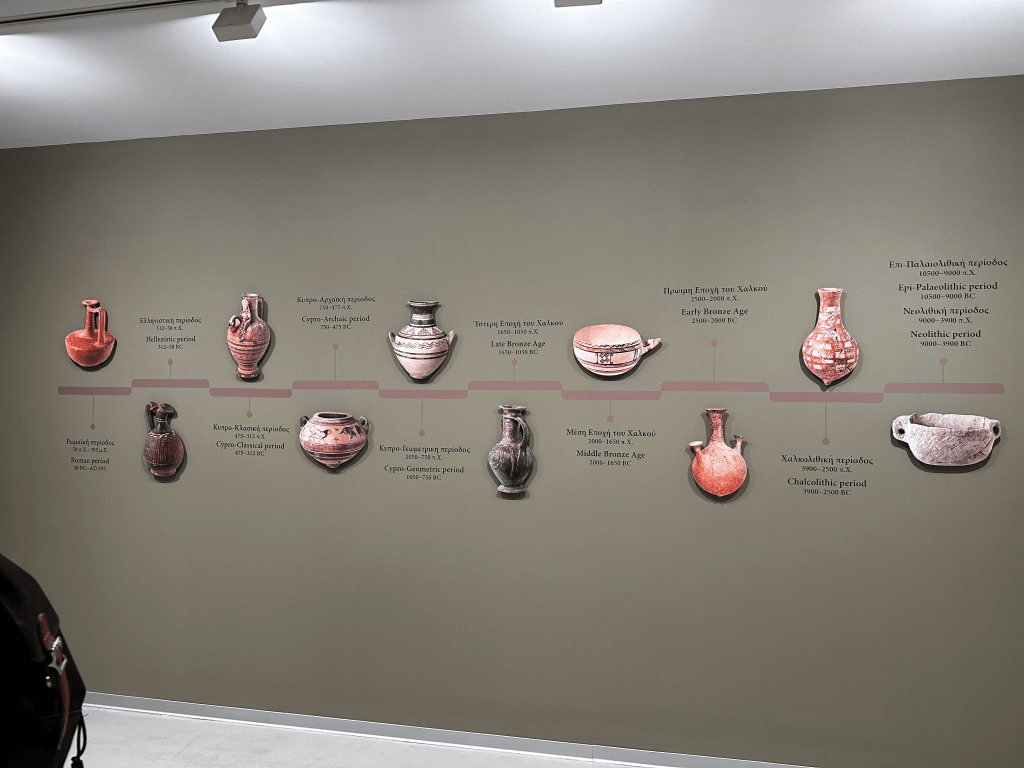
Anyone who worked at any point at Vigla during this season has pulled up and washed dozens of sherds of ceramics. Ceramics are the most common finds with most of them being non-diagnostic and difficult to read. I’m not going to pretend to know half as much about ceramic and ceramic dating as I would like to, but I have come to realize how vital ceramic dating is to dating the overall site.
Ceramic dating is complicated and seeks to understand ceramic trends in the Mediterranean and Aegean and connect them to archaeological sites. Dr. Mel likened it to water bottle trends in our day and age where a new type of water bottle gets popular in different time periods. You can take the waterbottles and trace a general chronology of the last few years with Nalgene being the oldest and Stanley Cups being the newest. Ceramics are also likely to be thrown out and be more accessible to lower classes, unlike metals like bronze or iron which would have been melted down rather than simply thrown away.
If we return to ceramics, how they are fired, what temperature they are fired at, how they are formed, how many times it is levigated, and the actual shape and form give us a basic chronology. The sherds of ceramics that seem to tell us nothing now can give clues about the chronology of a site. Paired with the position in stratigraphy and metalworks, the puzzle begins to come together. With our site specifically, there is a large amount of Late Roman and Byzantine in the topsoil stratigraphic layer that isn’t found deeper into the stratigraphy. This is the intersection of ceramic dating and stratigraphy and from this, we can conclude that Roman influence is nonexistent at Vigla
Beyond chronology, we can understand which groups came into contact with Vigla. This is also a difficult process as cultural exchange and overlap are hard things to track. Ceramics often bear clues to their original home with inscriptions but also the actual design of the pottery. Attic fine ware pottery, for example, is a very finely levigated pottery with a fine fabric and a black, glossy glaze. I have found a few pieces from our own site while washing pottery. Often, our pottery sherds at Vigla are domestic but eyeing the occasional imported good is important for determining the purpose, international connections, and importance of Vigla
I enjoy learning more about the ceramic sherds I pull up, even if they are not as exciting to me as they were at the start of this trip. I’m happy to be somewhat more familiar with ceramics even if I really don’t know that much. I know more than I used to so I’m satisfied with that.
audrey
-
The Warlike Aphrodite
I have never appreciated Aphrodite nor had much desire to learn about her and the religion focused around her. I had only ever encountered a version of her which focused on love, sex, and beauty. Think Titian’s Venus of Urbino or Cabanel’s The Birth of Venus. This is a very limited and very modern view of Aphrodite. Her origins are much more complicated and layered. She has many faces and many aspects, and I would like to take the time to unravel these.
I’ll begin with one aspect of Aphrodite that we all many be familiar with: Aphrodite’s association with the sea. We often see Aphrodite depicted coming out of the sea with the sea foam curling around her strawberry blond hair. In Hesiod’s Theogony, Aphrodite is born from Uranus’s severed penis being thrown into the sea and the subsequent foam from it. Aphrodite is the Greek version of the Phoenician goddess Astarte who was sometimes associated with the sea. The Phoenician Temple of Astarte at Ancient Kition is located close to the where the ancient shore was and was likely a stopping point for sailors to stop at to gain protection for their sea voyage.
However, Aphrodite’s main sphere of influence would be fertility, and it would be the most consistent aspect with regards to Aphrodite. Fertility is a broader arena than we might think. It includes sexual reproduction which is obvious but, in the case of Cypriot Aphrodite, it extends out in the abundance of metal. There is a particularly statuette of Astarte that depicts her standing on a copper ingot. Beyond this depiction, the Temple of Astarte in Kition would have copper metallurgy as part the sacred space which further places copper in Aphrodite’s sphere of influence. In later Classical versions of Aphrodite, she would still be linked with metallurgy due to her marriage with Hephaestos who was the god of metalworking among other things. Despite this point far from being a major part of her sphere, Aphrodite has some connections to metalworking which tracks with her connection to Cyprus, a island known for its copper.
Aphrodite’s character is best described by the word war. As previously noted, Aphrodite is a goddess derived from Astarte and Ishtar who both would be associated with war. Egchelos, or “the goddess with the spear,” was another name for Aphrodite who had a deep ferocity to her character. She was never a mother goddess trending after her children, but a passionate and furious goddess. War, I think, describes Aphrodite well. Her control of the stormy sea and the crashing emotions of human sexuality can be best described to me as warlike. The notion of her sitting delicately on a sea rock, not a single blemish or hair out of place, completely contradicts Aphrodite’s associations and complexities ad a mythological figure. It is no wonder they call her “the Great Goddess” of Cyprus for she dominated their sea, controlled the fertility of their metal and sexual relations, and was one of their war deities. Most of Ancient Cypriot life would have been slotted under her control, so it’s no wonder she had three major sanctuaries on the island.
I have learned a lot about Aphrodite while I have been here in Cyprus. I am most fascinated by her furious nature and her deep connections to metal, war, and sea-fairing. None of these things I would associated with Aphrodite before this, and I have appreciated the nuance within her character.audrey
-
Watercolor Interpretations in Cyprus Museum, Nicosia
When visiting Cyprus Museum, amidst all the incredible archaeological finds, it was hard not to notice the lovely watercolor paintings in front of many of the exhibits. Sometimes, the painting was displayed even before the description of the artifact, as you can see in this photo of a limestone base or altar.

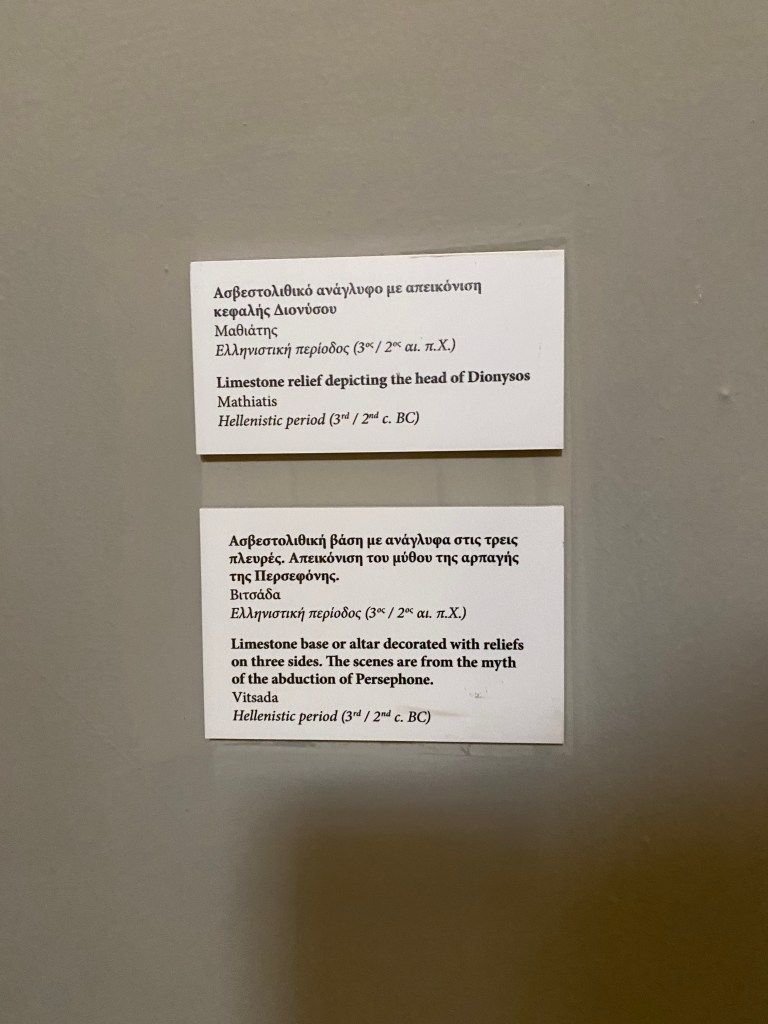
It had me wondering about why the museum chose to exhibit the artifacts in this way, and what “prompts” they gave to the artist. Did the curators ask for something in particular to be painted? Did they just give a general vibe that they wanted? How much latitude did the artist have? What was being depicted? How did this relate to what was being displayed? I had read a bit of info at the start of the museum about this exhibit, but I still had these questions. Dr. Stephens bought a book from the gift shop about it, so I had a good start.
Upon reading this book, I’ve learned that the watercolor artist, Katerina Attalidou, approached the Cyprus Museum to propose this project, called In the Same Place. She had been coming to the museum for years, visiting the exhibits, and wanted to deepen the connection she felt toward them. Attalidou’s work seeks to add back the context of “place” for viewers of the museum’s items. To accomplish this, she travels around the island to the places where the displayed artifacts have been uncovered, and paints the beautiful scenery she finds. Efthymia Alphas, the Archaeological Officer at the museum, describes this work as “bridging the ‘gap’ formed when an archaeological object has been removed from its find-spot and is displayed in a museum exhibition space.” These watercolor landscapes added a lot of beauty and context to the artifacts, and I feel lucky that we were able to catch the exhibit.
-Rachel
-
It’s a Great Day
I learn something new every day in Cyprus. Like how Maratheftiko is an ancient variety of red grape still used for wine production on the island, or that there is a kind of feline COVID going around taking its toll on the local cat population. However, one thing that becomes clearer to me every day is the importance of connecting and collaborating with the group of archaeologists you are working with. Archaeology requires communication, without it digging a large hole into the earth in uniform fashion would be nearly impossible. It takes honesty with oneself and others. You must be able to say when you need a break, or when you need someone to bring buckets without feeling like doing so is a burden and without making those you are asking for help feel used or unappreciated. You are working and living in close quarters. In my case sharing one bathroom between six people takes a special kind of coordination in itself. I am learning that archaeology takes self-awareness. It is crucial to be aware of where your body is while in or around the trenches, as well as how your personal objects, attitudes, or habits impact others. Open communication is one key to success here. Taking nothing personally is another. When someone tells you a piece of pottery does not look clean enough, try to find gratitude for their close eye, it will after all make the job of someone else down the line easier. Don’t be afraid to tell others that you like to live in a clean space or that you are sensitive to smells, loud noises, or bright lights. These are often easy things to adjust that, while maybe a little annoying at first, will make everyone much happier in the end. Collaboration means both offering your help even when you don’t really feel like sifting another bucket and also being honest about when you really just need an afternoon of introversion. It is unlikely that you will become best friends with everyone you are working with, but at the end of the day there are few other settings in life that provide you with the opportunity to work with others who are in a similar position in life and sharing a similar passion, so I would say to do your best to find something to connect to and relate to with all those you are working with. Simply starting the day with a smile and good morning can do a lot to set the mood at the dig site. Be happy for those who come across a find, it really is a cool thing, and here on Cyprus your time is almost certain to come. Take care of yourself for the sake of those you are working with. It is so important to get a good nights sleep, to stay hydrated, to fuel your body with healthy foods, to do what makes you feel rested after a dig, be it going for a swim, taking a nap, reading a book, or doing some stretching. Being in the field takes a lot of work, mentally, physically and emotionally. It is important to respect that and the best way to do that is by communicating with others and being willing to collaborate to create a plan and experience that works for everyone. Being flexible, mindful, and grateful for the experience that is each new day will make your time in the field a much more enjoyable one, and will truly help to make every day a great day.
-Grace Simonsen
-
Lokmako
My first day on the island of Cyprus, I was stressed out and jetlagged. The fact that I was here on a tiny island in the Mediterranean had not hit yet. A group of us after dinner were wandering around Larnaca when we came across Lokmakos, which at first looked like a nice place to get gelato. As we perused the menu, we realized that it was not just gelato but handmade donut holes served with gelato. Behind the counter we could watch the staff fry these small dough balls as the desserts were made to order. I ordered the Cyprus classic, which was the donut holes or Lokma with a sugar coating, honey, and vanilla ice cream. We all waited patiently for our Lokma and when they were handed to us, we went through a back door of the shop which led to a beautiful courtyard. We sat on a stone structure in the middle of a stunning courtyard and tried our Lokmakos. They are the best dessert I have ever had. They are crunchy on the outside and doughy on the inside and the gelato pairs perfectly with the small donut holes. As I sat there eating my Lokma it finally hit me. After all the investigating, planning, and brutal travel, I had finally made it to Larnaca, Cyprus, an island that is full of a mix of so many peoples and traditions. I was sitting on stone eating a food that has been tied to 13th century Arabic cookbooks. Lokma is a dessert with a deep history. It is mentioned often in One Thousand and One Nights and was made by palace cooks during the reign of the Ottoman empire. It has traditionally been served as fried dough balls soaked in honey or syrup. Not only does it have origins in Arabic culture, but it also served and tied to Greek, Turkish, and of course Cypriot culture. Lokma are an important part of the food cultures for these countries. On a whim I was able to try these amazing donut holes that connect me to the culture of many people over thousands of years. I am so very glad I decided to stop at Lokmako as not only did it bring me to the reality of being on this island but they are absolutely delicious.
Madi Barber
-
Eustolios’ baths
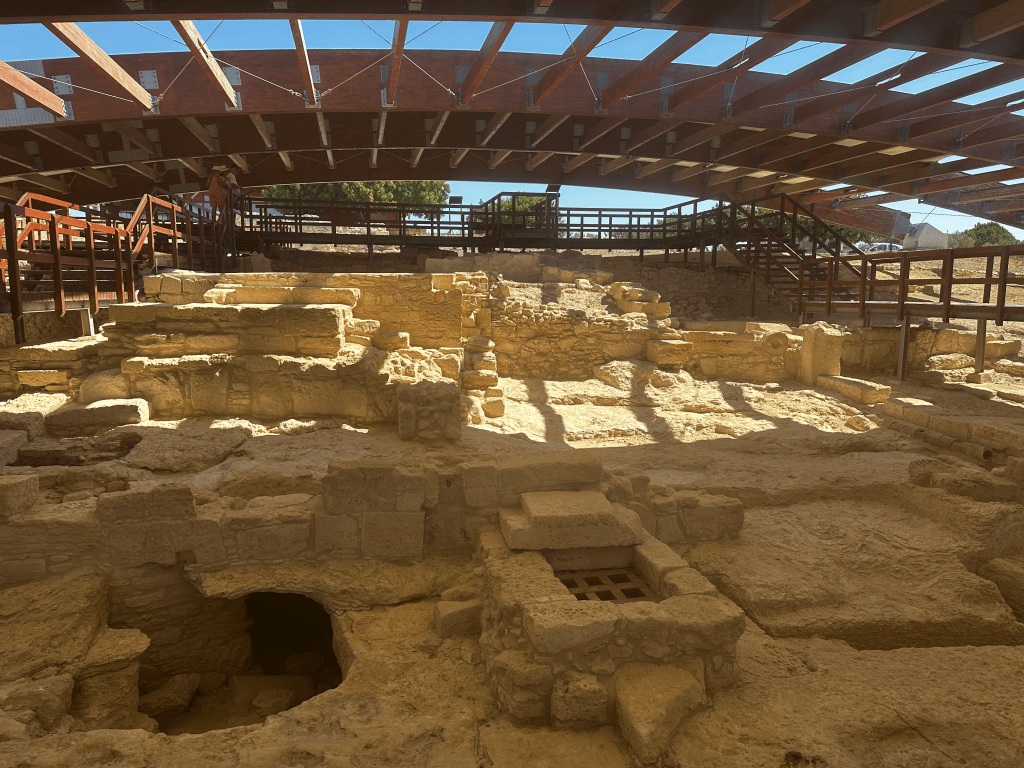
At the ancient site of Kourin there are a series of stunning floor mosaics that depict various geometric patterns and animals. They are part of a larger complex made up of a private house and a public bathhouse which were owned by a man named Eustolios. Eustolios’ complex would be remodeled during the reign of Theodoius II which was towards the end of the Roman Empire at 408-450 CE and a time of religious change. Prior to renovation, Kourion would be hit with a devastating set of earthquakes from 365-370 which would leave much of the city destroyed. These two factors would provide the backdrop for the mosaics: an empire slowly leaving behind its pagan past to embrace Christianity, and a city devastated by natural disasters.
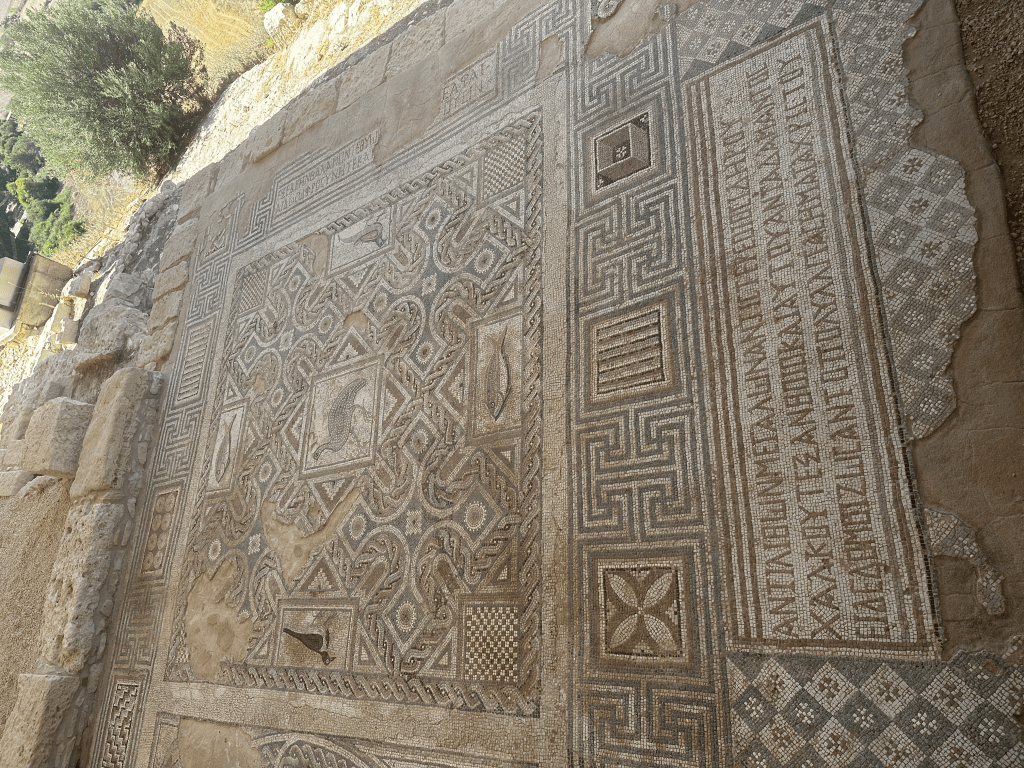
With an undertsanding of the background, let’s turn to the actual content of the mosaics. There are several Greek inscriptions within the mosaics that give us much of the context for them. One says,
“The citizens of the Kourion, who once had considerable wealth were now in abject misery. When Eustolios saw this he did not forget his land, but naturally remembered her with love, presenting the city with baths. He indeed took care of Kourion, and Phoebus had once done, by restoring calm in the earthquake-struck land.”
This inscription gives us the sponsor of the mosaics and the bathhouse (Eustolios) as well as his reason for creating them. It was a act of charity for the citizens of Kourion. This is tender context for the bathhouses; A private house that would converted into a public place of rest in trying times. There are other clues to be taken from this inscription, but there is an unexpectedly human act of kindness within it as well that I think should be acknowledged.
We will move onto a less sentimental note within the inscription: the mention of Phoebus Apollo. Although not surprising in a Greco-Roman city, it is surprising given the timeperiod. This is after the Roman Empire is Christianized, and paganism is slowly being shut out. The mosiacs become more perplexing when we consider another inscription from the bathhouse:
“This house, in place of its ancient armament of walls and iron and bronze and steel, has now girt itself with the much venerated symbol of Christ”
Eustolios had mentions of both Christianity and paganism in the mosiacs, not opposed to eachother but harmonizing. Despite the massive cultural shifts and the uprooting of pagan religions, paganism still had deep bonds with Roman culture. This is further shown by other mosaics built around the same time in Kourion that also depict pagan literary elements and culture. The mosaics at the complex of Eustolios give a stunning picture of the slow cultural transition from paganism to Christianity. Despite Christian emperors and the abandonment of pagan temples, pagan culture remained in the minds of the people.
I am reminded of a book I read last year (Shout-out to Dr. Stephens!) which had a section on Christian tolerance during Constantine’s reign. Constantine would be similar to Eustolios where he would uphold the Christian faith and support the Christian Church while also leaning on pagan symbolism. Christianity’s spread throughout the Roman Empire was remarkable quick but it was not a destructive wave that obliterated paganism within the Empire. Greco-Roman paganism would continue to permeate the minds of the Roman Empire and its successors, and it would never quite lose its grip.
audrey
-
Important Questions With No Clear Answers
As we made our way from the Archaeological Museum in Paphos a few days ago a man called out as we filed onto our large white tour bus, “where are you from?” he asked. We informed him we were all from America and he proceeded to share with us something he clearly felt passionate about. “You know what they don’t tell you in those museums?” hmm I wondered; this seems like it will be fun. “What they don’t tell you is that Americans, the British, Italians, they have all taken what belongs here.” I felt deeply for his cause immediately. He is right, Americans, Brits, Italians, the French, Greeks, Dutch, and many other nations have long been staking claim to artifacts which did not originate in the nations they are now being held in. What are the consequences of this? What does it do to a nation to have artifacts removed and placed in another state’s museums? I have been pondering these questions and others over the last few days. Firstly, I think it is important to recognize the value of an artifact. Seeing these ancient reminders of past individuals, communities and cultures in person brings them to life with striking color. It simply has a different impact on the viewer than it does to read or see a photo of pottery, sculptures, or coins cleaned up and brightly lit on display. I have thought about being a young Cypriot and only seeing a handful of the artifacts that had been unearthed on this rich island still available in the city museums, and then being told that originals or more extravagant objects are on display in a museum across the sea or on another continent entirely. I think I would feel sad, and I would feel hurt. Sure, it is neat that others see them in fancy Metro Museums in London or New York, but would more people come to Cyprus (would more Americans be aware of its existence) if they were informed of their uniqueness but forced to make the trip to actually see their beauty in real life? Ultimately, I do not know. However, I do think it is wrong that nations have taken what belongs to the island and after so many years still hold onto them as if they were theirs to keep. I think Cyprus could be a richer nation if what was found here remained here. This has led me to wonder about how archaeologists in the field feel about this subject. Do they advocate for the return of artifacts to their original points of discovery? Do some feel it is actually more valuable to disseminate artifacts than to keep them in the countries where they were found? While everyone is sure to feel differently about this, and they are questions with far from clearly defined right or wrong answers, I do think it is extremely important that we as students of archaeology be thinking about them as we participate in unearthing objects that have remained in Cypriot soil for thousands of years.
-Grace Simonsen

Study Abroad in Cyprus
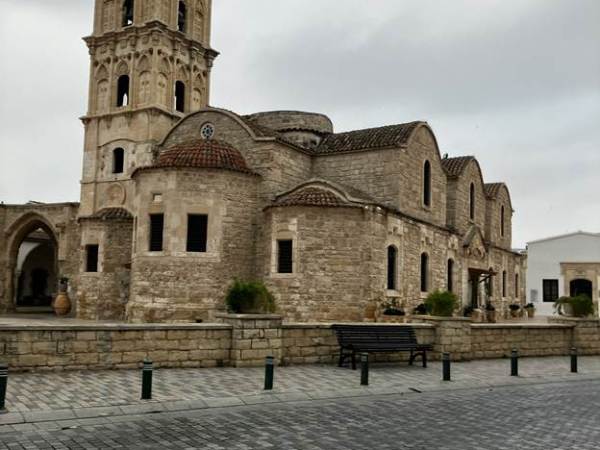
By: Arthur Pino Coming to the Old World is a new experience for me. I can say that, besides the luxuries and brands similar to those in America, it is quite different. This land has been inhabited for at least 4,000 years, according to the sign outside the Agio Lazaros (The Church of St. Lazarus).…

House of Dionysus
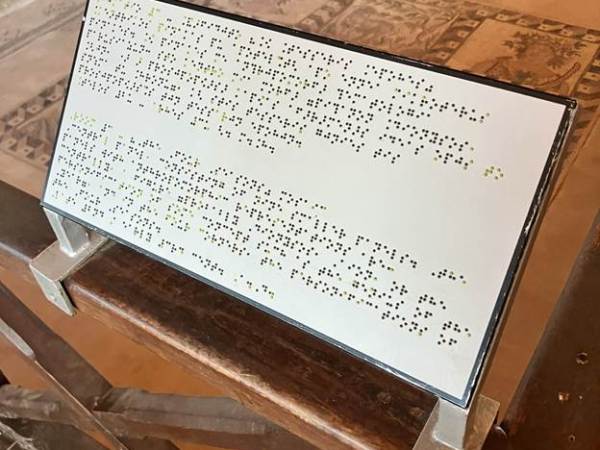
By: Arthur Pino On a field trip, we went to Paphos, where we were able to visit a “World Heritage Site.” This would be the second opportunity I have had to see one in my life within the last year; the other was Chichen Itza in Mexico. It was a very hot day, and walking…

A Big Discovery!
By: Arthur Pino Today was another hard but rewarding day. It was the first time I had worked in the trenches three days in a row, and I felt it. This day, in particular, revolved around hands. My hands themselves, and an accessory for hands. As usual, I did not wear gloves to start…

