-
The Wall
The same day that C Team was formed (see my previous blog post titled C Team), I also helped clear the wall. Dr. Olson arrived on site and his focus for this season was to excavate part of the fortification wall that is on the Vigla site. The other four trenches are right next to each other on a relatively flat hilltop. The wall is on the hillside, which means all of the terraeing, clearing, and digging happen at an angle. C Team’s task was to help clear a 2 by 5 trench to excavate the wall. This is quite small compared to the five by five trenches, and of course it is on the side of a hill. So, we carefully walked up and down the hillside as we cleared the wall. Gravity was very helpful when it came to clearing off the brush, but very unhelpful when it came to walking buckets of dirt off the hill to be sifted. After clearing it, all of the C team stayed to work on the Wall. There are two contexts for the wall. There was a lower trench on the outside of the wall, and a trench closer to the top of the hill which was on the inside of the wall. The bottom trench was closed quickly, as after digging and sifting 90 buckets the floor was found and only a single piece of pottery. It was known to C team that we probably would not find the cool intact pieces of pottery that were being found in the main dig area. After what happened on the bottom trench, we thought we might not find anything. I was assigned to the top trench. It is a small area, so really you can only have two people in it at a time. So far, it has been a round of pickaxing followed by a round of sweeping up all of the dirt so it can be sifted. We have found a lot of shards of pottery, which is a good sign as it illustrates that the top of the wall had a lot of human activity. For those of you wondering, the wall was where C Team parted ways. Both of my C teammates went back to the main trench. This is because they are way more likely to find something on the main trenches. I have stuck on the wall. Although I will likely not find much here, I like being in a smaller group of people and the wall itself is exciting and challenging. I do not think I would have ended up at the wall without the formation of C Team. So, for that I am very grateful.
Madi Barber
-
Note-taking
I struggle to take good notes. Notetaking is fairly difficult for me mostly because I struggle to put all my thoughts down on paper. It takes several editions before my class notes become legible if I even take them. Normally, my process consists of me scribbling down all the information I hear and maybe going back to edit and clarify. However, I have come to realize how important it is becoming to take more detailed and clean, clear notes on the site. I often come back to start my blog posts which little memory of the day. I knew exciting things happened but the details within the layers of the dig have vanished in my mind. It was not so harmful at the beginning of the dig as I was being bounced around from trench to trench, but now that I’m settled I want to remember the process of the dig, the stratigraphic units, and the finds.
I have found it useful to take pictures (if I remember) and collect my thoughts at the end of the day. I have been trying, with limited success, to then draw those pictures along with any specific notes from the day. I have found that in re-drawing the photos, I am able to better understand the actual layout of the features, the position of the stratigraphy, and the locations of the finds. Drawing somehow bridges the gap between the reality of the trench and the abstract description and narative of that trench. Sketching comes much easier to me than narratives so having a sketch that simplifies the trench while also documenting the excavation process during the day seems to help me actually take notes.
This is a process I will have to work through. I have enjoyed carrying my little notebook around to document my thoughts and experiences on Cyprus.
-audrey
-
Rubbing Elbows
Archaeology is a small field, and archeology on Cyprus is even smaller. Archeology has always seemed quite large to me, possibly due to my own feelings of intimidation about the field. I was particularly struck by this when I came across Terra Ompras for the first time. I had been told it was “a museum” which made me think of the Denver Art Museum or the Colorado History Museum. I had thought it would be a crisp, modern-looking building that had air conditioning blasting a bit too cold for my taste. Terra Ompras is not like any of those museums: it’s small, old, and doesn’t have air conditioning. However, I was not disappointed by it by any means. There was an open excavation in the middle of the complex and dozens of stone sarcophagi everywhere, both of which made me very excited. Although air conditioning would be nice, Terra Ompras was better than I expected in many ways.
One element that I liked about the place was rubbing elbows with people whom I could have never expected to meet. Once, while we were diligently scrubbing away at pottery, an elderly woman pulled up to the Terra Ompras. She came over to our little corner of Terra Ompras and said good morning. We all said good morning and asked her what she was doing at Terra Ompras. Most of the archaeologists we had seen had been focused on their work, only sparing time for a quick “good morning.” She introduced herself as Maria Hadjicosti, the former director of the Department of Antiquities, and explained that, though she had been retired for ten years, she still liked to be involved in the digs around Cyprus. She asked about our dig which we were pleased to tell her all about (or as much as we could). She was too busy to sit a chat for long, but her quick visit made a college kid from across the world feel a bit more connected to the archeaological community on Cyprus.
Terra Ompras is a place of community whether it’s the community between my classmates, peers, trench supervisors, professors, or other archaeologists. Sometimes it’s frustrating to be in such close quarters, but often it’s rewarding. I have enjoyed the conversations I’ve had at Terra Ompras about fields of study and academic passions. I’ve learned more at Terra Ompras just from conversation than I could from some textbooks and much of that learning was done slumped over a bucket of muddy water. Many blog posts have noted the importance of community in archaeology and nowhere is that lesson more clear than at Terra Ompras. It may not be fancy but there’s a lot of good work being done at Terra Ompras and that is more valuable than air conditioning
audrey
-
Gatekeeping
I have a bit of an “I’ll just do it myself” attitude. Most of the time, if I have a question, I tend to just shrug, figuring that I can just look it up when I get home. I have never known a world without the Internet and the subsequent endless amounts of knowledge that you can get with little effort. I know how to research after all so finding what I need shouldn’t be that hard. I have found a large stumbling block in my usual method in that I cannot simply look the information up when I get home. I have often left archaeological sites overwhelmed by the information and desiring straightforward information about the sites I’ve visited, or at least online versions of the information at the sites. Further, I often get confused about concepts or practices on our own site, and I attempt to look up how archeaological sites’ work. However, there is little in-depth research or advice that is actually accessible. It is sad how much the information around many of Cyprus’s archeological sites are locked up in small, weathered signs on Cyprus, or behind $90 paywalls. There are two elements to note from this phenomenon: the inability of the layman to gain access to archaeological information, and the networking required for archeaological research.
I have found in my daily life that many of my friends and family have absolutely no idea how archaeology works. I have had to answer many a question about how the dig functions and operations, what time period we are digging in, and, my personal favorite, where Cyprus even is. There is a broad lack of understanding for ancient history and archeaology, and it is likely particularly due to the lack of accurate information available to the layperson. One solution, if flawed, is the rise of podcasts that lean on experts to relay information in a clear and accessible way. This is not perfect as misinformation or sensationalized information can easily be spread with much done to correct this information.
One positive I have found is that I have been forced to lean on others for their information and actually reach out to the archaeological community. This has forced me to ask questions and have conversations that I would normally avoid. Although I dislike how difficult, and often expensive, it is to find the information I need to satisfy my curiosity, it has forced me to reach out to other people and listen to their information and advice. I will forever proclaim, “No gatekeeping!” but not at the cost of the community.
With love… of course :).
audrey
-
Chapter Four: A Mosaic Incites Fears of Climate Change
I have been fortunate enough to see a lot of mosaics in Cyprus. Grandiose stretches of tile spreading across the ground, open to the air or tucked inside structures. Mosaics depicting deities like Zeus and Aphrodite, or mythic legends like Achilles. Even gladiators fighting each other on the floor. I stop at each one and think about how lucky I am to get to see them live and in person. Someone fit those tiles together to make a place for people to walk, yes, but also because it was art, and that is always something people have done. It will never stop amazing me, that people have always liked things to be pretty. I think it is the most human things ever, to want to walk in beauty. To take that beauty in.
My favorite mosaic is the Four Seasons mosaic at Nea Paphos.
It captured my attention instantly. Patched together like a quilt, it is nine squares of tile. Each corner has the face of a season, personified. In between are symbols of the seasons, and in the middle another face, maybe Dionysus. It was his face that captivated me. It’s not terrible realistic, but it’s captivating all the same. The winter face is haggard and cold, with a scraggly beard and tired eyes. The autumn one is warmer, sepia toned and proud, boasting from a plentiful harvest. Spring is donning a floral crown, and Summer is mostly faded away, but you can still see her smile.
I think I liked this one the most because I can picture myself as a child, walking on it like it’s in my own house, entranced by the faces looking up at me. I remember learning about the seasons in preschool. It’s one of the earliest ways we learn to understand the passage of time, because we live in it so solidly. We change our clothes depending, and our routines change with the seasons, too. It’s more abstract that months or days of the week, but it’s dependable. Mostly.
I found myself wondering if there will be people who come to see that mosaic who won’t remember what it’s like to see the seasons change. With climate change rapidly forcing humans to evolve and adapt to harsher conditions, how do we know that this mosaic, one that has thus far stood the tests of time, remain relatable?
We watch the baby animals emerge in the spring, watch the birds fly south for winter, wait for the harvest in the fall, live in the sun in summer. It’s all right there, cemented in tile from a thousand years ago.
But what if one day, we need to write a longer description of the mosaic on the plaque that overlooks it?
It’s strange to think that the most understandable piece in the entire sea of mosaics might one day be misunderstood.
I had to take a break from the whataboutism and just appreciate that I wasn’t just looking at the past when I saw that mosaic, but the present, too. I’ll leave the future for the future. In the meantime… pretty tiles.
-Abby
-
Chapter Three: I Feel Deep Emotions Over A Rock
I can tell that Tom does this bit every year. He seems so excited to do it, bouncing on his heels as he leads us to the tiny room inside of the old sugar mill.
“We’re going to see Aphrodite. We’re going to see her as they worshipped her.”
And to tell you the truth, he had looped me in a little before we walked in.
“It’s not what you’re gonna expect.”
But even thought it was funny when we walked in and Tom pointed at this giant black rock that looked like a nose and said, “That’s Aphrodite.”
I understood completely.
I can’t count the number of times I’ve gone on hikes or walked beaches or even just wandered around my own neighborhood and found a stone or a shell lying on the ground and felt moved.
A sign from the universe or God or whatever, lying there waiting for me to find it.
I can imagine it was maybe the same for the Cypriots who saw that rock. Because when something so ordinary can make you feel that way, like you can find something in it that makes it seem like more than it really is, that’s special.
Although the Aphrodite the Cypriots worshipped isn’t the same Aphrodite we know from the classic Greek myths, the sparkling woman who walked out of a shimmering sea, there is still something to be said about putting Love above all else.
The Athenians worshipped Athena, goddess of war and wisdom. The Roman turned their eyes towards a savior in Christ. It’s all so bloody and grim. Which isn’t to say love can’t be that way, too, because it can be. But the intention of love is peace. What’s more peaceful and solid and strong than a giant rock?
So it made sense to me. And I looked at that big rock for a while, and I started to love it, too.
-Abby
-
Pita Bread
For all my fellow vegans out there, let me tell you that you will not go hungry in Cyprus! There are incredibly fresh fruits and veggies, falafel galore, a delicious selection of nuts, and pita bread, pita bread, pita bread. These tasty flat breads can be found in every market and stuffed with just about anything you desire, and you have options when it comes to the kind of pita you are looking for. While sharing a common name, Cypriot pita differs from both Greek and Lebanese pita, and it is no surprise with a 4,000-year-old history in the Mediterranean that this delicious dough has taken a unique shape depending on its geographical location. Being closest together on a map has also resulted in Lebanese and Cypriot pita being more similar than Greek pitas. Cypriot pita, like Lebanese pita, is thin and oval in shape compared to Greek pita which is thicker and circular. Unlike Greek pita which is rolled, Cypriot pitas are stuffed with food, and while Greek pita is usually grilled, Cypriot pita is baked. A vegan Cypriot meal that I have found to be very common, tasty and often very cheap is a falafel pita. Served in the Cypriot fashion it is stuffed with fresh tomato, cucumber, parsley and if you are lucky hummus or the most delicious tahini I have ever had. Pita bread is an obvious staple of the Mediterranean and I think I have eaten it nearly every day on Cyprus so far. I have found it great for a snack with olive paste, or heated in a toaster, on the dig site with some sliced peppers, or even (for an American twist) with some PB&J. Eat it while you’re here and eat it quick! While it is a delicious and easy treat, make sure to either be ready to eat a lot or share with a friend because they do mold with absurd speed! The humidity of the ocean takes its toll on any bread, but I have found pita to be particularly sensitive and best enjoyed fresh. I hope your time in Cyprus is filled with amazing flavors, tastes and experiences, and from one vegan to another, you will definitely find plenty to eat.
-Grace Simonsen
-
Chapter Two: I Earn Some New Battle Scars
There is a bruise on my right forearm right where the handle of the pick axe digs in when I swing it down into the dirt. It’s decorated with dainty little scratch marks, framing it like a picture. It hurts when I press it with my fingers, but not when I lift the pick axe up and bring it down again.
All of my nails came off week one. I got them done the morning I left, short and clear and with stars painted onto my ring fingers. I asked for the toughest gel, so they’d last all month long. They popped off easily, evacuating themselves from my real fingernails like they’d never even been attached in the first place. I tried filing them down to keep them tidy, but not even my gloves can halt the buildup of dirt caked beneath them. I bite at the scraggly ones when no ones looking, and even sometimes when they are.
I have blisters on the bottoms of my toes, a little bubble on the base of each one. It hurt the first few days, but now they’re all calloused over. Still sensitive when I walk, but I don’t even notice anymore. I think about the legend of Johnny Appleseed and roll my eyes. Barefoot over grass is nothing compared to the friction of my boots and wool socks.
I reapply sunscreen constantly, partly because I’m scared of burns and partly so my skin looks soft and smooth as long as it can. But my forehead is rough, no matter how much I scrub at it with soap. The sun leathers you out no matter how much you try to stop it. I may be tougher than Johnny Appleseed, but I’m not tougher than the sun.
I see my classmates change, too.
We all complain about the way our hair never feels fully clean. It’s always waxy, coated in dirt and sunscreen and sweat and something unfamiliar and mildly alarming. We dunk our heads under the salt of the ocean and let it all clump together. And we put it up when we’re trying to look nice. But we all sort of look nice anyway, skin golden from the sun and eyes happily tired from hard work.
We reach for Band-Aids less and water more. We watch the planes come in over the ocean and think of how long ago it seems that we were doing the same thing, gliding over the Mediterranean to a place that would give us bruises and blisters and gross hair and broken nails.
Everything I did before, to prepare for this, feels like another lifetime ago. Maybe the sun has cooked my brain, or maybe it’s just kind of funny the way time works. Either or.
-Abby
-
The Cats of Cyprus
Cyprus is an island of friendly people, tasty food, and abundant beauty. It is also an island covered in cats. As I have been roaming about Larnaca, I have seen many cats running around. They vary greatly, from how friendly they are to their coloration and how healthy they look. When I sit down at a restaurant outside, a cat will often appear. Sometimes, they cry at you and beg for food and pets. Other times they wait off to the side hoping for you to drop something. At many restaurants, it seems like the restaurant has one or two resident cats. Many of the restaurants on the boardwalk have outside seating, and I often spot the same cat strolling around the same restaurant. While at Hobo’s, a steakhouse on the boardwalk, I was eating dinner while two cats were taking turns begging for food. I did not mind at all and I was giving them small pieces of chicken. One of the waitresses shooed the cats away and, when she thought I was not looking, pet the cats and gave them scratches. This is one of the first interactions I saw between the locals and the cats.
It can be easy to miss, but if you look carefully as you walk the streets of Larnaca, you will see many stores that put out food and water for the cats. It also seems that, like the restaurants, many shops have a few local cats that are fed by the store owner. The other really interesting thing about the cats is that, for feral street cats, most of them look very healthy. There are definitely a few that look the worse for wear, but many of the cats look healthy and taken care of. It definitely seems like there is a relationship between the people of Cyprus and the cats.
My favorite cat story has to be when I visited the stationery store. There is a little office goods and stationery store close to my apartment that I visited a week ago. As soon as I walk in, I see a long black and white cat sleeping on a table of books and a very chunky grey and white cat sleeping on the floor. I immediately ask the store owners if I can pet them and they say yes and tell me that the one laying on the books’ name is Charlie. I chat with the store owners for a while and come to find out that both cats were street cats that followed the owners around town until the owners made them store cats. As I was petting Charlie and speaking to the owners, I asked them about the cats of Cyprus. They told me a legend around Helena of Constantinople and the cats. The legend is that in the time period of early 300 A.D., Helen had shipped hundreds of cats to Cyprus to help control the population of venomous snakes at a monastery on Cyprus. Over time the cats got rid of the snakes and bred to lead to the massive population of cats in Cyprus. Is it really Helena who is responsible for Cyprus having so many cats? Probably not. But it is clear that the Cypriots have embraced the cats and they are a fundamental part of the Cyprus experience.
Madi Barber
-
The Archaeological Fit Check
What does one wear as an archaeologist, or one in training, while in the field? That is an excellent question. Everyone seems to have some of their own preferences, but there are a few that are key. The first one is a good pair of gloves. Gardening gloves are what I use. These are vital as you are often kneeling, crawling, and leaning on sharp rocks. I would honestly recommend bringing two pairs of gloves as the day I did not have gloves was not a fun day. Another must-have is kneepads. They were not on our packing list and I think they are vital. 90% of archaeology is squatting and kneeling in a tiny pit in the ground. There are rocks everywhere, the floor is uneven, and unless you are a world champion kneeler you are going to want kneepads. The actual clothing tends to differ slightly from person to person. What I do, and what has been recommended, is a long sleeve sun shirt and long pants. I use button-up fishing shirts and they have been lifechanging. The sleeves roll up if needed, but they are breathable and do not stick to you when you sweat. I have also found hiking pants and fishing pants to be my best friends since I have been in the field. They do not stick to you when you sweat and the material protects you from all of the rocks and prickles that are in the field. Many people wear short sleeve shirts and shorts, and these are a viable option. They are not my favorite option, though, as they leave you open for a sunburn and they do not protect you from the elements. Long socks, a hat, and hiking boots are also important parts of an archaeologist’s clothing selection, but I think every single one of the professionals onsite have a really good pair of gloves and knee pads. If you forget everything else at home, and can only have just one thing, gloves would be my choice as your hands are constantly being exposed to sharp rocks and protection for your hands is vital.
Madi Barber
Study Abroad in Cyprus
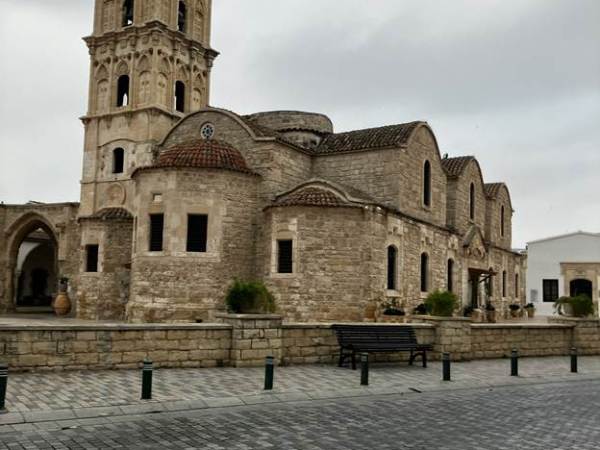
By: Arthur Pino Coming to the Old World is a new experience for me. I can say that, besides the luxuries and brands similar to those in America, it is quite different. This land has been inhabited for at least 4,000 years, according to the sign outside the Agio Lazaros (The Church of St. Lazarus).…

House of Dionysus
By: Arthur Pino On a field trip, we went to Paphos, where we were able to visit a “World Heritage Site.” This would be the second opportunity I have had to see one in my life within the last year; the other was Chichen Itza in Mexico. It was a very hot day, and walking…

A Big Discovery!
By: Arthur Pino Today was another hard but rewarding day. It was the first time I had worked in the trenches three days in a row, and I felt it. This day, in particular, revolved around hands. My hands themselves, and an accessory for hands. As usual, I did not wear gloves to start…

