-
Mythology of Cyprus
This is a quick crash-course into Cypriot mythology, cut down to something around 400 words.
First important Cypriot myth is the myth of the birth of Aphrodite. In short, Cronus and his brothers castrated and cut their father, Ouranos, into pieces. When the castrated bit fell into the ocean Aphrodite was born. In Cyprus it is said that she rose out of the sea somewhere near Paphos. However, Cyprus is not the only place to claim their island as the birthplace of Aphrodite. Cythera, an island south of the Peloponnese, claims this as well.
The second important myth is that of Pygmalion and Galatea. Pygmalion of Cyprus was a skilled sculptor who created a statue that looked like it could very well be alive. Pygmalion fell in love with Galatea. On the festival day of Aphrodite, Pygmalion prayed that he would find a bride who would be “the living likeness of my ivory girl.” When he arrived home that night, he kissed Galatea and found her lips to be warm! Aphrodite had received his prayer. In this myth we once again see the presence of Aphrodite, obviously an important figure in Cypriot mythology.
A third myth, thats not quite as important, is that of Teucer. Teucer fought in the Trojan War on the side of the Achaeans and he had quite the family tree. His father was King Telamon of Salamis island, so he had the same dad as Telamonian Ajax. Telamon’s brother was Peleus, father of Achilles. That’s right Teucer and Ajax are the cousins of Achilles. And that’s just through his father. His mother was Hesione, daughter of King Laomedon of TROY! That would make King Priam his uncle and make Hector and Paris his other cousins. Teucer is related to the two great fighters of the Trojan War, Achilles and Hector! Thats one hell of a family tree. Anyways, he was a great archer and was even one of the Achaeans to enter the Trojan Horse and is credited with killing thirty Trojans. When Ajax committed suicide, Teucer guarded his body until it was buried, but this would end up being his downfall. When he returned to Salamis island his father held him guilty of not returning with Ajax’s body and was banished. Eventually Teucer made his way to Cyprus and founded the city of Salamis on the island!
So that’s my crash-course into three myths involving the Cypriot island!
Hunter Powell
-
Tattoos and Piercings in Cyprus
Tattoos and piercings are not something you should get on a whim. It has to be something you’ve planned out and something you’re sure you’ll like. You don’t want a scar on your body forever for no reason! However, if you have a pre-set idea and you’re prepared then here’s an all-purpose review of the tattoo and piercing scene in Larnaca.
Now I can’t claim to be an expert as I’ve only been to one company (two separate buildings, three separate trips). But I can tell you all about Easy Rider Ink and Steel.
First, piercings. As Larnaca is relatively small, Easy Rider has a small staff. Each location only has 1 or 2 piercers however they are quick and efficient with their work. There are downfalls and gains to their efficiency though. One downfall is that, compared to American piercers, their preparation for the piercing sucks. OF course everything is sterile, but they hastily dot out the piercing location, so you WILL have to double check its symmetrically. But, in my experience I was able to get symmetrical piercings with little to no problem and the piercer was the nicest lady ever. Another thing about piercings in Larnaca… they are cheap! They are around 20 Euro INCLUDING jewelry which is so cheap compared to America, and as far as I can tell with my piercings, there is almost no quality difference in equipment such as needles and jewelry.
Secondly, we’ve got the tattoo scene. While it isn’t UNCOMMON to see a tattooed Cypriot, I’d say it’s much more uncommon than in America. But what does this mean, and what more is there to say on the scene and actual tattoo artists? Well, as those of you who have gotten tattoos in America know, artists take their craft very seriously. The same can’t be said about Cyprus. Of course they care! And they do their job well. They just don’t have the same air of seriousness and don’t seem to represent their respective individuality well. However, the actual work is exemplary! Just as good as an American tattoo!!
That’s what I have to share with you regarding piercings and tattoos in Cyprus.
Hunter Powell
-
Graffiti in Larnaca
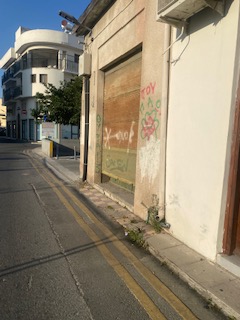
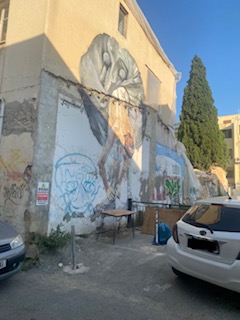
When first arriving into Larnaca I noticed there was so much graffiti along the streets. There would be normal tagging that you see, but there were wonderful artistry as well that was painted along parking lot walls and buildings. I had never been much to stop and pay attention to graffiti back home but here it seemed like it may have more of a meaning culturally than I would suspect. When walking around the non-tourist part of town, in the everyday homes, I noticed a reoccurring number that was tagged along the streets, signs, and buildings. Each time that this number appeared it had a word next to it. This number was number 13. I had asked if there was a significant meaning to this number here in Cyprus only to find that no one in my group knew about it. As I continued throughout the neighborhood, I came to realize it was more apparent in certain areas more than others. This sparked my curiosity more about why it is more common in some others than in others. I began taking photos of this tag as I continued my journey. NAO 13 is the most common of this tag that I have seen but in certain areas it will also say OYPA 13, NAO 0.13 or even NAO OYPA 13. Generic usually with just paint, some were more elaborate with some artistic thought into it. My favorite of these was the clover on the wall close to our apartment. This idea that this was a local group sparked my interest in researching the area. Come to find out there was a lot more meaning to these than I had suspected.
-
Echoes of the Armenian Genocide
People in Cyprus come from all over. Greece, Turkey, Great Britain, Russia, Egypt. It’s one of the biggest charms of this island. However, some of the reasons for people’s arrivals can be tragic. One afternoon I was walking around, looking for somewhere to sit and enjoy the day, when I saw a stark reminder of this. A strange looking bronze sculpture atop a pinkish stone base, set into a small tiered square with pomegranate and cypress trees surrounding it. It looked like a nice place to sit. When I walked up and read the inscription in front, I realized it was commemorating the Armenian Genocide.
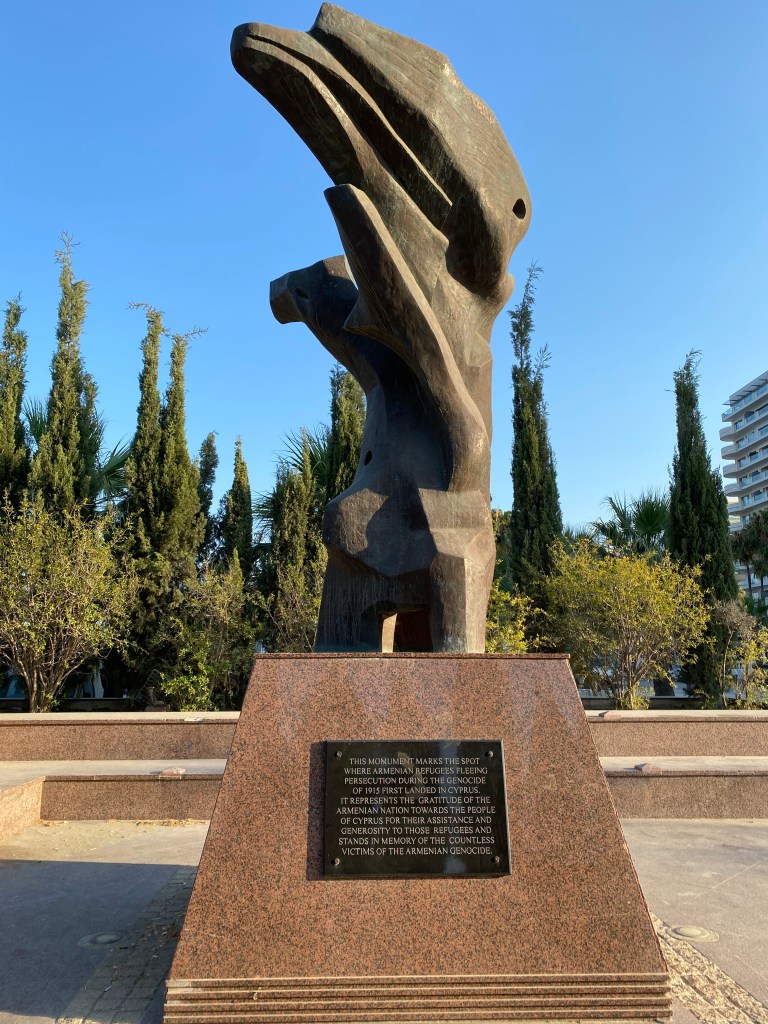
The Armenian Genocide saw up to 1.2 million Armenians in the Ottoman Empire (present day Turkey) killed or displaced, from 1915 to 1923 (although most of it occurred between the spring of ‘15 to the autumn of ‘16). Tens of thousands of these refugees turned up in Cyprus. The monument in Larnaca commemorates not just the genocide, but the gratitude that the Armenian people feel toward the people of Cyprus for welcoming them in during a dark and desperate time in their history. It is placed in the spot where the first refugees to Cyprus arrived.
Today, there are about 3,500 Armenian-Cypriots on the island, qualifying as a recognized minority and “religious group,” despite their distinguishing feature being ethnic, rather than religious. When asked to choose whether they identify more with the Greek-Cypriots or the Turkish-Cypriots, they chose the former community (for rather obvious reasons). Thus, they live mostly on the southern half of the island. They make up a small percent of the population here, but their presence makes the social fabric that much richer. Cyprus welcomes all.
-Rachel
-
It’s SO Early. But, Zorbas…
03:45 is what the clock on my phone reads when my first alarm goes off in the morning. It’s early. The only other times I’ve been awake at this hour have been to catch a flight, or if I’m still up from a really good night out. I try to be out of bed by 4 to make sure I have a full hour to get ready, and then my roommates and I leave the apartment to meet the others in the parking lot by 5. The sun has not yet followed our lead. After several rounds of “good morning,” we all load into the vans and head to Zorbas, a combination bakery, convenience store, and coffee shop (though the coffee shop is not ready for service at the early hour that we arrive each day). A warm pastry and cold canned coffee makes a perfect breakfast, and the women who work there are lovely.
One Sunday we arrived, after having just seen them the day before (and the previous five days as well). We were digging on the weekend to make up for the following week being canceled due to the military base changing their shooting schedule last minute. Stricken with horror that we were working not only through the heatwave, but also on the weekend, they handed one of the grad students a bag of twenty or so little lemon custard pastries, on the house. “Even Sunday??” they questioned, amazed. They now give us what we’ve been calling “pity pastries” seemingly every day on our way to go work in the heat. They’re delicious.
Once we arrive on site, we set our things down, and set up the shade tent and stools. The light is soft. Soon, we get our marching orders, jump into our respective trenches, and begin digging, or sweeping, or whatever is needed. It feels so easy in the cool morning air. Sometimes I even wonder, if I struggled the previous day, what the big deal was. Second breakfast can’t be too far off now anyway.
-
Inter-Institutional Bonding
For context: there are two different schools on this trip. Reed College and of course MSU Denver. 6 students come from Reed and 9 come from MSU.
At the beginning of this trip I was, well, intimidated by the Reed students. They seemed to know what they were doing, while I was a complete novice. They were full-fledged academics: taking ancient language classes and already discussing thesis projects. Eventually, I would come to learn that most of them didn’t know what they were doing either. However, before we could get to truly know each other, we ran into a problem. For some reason, we just didn’t get along. No matter what I did, they just wouldn’t look my way. Because of the tension rising, each school naturally developed a diplomat, paving the way to solidarity. I was shocked when, one night, the Reed students invited us out at night! Somehow, our diplomat had made ground, leaving an impression on the Reed students!
I actually had a really fun time hanging out with them and they all seem so interesting. Their stories from college are so fun! I can say with confidence that I am glad that we have started to get to know each other, even if it did take a good chunk of the trip to lay the groundwork.
If you’re a student coming on this trip in the future: always be kind to all the students around you! Try to make those lasting connections! Don’t let things like anxiety and ego get in the way of the fun you’ll have here!
Good luck and thanks to the diplomats!!
Hunter Powell
-
Grigoris Afxentiou and Cypriot Identity
One thing you learn about Cypriots is that they tie their national identity pretty heavily to Greek identity. The British influence is hard to ignore though. Even after fighting to get the British out, whether for independence or enosis (union with Greece), it’s visible. Most people speak English here. And cars do still drive on the left side of the road.
One evening, at a late hour when I really should have been in bed, I was hanging out in my favorite Cypriot bar with my favorite Cypriot bar owner, George. His parents are both from here, but he grew up in the UK and speaks British-accented English. However, he’s been in Cyprus for 35 years now and speaks fluent Greek too. He teaches me little Greek phrases, and once when a group of British ex-pats were in the bar arguing about whether the shade cover out front is called an awning or a canopy, George jokingly insisted that both of those English terms were from the imperializing Brits, and only the term τέντα is appropriate (despite technically being British himself).
That all-too-late evening, after showing me dozens and dozens of photos of his travels in Greece, and insisting “just a half a pint more!” enough times that I couldn’t rightly say no, George began talking about Grigoris Afxentiou. He told me that Afxentiou was “set on fire by his own people.” I looked him up later, and I still don’t know exactly what George meant by that, because Afxentiou was born in Cyprus, fought the British, and was killed by the British. He was indeed burned alive though, after a battle that is greatly revered in Cyprus. He went out a hero according to most media I can find here. But he wasn’t what I would call British. Maybe George was referring to the story that Afxentiou ordered his soldiers to leave him there on the battlefield to fight the British alone. He is said to have repeated “I have to die,” four times, and his men did eventually follow orders, leaving him there to ultimately be killed.
The Cypriot identity straddles different nationalities, as many places that have been occupied for centuries do. On this side of the island, it is the Greek element that people identify with the most, with a bit of a love/hate for the British. They’re here, they’ve been here for quite awhile now, and they still have two military bases here. It doesn’t seem like it will be changing anytime soon. But the southern side of the island still identifies as Greek Cypriot above all.
-Rachel
-
What the Heck is an Unguentarium?
After finding SO many pieces of random broken pottery, I was wondering if I’d ever find anything still in one piece! It seems rare to be lucky enough to find something whole. But one day on site, I got awfully close.

What I had uncovered is known as an unguentarium, and I had to look up the name after seeing it labeled on the bag, as I had never come across this term before.
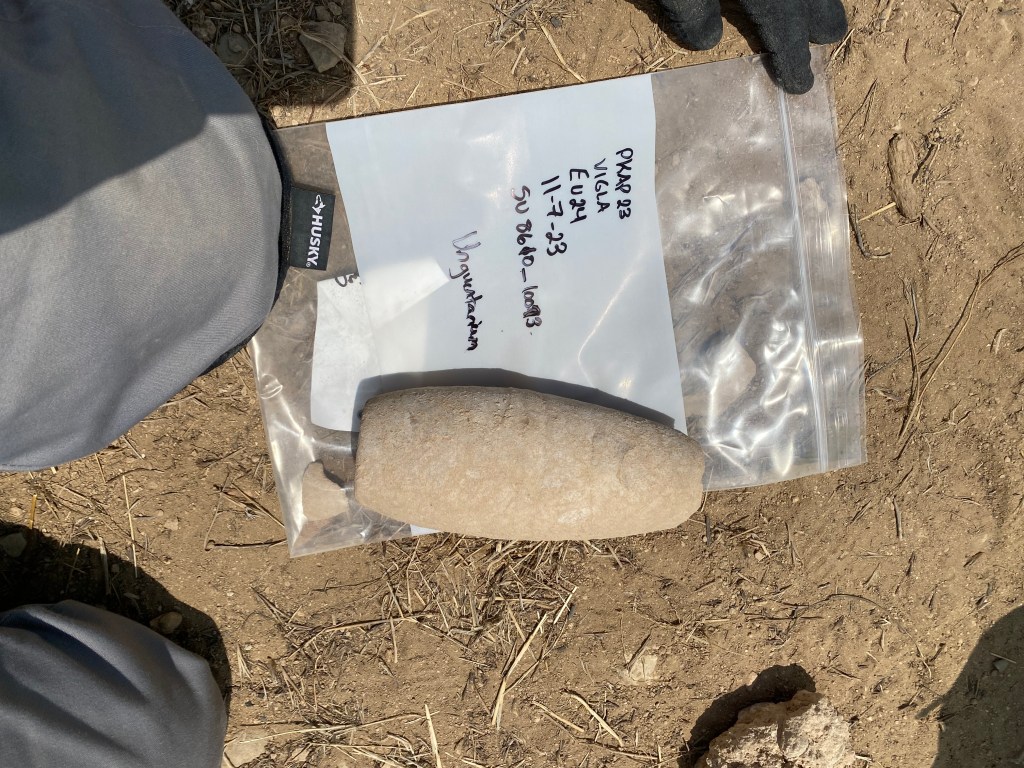
Unguentarium (or “ointment vessel”) is a broad term. Sometimes also called a lacrimarium (“tear vessel”), they were used for storing small quantities of not just ointments (or tears apparently), but other liquids and powders as well. The term refers more to the function than the design, as their design has fluctuated through the years and the locations of manufacture. Early examples seem to represent small versions of amphorae (large shipping and storage vessels). It’s easy to imagine doling out olive oil from a large amphora into its tiny twin version, to take from the market back to the home. They could then be used at home for storage, or for setting out on the table to decant oil or wine. These would have been ceramic: made from clay, molded by hand, and baked hard, like the one I got to excavate at Vigla. Later versions were colorful blown glass. Delicate and intricate. They held perfumes, cosmetics, medicine, oils. Rarely, they were smithed from metal, or even carved from rock. Unguentaria come in many shapes and materials, and I feel grateful that I got to find one in nearly one piece.
-Rachel
-
Things to Know About Cyprus
We had several informational meetings before going on this trip. It was emphasized that Larnaca is a pretty user-friendly place to navigate, which I as a novice traveler totally agree with. There are some random things I have learned about Cyprus that I think could be useful for anyone who might want to come here to know about.
- Water: In Cyprus, and if I am not mistaken in Europe in general, when you go out to restaurants you do not automatically get free water with dinner. If you want water, you have to order it, and it comes in a bottle. To be fair though, water here is very cheap at a restaurant, usually around two euros for a big water, and at mini markets it is usually around one. So, buying water is not a big deal. If you bring a water bottle (which after not bringing one I would recommend), you can get a giant jug of it at the supermarket and fill it up at a Mr. Penguin for like 60 cents. That is a way to be both cost effective and sustainable. If you are adventurous (like my roommate) you can drink the tap water. She started off with small amounts of the tap water at the beginning of the trip and has had no issues, so that is also a route you can go.
- Bathrooms: This is a weird topic, but there are two important things to know about bathrooms. The first is that you should not flush anything, including toilet paper, down the toilet. There are signs everywhere telling you to put it in the trash can. I know this probably sounds terrible and gross, but the plumbing cannot handle it and that is what everyone here does. The other thing you should know is, if you go out to dinner and need to use the bathroom, you pretty much always have to go up a set of stairs. They are often spiral or steep, so just keep that in mind. Bathrooms are also labeled with WC, so if you are looking for a bathroom look for WC. I know this is not vital to know, but I figured a heads up to anyone traveling here would be helpful.
- Food Spoilage: Here in Cyprus the food spoils extremely fast. Every time I have bought fruit it spoiled before the fruit was ripe enough to eat, often in two to three days. The same goes for bread and pita, although pita seems to spoil the fastest, often in three days or less. So, if you are planning on buying bread or produce, I would suggest buying only what you need for a couple of days and planning meals and lunches around it as it spoils so quickly.
- Beaching: Finikoudes Beach is very, very close to the apartments we are staying at. It is about a three minute walk to the beach. The beach is beautiful, although it is covered in cigarette butts. There are a bunch of chairs on the beach for you to sit on. If you do, people in blue shirts will come to collect 2.50 euro for each chair and 2.50 euro if you are using an umbrella. If you do not want to pay for it, you can also just put your stuff on the sand. The other really cool thing is that if you leave your stuff on the beach either on the chairs or on a towel on the sand it is safe. No one will go through your stuff or try to take anything. I have left money, snacks, my phone, and random stuff on the beach while I have been in the water, and it has never been a problem. Finally, the water is incredible, so I would 100% recommend taking a dip in the Med, especially after a long day of digging.
- Smoking: There is a big smoking culture here. If you remember, I think almost two decades ago you used to be able to smoke in bars and restaurants in the States. That is how it is here. Almost every restaurant has ashtrays and it is perfectly acceptable to smoke or vape in bars and restaurants. This is very different from the U.S., where the rules are much stricter. So, if you come to Cyprus, be prepared to be around people constantly vaping and smoking.
There are so many little things I have learned about Cyprus but these are the main ones I can think of that are not a huge deal but different from the U.S. I hope whoever is reading this finds it helpful as a small heads up about what to expect in Cyprus.
Madi Barber
-
C Team
There are many jobs on an archeological dig site, especially when a new trench is being opened. So much dirt has to be moved, and it requires a lot of people to move the dirt, transport the buckets, and sift through the dirt. Sifting is often a two person operation: one person pours the dirt, the other shakes the sifter, and both pull out pottery. Excavating itself is another crucial task done on a dig site. Due to the cramped spaces in the trench, excavating is often one or two people per context, as you have to be very careful and there is not very much space. Paperwork, making artifact bags, and taking points and photos are often things that have to be completed, although they are often completed by the trench supervisors. Needless to say, there are many jobs to be filled on a dig site. The cool thing about this is that, if needed, people can switch jobs if they get really tired. For example, if someone is pickaxing and they are exhausted, they might switch with a person who is sifting which is a less strenuous job. That is one of the unspoken rules of the dig site. If you are doing a less physically demanding job and someone else is doing something very demanding, when they need a break, you should switch with them.
Anyway, I digress. We at any point have around fifteen people on site, so there are certain times where there are slow points. On this particular day, there were a few trenches open with people switching off from excavating to sifting. I was in the new trench, and we had gotten to a point where we found five contexts (five areas in one trench that need to be excavated separately). There were eight of us, and all eight of us were not going to fit in the trench to excavate. It became clear that this would be the time when some of us would part ways with this trench. I knew that many of the people in the trench wanted to be archaeologists and were really excited to excavate, so I opted out. I enjoy digging and learning, but this is not my career path and I wanted to let those who were amped do it. So, two of my peers and I ended up not being able to be in the trench. This was one of those days where everyone was doing a job. Sometimes that happens. So, our trench supervisors tell us to take a beat as he gets those in the trench started. We got some water and were hanging out when a few minutes later Brandon tells us to find the rocks that get chucked out of the trench and to line the trenches with them. Was this an ultra-important job? No, but it needed to get done, so we did it. My peers and I were quite tickled with being rock collectors, so as we walked around and picked up rocks, we named ourselves “C Team.” As only a C team would pick up rocks. This is a very fond memory for me as it was funny and now we still refer to ourselves as C team. It also shows how much a dig site can ebb and flow and that all jobs, even ones that seem silly, are important. Our leisurely job of picking up rocks did not last long. Dr. Olson arrived about 30 minutes into the formation of C team and quickly put us onto the task of clearing brush from two new trenches, one of them being the wall which is where I ended up being assigned.
Madi Barber
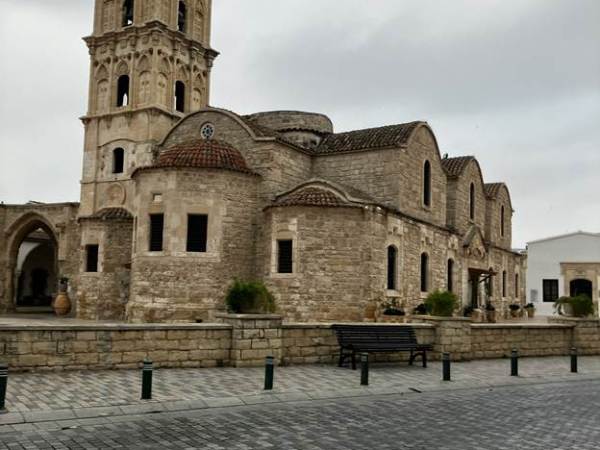
Study Abroad in Cyprus
By: Arthur Pino Coming to the Old World is a new experience for me. I can say that, besides the luxuries and brands similar to those in America, it is quite different. This land has been inhabited for at least 4,000 years, according to the sign outside the Agio Lazaros (The Church of St. Lazarus).…

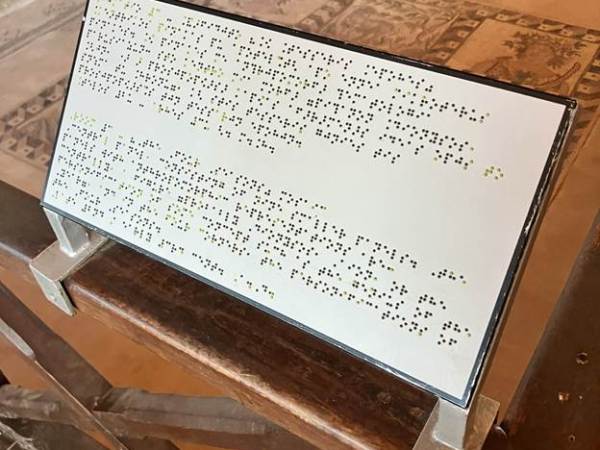
House of Dionysus
By: Arthur Pino On a field trip, we went to Paphos, where we were able to visit a “World Heritage Site.” This would be the second opportunity I have had to see one in my life within the last year; the other was Chichen Itza in Mexico. It was a very hot day, and walking…

A Big Discovery!
By: Arthur Pino Today was another hard but rewarding day. It was the first time I had worked in the trenches three days in a row, and I felt it. This day, in particular, revolved around hands. My hands themselves, and an accessory for hands. As usual, I did not wear gloves to start…

