-
The Church of Saint Lazarus through the eyes of a local
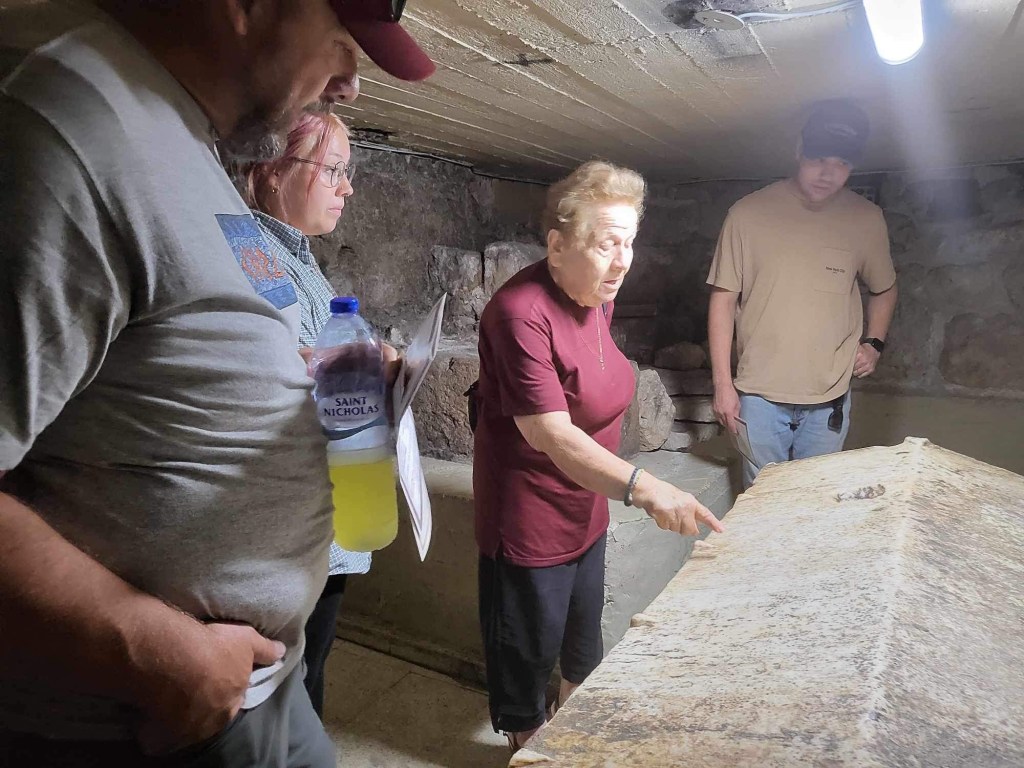
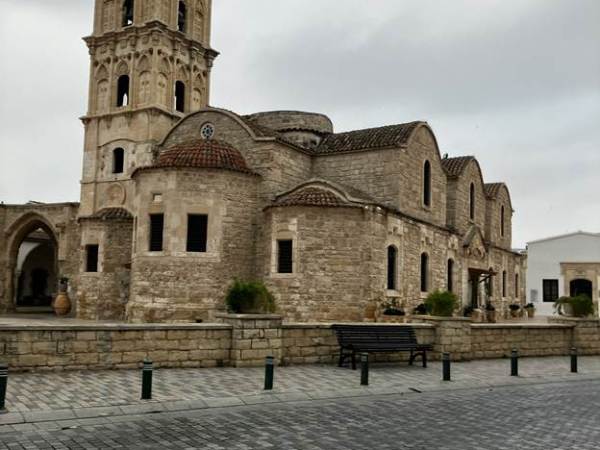
When we first went to the church of saint Lazarus, I was immediately intrigued. I love a good byzantine church (if you couldn’t tell), and I knew I wanted to return at some point along the trip. I was able to return with my family and while we were down in the tomb, we were stopped by a local who was asking us if she could tell us more about the church. She was an older woman, named Aspasia, who was born and raised in Cyprus her whole life. She was raised Greek Orthodox, and was actively practicing while we were there. She took us around the tombs and it was very interesting to hear her story of the church, and what her understanding of its history was, and how this history of the church is understood locally. She described how the department of antiquities discovered the tomb in chunks and at different times. The entrance of the tomb was discovered first, and then later when they wanted to extend the church for storage, they found the first sarcophagi with just a few bones. In another attempt to extend for space, is when they found the second sarcophagi with the inscription inside, which she says roughly translates to “the friend of Christ”. Which was later determined to be the bones of Saint Lazarus. Aspasia tells us that some of the bones were sent to Rome, but the bones found in the second sarcophagi were kept in Cyprus, and she took us upstairs to the box containing the “bones of Lazarus”. It was an ornate silver case adorned with intricate pictures of Saint Lazarus, gemstones and prayers. She gently kisses the box, and explained how lucky she is to have been in such a holy place. She then toured us around the frescos and explained to us each Saint, and their importance to the church. We thanked her for her time and as she walked us out, she taught us the importance of using the door that has the cross, with four smaller crosses in each quadrant. She says that this door is the entrance for all, and this symbol means that any religious denomination can enter, but only through this door. Once we were outside, she pointed out the missing domes from the church, and informed us that the domes were destroyed by the Turkish, as they felt it was too grand and didn’t need to compare with Turkish churches, which I thought was interesting to say the least. As we left she gave us some of the church cards depicting the blessing of Saint Lazarus. She was so excited to show us Americans around and said she was so happy that Cyprus was being appreciated. I told her about my fellow students and how much we all loved being here, and thanked her for sharing her history with us.
-
The Church of Archangel Michael
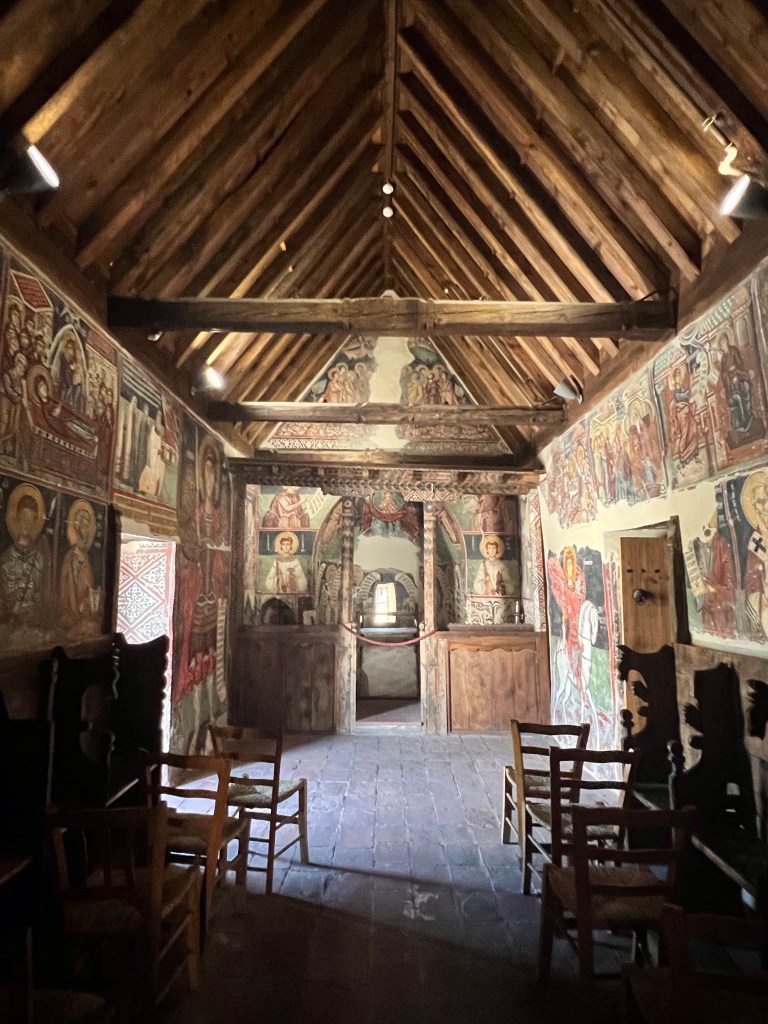
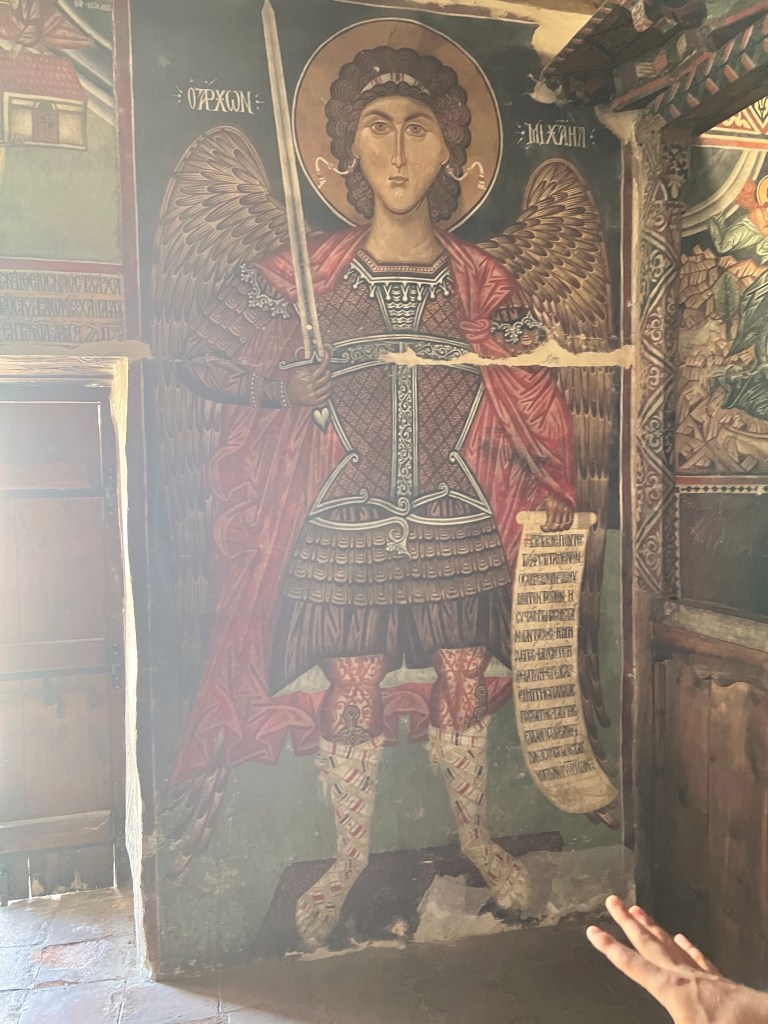
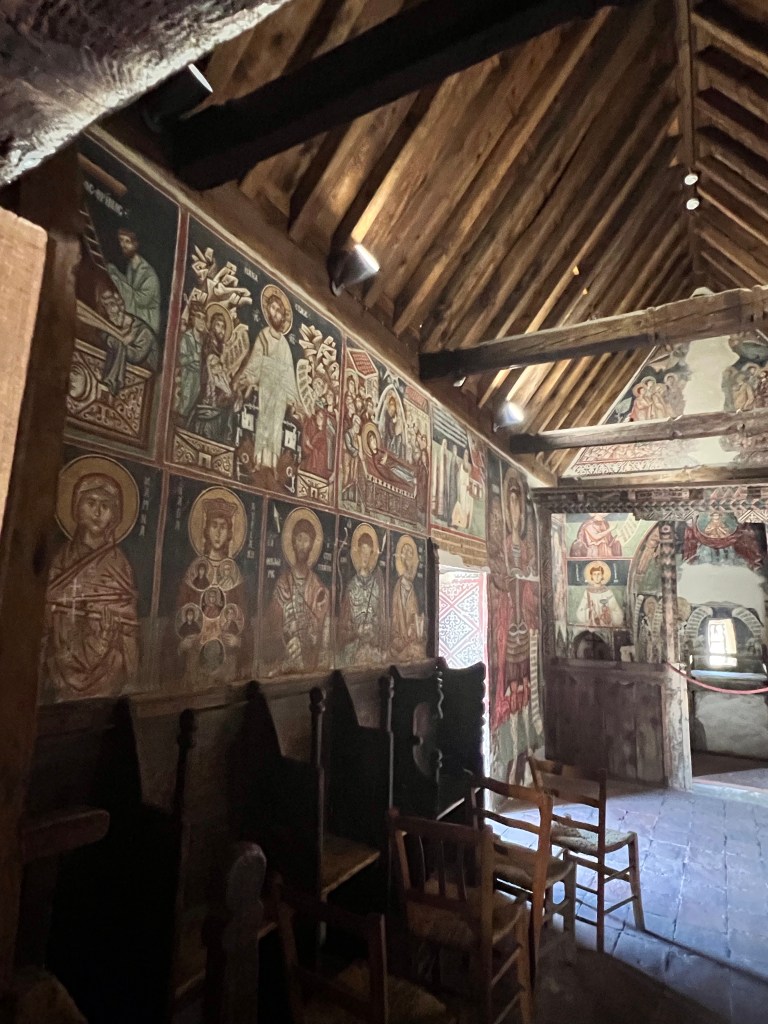
After we closed the dig site and people started to make their way home, I was fortunate enough to stay in Cyprus another week with my husband and family. During this time we were able to visit some historical places around Cyprus that I otherwise wouldn’t have been able to see. One of these included the Church of Archangel Michael, located in Pedoulas. This church is a UNESCO heritage site and was built in the 15th century. It is a small, church, with a main chapel in the center, and a L-shaped foyer surrounding it. What makes this church stand out is the amazing local Byzantine frescos covering all sides of the chapel, including the ceiling. The church was built and painted by a man named Minas in 1474. Minas the walls split into two levels. The upper level depicts the festival cycle of Jesus in eleven panels . These include the birth of Christ, the baptism of Christ, the transfiguration, the crucifixion, and the resurrection / ascension. The lower level of panels depict the patron saints. The frescos in this church are very well preserved, and some of the best preserved of Saint Michael. This church is also notable because of its well preserved wooden templon, which is an intricately carved wooden barrier that separates the nave from the altar. I was very excited to learn more about the Byzantine period of Cyprus through the museum right across the street, I’ve attached my photos of the chapel here and hope you all enjoy!
-
Lead Sling Bullet -EU 23
I want to document my personal discovery: a lead sling bullet. I found this bullet in EU 23.
As the name would suggest, a lead sling bullet was made with lead and was shot using a weapon called a sling. Many sling bullets at this time had inscriptions on them, whether that be a phrase or a name of a king. The one I found was partially broken and had no visible inscription. Who knows,,, maybe the side that was broken off had an inscription, but I guess we won’t know.
Unlike some other finds, this find makes sense that it was found at Vigla considering we are digging on what is speculated to be a fort. Many may imagine lead as a dark gray color; however, in reality these bullets are light in color. They are hard to mistake for a normal rock or plaster because of their weight and their distinctive shape. It should be noted that they look like a football.
The sling and sling bullet have a long history, dating back to the neolithic or perhaps earlier. The sling is mentioned in writings by Homer, Xenophon, Thucydides, and Vegetius. And that isn’t an exhaustive list. And you may be wondering: why were sling bullets still being used after the invention of the bow and arrow? Well, ancient sources state that the sling bullet’s main factor in combat was its surprising range. When lobbed high at an angle it could travel 1,300 feet! This just isn’t a range that can be found with arrows.
Generally, in archaeology, sling bullets are not an uncommon find, but I’m still happy to have found this!
Hunter Powell
-
The Art of Sweeping
A big part of archaeological work is sweeping. Removing that fine layer of dirt from your Stratigraphic Unit is essential. However, this job can be tedious and mentally exhausting.
Firstly, this job involves using the same motions from your body over and over. This can be physically tiring. The tedium could possibly cause soreness and cramps.
Secondly, this job is mentally exhausting. Especially if you’re a perfectionist. The dirt will never be completely gone and, sometimes, you’ll have to sweep the same spot multiple times just for it to look clean. For me, this took a toll on my archaeological thought process and made me feel as if I was doing a bad job or not trying hard enough. I would always take a long time sweeping because I felt I was doing bad. There’s never a worse feeling then having to stop a task in the middle of it because you ran out of time.
One of the first jobs future students will be doing when they arrive on site next year is sweeping. Please keep in mind that it will never be perfect and try to do your job efficiently. BUT if you take a little longer than your peers, don’t beat yourself up about it. You should be swift, but you should also make sure your work isn’t bad. For many of us this was our first archaeological project so we had no idea if our job was acceptable or not! But we proceeded and with help from our trench supervisors we succeeded.
Good Luck!!
Hunter Powell
-
Archaeology: A Fair Warning
So, the large majority of you students coming on this trip are coming because you want to become an archaeologist. Personally, I came for the history of Cyprus course, but of course, was interested in maybe doing archaeology. As someone who wasn’t quite as motivated/prepared for archaeological work, I was met with some roadblocks.
My first roadblock was that of hard labor. I know I know this seems like an obvious expectation of archaeological work, but it was MORE than I was expecting. Pickaxe-ing and using a tureya is hard! It’s tiring and the heat is just pouring out from the sun making the work that much harder. It is something you get used to though, so it gets easier the longer you’re on the trip. I did notice that those with previous archaeological experience as well as those that planned on becoming an archaeologist worked a little harder. But that isn’t to say the history or other miscellaneous majors didn’t work hard as well. Some history majors on this trip have decided on becoming archaeologists!
My second roadblock was the tedious tasks. These tasks included pottery washing, baulk trimming, and sweeping. Repetitive tasks just, personally, aren’t for me. But some people found these tasks to be meditative and somewhat soothing.
I don’t think either of these things should deter you from coming on this trip. In any circumstance it will be a fun learning experience! The silver lining in all of this is that PKAP-Vigla is a site infested with discoveries just waiting to be uncovered. Every. Single. One. Of you WILL find something on your trip.
Hunter Powell
-
Pottery Washing
There are two main archaeological tasks we are expected to do on this trip. The first one is going to the dig site, digging, and excavating – doing the actual moving of dirt. The second is washing all of the pottery that comes into the field. At first glance, pottery washing sounds simple and easy, right? Just throw some soap on it, scrub it with a wool pad, and it’s clean. That is incorrect. The pottery is very, very old. It has been sitting in dirt and mud for thousands of years. It is also extremely fragile, so it has to be washed with care. The way pottery washing actually works is we go to Terra Ombra, we fill up a basin with water, grab a toothbrush, and find a spot on the ground that is in the shade. The shade part is tricky because, as the day progresses, the shade becomes more and more scarce. After we get to our little station, we get a bag of pottery. One of the most important things we have to do is to put both the bag and tag under the plastic in the tray. This is so that the pottery can be identified. Without that, there would be thousands of sherds of pottery everywhere, which is pretty useless.
The goal of washing pottery is to clean off both faces of pottery and one side fully so that a ceramicist can read them. Well, you may ask, what does that mean? There are experts like Dr. Olson who can look at a piece of pottery and notice its fabric (the clay), how thick it is, the glaze, the detailing, and other attributes besides, and be able to identify its use and oftentimes even date it. This is greatly important as the type of pottery (cookware, drinking glasses, anaphora for shipping) can tell us what was being done on site. Maybe it was a place of production, or a place of drinking and eating; the type of pottery can give great insight into those sorts of questions. It also can help date the site. Different styles and types of pottery are linked to specific time periods, so a ceramicist can look at pottery sherds and get a good idea of not only what people were doing in the area but the timeline in which they were doing it. In order for them to successfully do that job, though, they have to be able to read the pottery, so it has to be cleaned. This sometimes is a much harder job than it sounds. Some of the soil is full of clay and it cakes onto the pottery. It is also very old pottery that cannot be scratched or damaged, so we are using toothbrushes to try to get off thousands of years of dirt. Sometimes, cleaning a single piece of pottery can take twenty minutes because of how caked in the dirt is. At times, it can feel frustrating as the dirt feels immovable. Often though, with some patience and elbow grease, you can get the piece clean. When we have big pottery days, there will be several people to one bucket. On those days, when there is a particularly frustrating piece of pottery, often we will take turns with it. I really enjoy those moments as it feels like a tremendous piece of teamwork to get one piece of pottery clean.
Madi Barber
-
Pano Lefkara
Shortly into our trip to Cyprus, one of my classmates read about Pano Lefkara, or the Lace Village. The Lace Village is a small mountain town about 40 minutes from Larnaca that is known for its handmade lace work and its extensive filigree silver work. As soon as my classmate learned about the Lace Village, all of us were intrigued and desperately wanted to go. After long periods of planning and figuring it out, most of us opted to go for an afternoon in the Lace Village. Getting to the Lace Village required going on windy mountain roads. The Lace Village is a tiny town with not that many inhabitants, all of whom mainly work on lace or silver.
As we walked around, we saw women and men sitting outside of the shops that look like houses beckoning us to come inside and look at their stuff. Most of the women specialize in the lace work, while the men do filigree silver work. The lace work is a tradition that is passed down from mother to daughter. The lace work is done on a special linen, and they only use three colors. In order to sell the lace as Lefkara lace, it has a special authentication sticker on it. They also only do very specific lace patterns as per the lace-making traditions. One can buy linen table cloths with lace detailing as well as table runners, coasters, designs encased in glass, and lace in glass trays. There is a very special lace design that almost every shopkeeper will tell you about, which is the da Vinci lace. This pattern is the one that Leonardo da Vinci bought from the village of Lefkara. One of the shop owners showed me a picture of the last supper painted by da Vinci and claimed that the table cloth was Lefkara lace due to its pattern. Lefkara lace is the livelihood of this village; it is what they do to make a living, but it is also a deep part of their culture and history. One of the shopkeepers told me the lace village was slowly dying as the girls who usually learn around 11 from their mothers are less and less interested in keeping up with the tradition. Lefkara is the only place in the world where this lace comes from, and if it is not passed on through the generations, it will go extinct. I really hope that doesn’t happen, but in case it does, I would highly recommend visiting Lefkara if you get a chance.
Madi Barber
-
The Sanctuary of Apollo Hylates at Kourion
A little west of the ancient city of Kourion (now Episkopi) there lay the ruins of an important sanctuary. This sanctuary was the center of Apollo worship on Cyprus from around the 8th century BC until the 4th century AD. The worship of this sanctuary was more specifically for Apollo Hylates, and epithet likely meaning “of the Woodlands.” Apollo Hylates was considered the protector of Kourion. Unfortunately on our trip to Kourion we were not able to visit this specific sanctuary, but I would love to tell you about it!
What’s most interesting about this site is that Hylates may have originally been the name of an indigenous Cypriot deity. Hylates is theorized to derive form “barking” or “forest” meaning that this deity was likely a god of woodlands, trees, and was maybe even associated with dogs. Eventually Hylates was fully synchronized with Apollo. However, Hylates was worshipped between the 3rd century BC to the 3rd century AD.
Now, the actual sanctuary. In it’s original rendition it most likely consisted of a temple, a circular monument, and an archaic altar. It was remodeled in the 1st century AD and mostly everything that can be seen of the sanctuary now come from those additions. Also important to note is that their was a votive pit. A votive pit is, well, a pit where one would lay votive offerings. Some votive offerings found in this pit include terracotta figurines and pottery. One of the new additions is a palaistra. A place where athletes would exercise and play games. The constant worship at this temple and the addition of the palaistra suggests that this was an important site, which is obvious from all this other information.
Although I wish I could’ve seen this monument, it was wonderful just to learn about it (and of it’s existence haha).
Thanks for tuning in B-)
Hunter Powell
-
The importance of blue
I see the blue everywhere I go. The ocean is a blue that parallels the sky, and much like the Cypriots, I am enamored with the beauty. I see blue in kitschy shops and evil eyes. The color resonates deeply within me. The doors and windows are Cobalt, electrified by the stark white stucco of the buildings. A bright signal, but what is it supposed to be telling me? I find myself asking, what’s the point? As we walk the streets, going to dinner, or even on field trips in different cities, the blue follows me. I see this most on painted shutters and doors. The whole island, seems to be spattered with this color.
Doors and windows themselves hold such importance in architecture. It’s your first impression and will relay the message of the rest of the building. The blue makes the buildings so inviting, even while closed. I was kind of hoping for a silly answer, like the blue paint was just popular or on sale, but the answer is much more mystical. In Greek culture, Blue has a belief to protect from evil. Sacred buildings like churches have all entrances and windows painted this beautiful blue to create “belts” of protection. Turquoise and Lapis Lazuli were used in weapon making, body adornment, and clothing, upholding the same belief. Blue holds such importance, that it is the color of the Greek flag, and is even the color of school uniform sashes. Following the turmoil in Cyprus, an uptick of this color was seen around 1974, and houses have since been painted blue and white to celebrate being Greek, and to match their flag. This blue paint is comprised of Laoulaki powder and lime, which has created the long lasting reflection of the sea, the sky, and Greek pride.
-
Carbon dating organic matter in EU23
Since arriving on site, I have been primarily working in trench EU23. I am very attached and want to know anything and everything I can about this trench. On Tuesday of last week, while cleaning a portion of sealed subfloor, a specimen of a charred root was found with much excitement to my trench supervisor (shoutout Mel), and the other supervisors. The specimen was wrapped carefully removed and wrapped nicely in tinfoil. With the background of all our other finds, I was interested in the enthusiasm. I asked what was so important about this find, and it was explained to me that the charred root was found sealed between two different layers of floor, and had been untouched until discovered. Since it was sealed, this meant the root itself could be carbon dated. I remember learning about carbon dating when I was younger, but any information on the process had been completely eradicated from my mind. I decided to research carbon dating, to have a better understanding of the excitement, and decided to share with all what I found.
Carbon dating, or better know as Radiocarbon dating is a process in which the age organic materials can be dated accurately. This scientific method was developed in the 1940s, at the university of Chicago by Willard Libby. Libby jump started his work off Martin Alamein and Sam Ruben, who discovered the carbon 14 isotope. Living organisms absorb carbon 14, and once they die, the absorption stops. The carbon – 14 slowly changes its make up at a predictable rate. Knowing this, scientist are able to measure how much carbon 14 remains in a specimen, giving an estimate of how long the specimen has been dead. In terms of EU23, This means that we are able to closely date the SU that this specimen was pulled from and based on that number, we can closely compare the surrounding SUs and have a better understanding of our trench as a whole.
Study Abroad in Cyprus
By: Arthur Pino Coming to the Old World is a new experience for me. I can say that, besides the luxuries and brands similar to those in America, it is quite different. This land has been inhabited for at least 4,000 years, according to the sign outside the Agio Lazaros (The Church of St. Lazarus).…

House of Dionysus
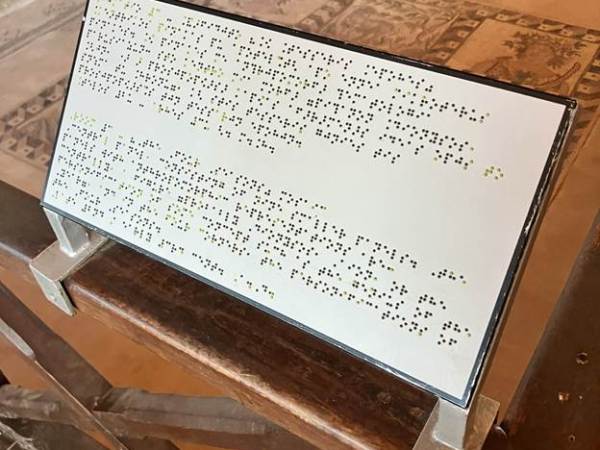
By: Arthur Pino On a field trip, we went to Paphos, where we were able to visit a “World Heritage Site.” This would be the second opportunity I have had to see one in my life within the last year; the other was Chichen Itza in Mexico. It was a very hot day, and walking…

A Big Discovery!
By: Arthur Pino Today was another hard but rewarding day. It was the first time I had worked in the trenches three days in a row, and I felt it. This day, in particular, revolved around hands. My hands themselves, and an accessory for hands. As usual, I did not wear gloves to start…
 Vigla Archaeological Project