-
Shrimp
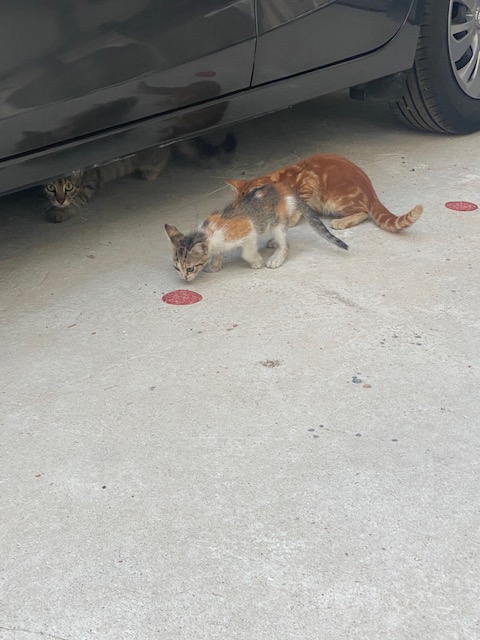
When talking about Cyprus you cannot not talk about the cats of the island. While there are so many non-domesticated cats roaming the streets it’s hard to not stop and visit with a few of them. This was the case for little shrimp! This little baby lived behind the Blazer Residence in the parking lot. It had one sibling that followed Shrimp around who was a bright orange and white kitten. Their mama was the same color cat as mine back home, tort-tiger, which made me more attached to this cute little family. The kitten I called Shrimp is a calico kitten who was not afraid to approach me even though his mom didn’t seem too thrilled with me. One night getting back from dinner he walked towards me as small as could be. I gave him the nickname, Shrimp, because his sibling was larger than him. I would see the family a few times a week so I began to give them any meat leftover I may have had on me. By the end of my stay, the mom would allow the babies close to me but not close enough to let me pet them of course. It was true when they say that the animals are residents there just as the actual human population is. The cat culture on the island stems from a story of the cats being heroic creatures to ward off the bad ones, I think they just bring a little light to the community!
-
The Heartbreak of Topsoil Sherds
I am not an archaeologist. Before coming to Cyprus, I never thought I’d have the opportunity to even pretend to be an archaeologist– aside from the time as a kid I buried some toys in the backyard one fall and then tried to find them all the next spring. I’ve never written a field report, never held a trowel, never sifted through buckets of dirt hoping to find artifacts.
Imagine, then, my supreme and surprised glee on our first day. Shown how to turrae, we started digging at the soil and churning up dozens of bits of what was clearly pottery. I thought it would be more ambiguous– all those pots I’d seen in museums reconstructed from a handful of fragments, I thought it would be more difficult to identify pottery.
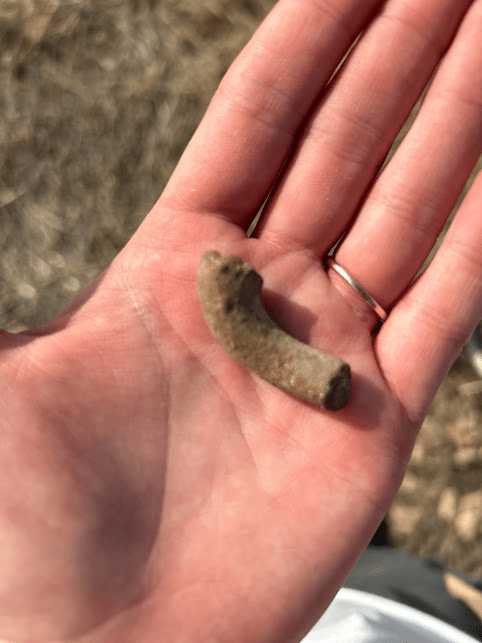
Casserole Dish Handle But here we were, a few inches into the soil, and unearthing what were undeniably pottery sherds. A handle the size of my thumb, the lip of a cooking pot, the sturdy toe of an amphora. I excitedly gathered one up after another, searching out one of our endlessly patient supervisors and with a childlike “look what I found!” And to my disbelief and alarm, after a quick identification, I watched my supervisor casually chuck it away.
This is all topsoil: these sherds are all worthless.
The “why” of this heartbreak comes down to the scientific rigor of archaeology and the basics of stratigraphy. Each layer you uncover is older than the one above it. You have to start digging at the top, which is newer, to get to the good stuff below. We were scraping through layers of time to reach our Hellenistic goalpost and documenting the finds that hadn’t already been moved. Because archaeology is by it’s nature a destructive science, once something is moved from the place you found it, you can’t just put it back. It messes with the timeline and provides bad data. Documenting where you find something is also part of documenting when it was put there and, generally, when it was made. The where is the when, in other words, when you’re digging.
So everything I found that first day had already been moved from its when. The pottery pieces were identifiable as probably from a specific time and place of manufacture, but because they weren’t in situ, they couldn’t be used to help ascertain when they arrived, when they were buried, and what their relationship was to the site. Up in the topsoil– and sometimes just literally sitting in the grass– they had left their archaeological context. Sometime between being buried in the 200 or 300 BCE and now, they’d been moved up in the stratigraphic timeline because of human activity.
So to the next round of MSU diggers: get excited about what you find that first day. There are few feelings like picking up a piece of something ancient and holding it in your hand. But remember that not everything you find, especially when you’re clearing out the first few inches of a trench, is going to end up in documentation. It’s part of the process, and I promise you that you will find something incredible if you just keep digging.
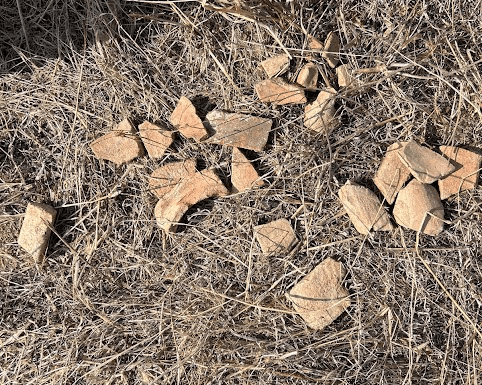
Beautiful and Unhelpful Pottery Sherds -Miki Hollingsworth
-
Burial Rituals in Hellenistic Cyprus – Pafos post 2
To piggy back off my previous Tomb of the Kings post, I want to cover what was discovered by the excavations, particularly about the burial rituals on this site. Going on this trip has changed a lot for me, and one of those being my concentration of study. I found great interest in body adornment and the relation it plays on ceremony. Leaning into this, tomb of the kings is a perfect site to learn more about ritualistic happenings in Cyprus history. After excavation, quite a few interesting points could be drawn about Hellenistic burials. First being that each family had their own burial space, and these tombs would contain rectangular enclosures and simple pit like tombs. Next, is that full intact burials we’re found at each site, in both these pit shaped to and the rectangular compartments. All of the tombs excavated contained wells, and this was believed to be for purification purposes during their burial rituals, which was also necessary in Greek burial sites. The water in these wells was deemed safe to drink, which also supports the purification theory. While predominately Greek Hellenistic burials have been studied, a few conclusions can be drawn from this site. While there is no evidence supporting preservation or preparation of the dead, there’s plenty of evidence supporting internment, offerings to the dead, and memorial services. This evidence including burnt burial offerings, offerings of nuts and fruit on small pots, along with the pyre over the tombs. Overall this site gave us great insight to ceremonies and how the dead were treated in Hellenistic Cyprus, and from this point we can make several cultural and social inferences as well.
-
St. Helena, Cats, and the True Cross
We’ve already talked about the cats. The cats in Cyprus are impossible to miss– weaving through legs on restaurant patios, sunning themselves in front of store windows, lounging on the roofs of parked cars– Cyprus is full of cats. The semi-feral feline denizens of Larnaca are unavoidable. Posts here have already covered the legend explaining their number, but the bookseller’s story was the first time I’d heard of St. Helena in Cyprus. Why was St. Helena, mother of Constantine the Great, in Cyprus?
I don’t know a lot about saints. I wasn’t brought up in a particularly religious home so my exposure to saints has been almost entirely academic. Usually I’ll learn about an interesting figure in the early middle ages and, almost as a side note, their sainthood will come up. Helena I knew as the mother of Constantine the Great (of Edict of Milan fame), who, sometime after her son became the Roman Emperor in 306 CE, traveled to Jerusalem looking for holy relics. According to both Catholic and Orthodox theology, Helena found the Tomb of Jesus, the True Cross, and other items directly associated with Jesus. This, along with her help converting her son to Christianity, is the basis of her sainthood. St. Helena left the True Cross in Jerusalem but took pieces of it, along with other relics, back with her to Constantinople.
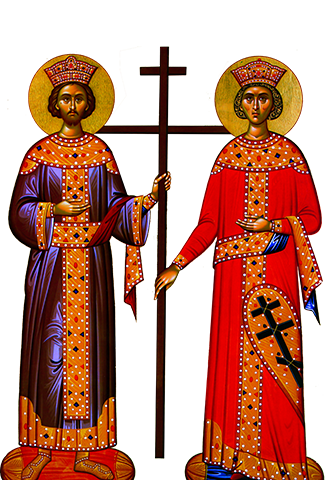
Constantine and his mother Helena What does this have to do with Cyprus? According to one tradition, St. Helena and her crew were shipwrecked on Cyprus on their way back to Constantinople from Jerusalem, and took shelter on the island with the holy relics. As an inveterate church builder, Helena ordered the construction of many churches on Cyprus, just as she had ordered the construction of churches throughout the Levant and the eastern edges of the Empire. She also, as with the “Church of Cats” in Akrotiri (St. Nicholas of the Cats), oversaw the maintenance of churches throughout the island before returning to her son’s side in Constantinople.
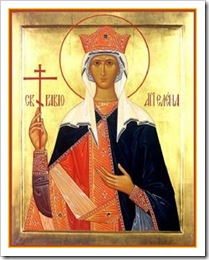
St. Helena, depicted with the True Cross We were lucky enough to see one of the most important of St. Helena’s churches almost on accident. During one of our last days in Cyprus, a group of us went on what was primarily a pilgrimage to a famous halloumi-making workshop. We knew we would visit a winery and a monastery as part of the journey, but my primary focus was the cheese making presentation. After the halloumi brunch and a winery tour, our ITaxi driver, one of the minor saints during our time traversing the island, stopped at a village. We piled out of the bus, and for the first time ever he addressed our crowd.
The monastery we were visiting wasn’t just any monastery. It wasn’t one featured in pictures on the excursion pamphlets with pictures of stunning mosaics and well-appointed Orthodox bishops. What it did have was more important: two pieces of the True Cross and a strand of the rope tied around Jesus on the way to his crucifixion. These relics, our driver informed us, were brought to this monastery by St. Helena, who founded the religious site specifically to house them.
There’s a joke that if all of the pieces of the True Cross reportedly held by churches across the world were brought together, there’d be enough wood to make a ship– and it’s not my place here to address theological controversies or the legitimacy of relics. What was special about this monastery-turned-church was, for me, the fact that our very Cypriot driver needed us to know that it was a truly holy place.
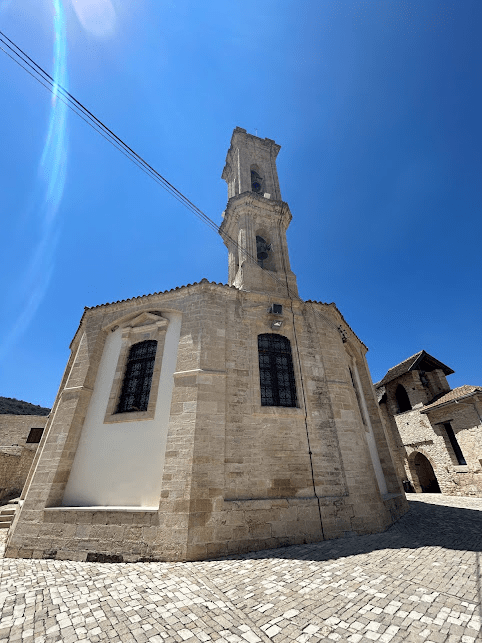
Timios Stavros Monastery, Omodos -Miki Hollingsworth
-
The Excavation History of the Tomb of the Kings – Pafos post 1
While visiting the tomb of the kings site, the work that we are doing in EU23 was on my mind. The number of days it took to clean one wall, and the amount of time I spent finding bedrock in one tiny square. I stared in awe at the columns above me and tried to imagine excavating this site. On the way out I purchased a book called “Digging up the Tomb of the Kings”, by Sophocles Hadjisavvas, hoping it would shed some light on my curiosity. The site was originally found by a treasure hunter, by the name of Luigi Palma di Cesnola in 1870. Scientific excavation did not actually start on the site until 1915, lead by the curator of the Cyprus museum, Menelaos Markides. This first excavation was mostly exploratory with only a few tombs discovered. In 1937, the site shifted hands again the the curator of the Pafos, and this is where the mass of the excavation of the tombs took place. During this time prisoners were actually used for free labor to excavate the majority of the site. Work on the site stopped during WW2 and restarted around 1945 to finish. By 1952, three tombs were completed and several others were in the cleanup phase. After the Turkish invasion in 1974, the department of antiquities took over the excavation and by 1977 systematic work began on the site specifically to study burial customs and Hellenistic civilization. In 1980 the site was included in the UNESCO world heritage sites list. This excavation continued for 14 years until 1990 when the dig was suspended due to conservation issues within the site, and is now in the state we see today. You can see how often this site changed hands, and due to early improper excavation techniques and the erosion of rock due to the salty breeze and sand, this site remains in conservation, and it’s excavation history is just as unique as the site itself.
-
Bio-Archaeology Exhibit at Cyprus Museum
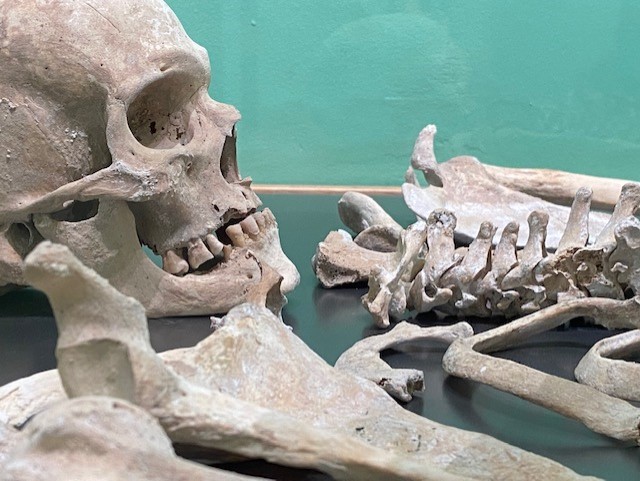
The exhibit “Face to Face: Meet An Ancient Cypriot” was my favorite exhibit visited on the trip. This exhibit was at the Cyprus Archaeological Museum in Nicosia. There were 5 studies of Cypriot individuals of ancient times. Each one of them had a story of who they were, how they lived and what life would have been like for these individuals. There were attached monitors that played videos of the remains found and how the bones were read. Some of which had the burial area and how the bodies were laid in the grave. Ranging from man, woman and child they all had different experiences while alive. One of the women was called the “The Woman From Omodos”. Her story provided explains how she wove threads during her life due to the notch in her teeth that would be consistent of her pulling string with them. This would wear them down over time creating this notch. She was 25-34 years old during the Early Hellenistic period and was approximately 147 cm tall. Her remains were buried with goods of pottery and were laid to rest in a tomb in limestone. Her placement was in perfect condition away from water and due to the soil she was in, her remains was greatly preserved. Her story was touching to me because my grandmother loved to sow and would often use her teeth instead of scissors. It was a reminder that our daily activities leave a permanent imprint on us even after life.
-
The Tomb of the Kings
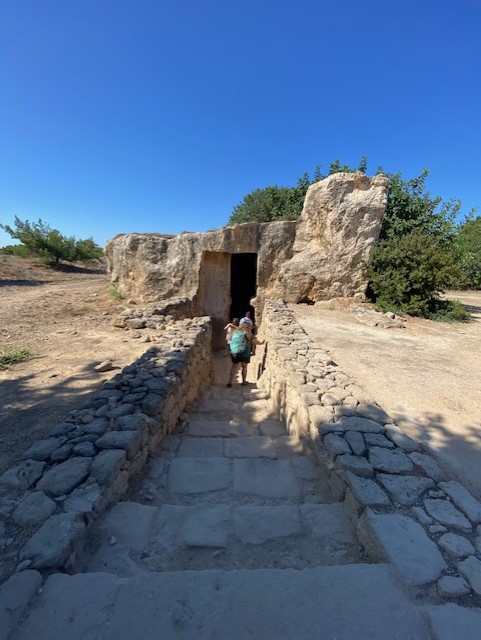
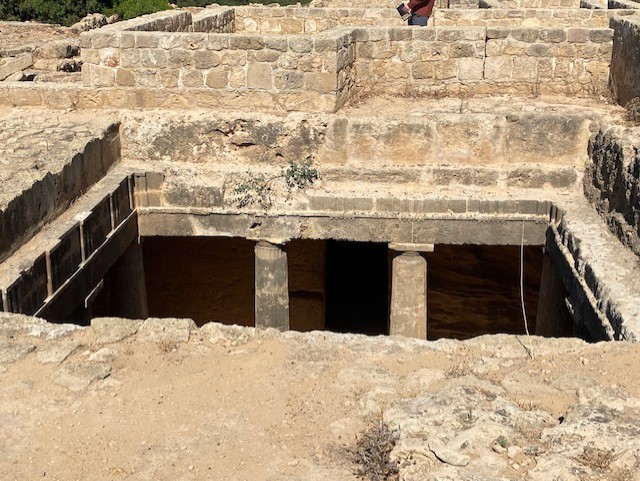
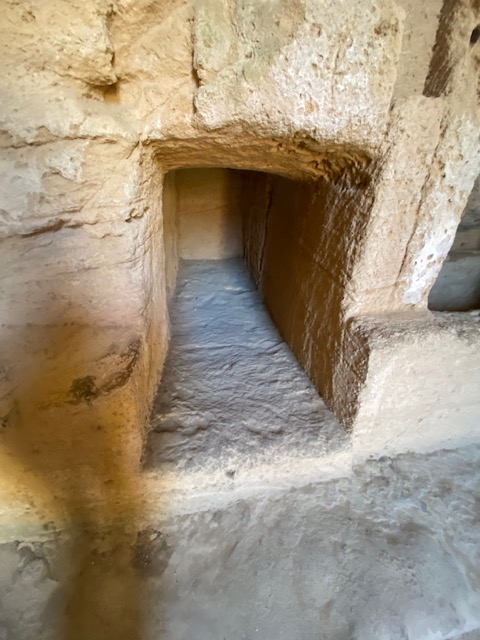
On our field trips we got to view some magnificent sites, one of them being the Tomb of the Kings. This site is a World Heritage site that is being well preserved. The architecture of the tombs is unworldly due to the massive size of these tombs. When walking up to the site you don’t get to see the beauty behind it until you go over the hill to tombs 3-8. The first tomb is directly to the left when you get through the entrance. It has a long staircase down into a massive rock structure. When you enter the doorway, you can see tombs on every side with possible niches carved into the wall. My favorite was Tomb 3 because the tomb is created in the rock below and has pillars with an open floor looking down into it. There is a staircase down into the tomb close to the coast where you can walk down into it. This tomb is called The Atrium due to the central hall that leads to different chambers of tombs. There is an area inside here where you can see tomb 4 as well! There are a few pit-shaped tombs in here that contained Hellenistic pots which would date this area between the 3rd-1st century BC. I found that fascinating due to the fact of our site being during this time and kind of made a full-circle effect on the Island for me in how it was inhabited during this time. However, there are 8 tombs on this site that all have significant awe about them.
-
Kalavasos-Tenta

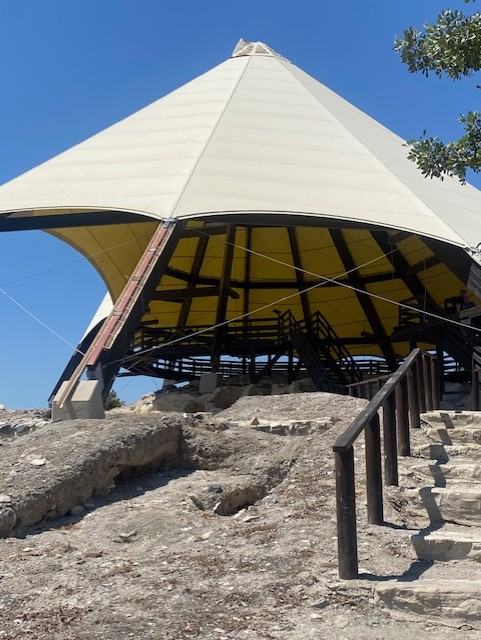
This Neolithic site is one to see! When arriving at the enormous tent I couldn’t believe that there was a site under it. This site was said to have been inhabited as early as 7560 BC due to radiocarbon dates that had been extracted from the site. Along with dating, the excavations have produced bone tools, obsidian blades, stone cookware, and remains of its previous inhabitants. Each of the structures of the settlement are numbered which I found to be peculiar. However, from what I gathered, is a way for people to identify where artifacts were found. For example, in structure #9 there were remains that had been excavated. There were 5 sets of remains that were found here in pits close to the housing structure. In total, there were 14 burials of human remains but contained at minimum 18 different humans. I found this to be the best part of this site because it shows how close they kept their loved ones to their home. I’m curious about how the kinship worked in having them buried below the floors and why there were shallow pits as well. While there are other Neolithic sites on the island this one has a great wall painting in one of the structures. It’s believed to be two humans with their arms raised and painted in red. The art is very neat to see how ancient civilizations interpreted how they looked or if this was something else, they were recreating. Tenta still has mysteries about the tenants who occupied this site which makes this site worth a view when visiting!!
-
The thrill of the dig!
When you think of Archaeology you probably refer to what you see on television. Loosely showing what goes into excavating a site. They show the cool artifacts that they find and how easy it was to pull them up out of the ground. Have you noticed most shows don’t show how they are digging out the items? I went into this thinking it was like the shows, however, it was so much better! Every day that you are on site there is a sweep to clean the area, kind of like doing surgery. Clean the area before you can cut through. This is what we did to get ready for our day most days, then wait for instructions on where and what we will be doing. Peeling back the layers of history a little at a time, looking for anything significant that you can see in changes of soil, seed, pieces of pottery or anything just different than what’s being pulled away. Paying attention to your area is key to finding these fragments of time. When that moment comes when you find something out of the ordinary there is a sense of joy, don’t worry, just go slow because it could be a few days before you get that out of the ground! Patience is key when digging! However, when you finally get out that item or those seeds, no feeling is greater than to show your directors what’s being uncovered. They’re amazing at giving you the background of what you have found as well to add excitement to what you just unearthed!
-
Archaeology stories on Cyprus
When walking around the island you will get to interact a lot with people from the culture and they have a lot to talk about when you do. The man at the corner store Angy’s down the way from the Armenian Church was enthusiastic about talking about the town that he grew up in. When he asked where I was from and I said America I feel like he knew the reason I was in his store. He said not for holiday, and I agreed with a no school for archaeology. His face lit up when I said that as he began to type words into his computer. He pulled up a place called Aya Trias Basilica and began to tell me an elaborate story about how his grandmother had told him the story of the woman who lived there. He explained that the woman had a dream that under the big tree on her property, there was something of significance. She was told in her dream that she needed to dig under the tree to find this and she would feel enriched. With a panic, she woke up and frantically told her husband they needed to dig under the tree because her dream told her to. Her husband laughed it off and told her she was crazy. For days after her dream, she insisted to her husband that they needed to dig under this tree and he still did not have it. It took a little while, but the husband finally said fine, you want to dig under the tree you dig under the tree then. The woman went outside and started digging, before she knew it she had found something of great value, she ran back in to show her husband that she was not crazy and her dream was really someone telling her to go here. Her husband then persisted to help her dig under the tree and they found Aya Trias Basilica in Sipahi, Yenierinkoy, North Cyprus. This is a story from a man who grew up in the village not o far from here.
Story by: The counter man at Angy’s (did not give name)
Study Abroad in Cyprus
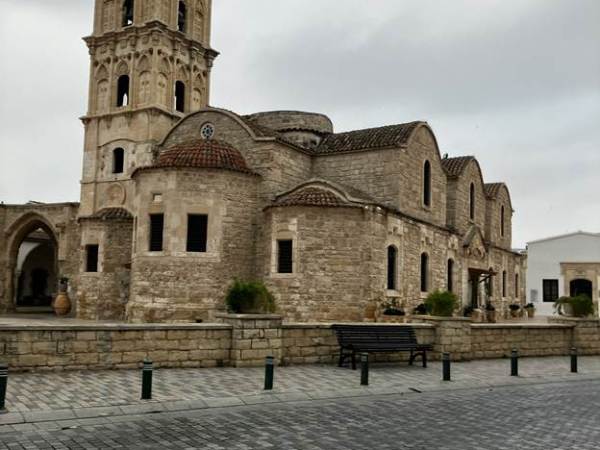
By: Arthur Pino Coming to the Old World is a new experience for me. I can say that, besides the luxuries and brands similar to those in America, it is quite different. This land has been inhabited for at least 4,000 years, according to the sign outside the Agio Lazaros (The Church of St. Lazarus).…

House of Dionysus
By: Arthur Pino On a field trip, we went to Paphos, where we were able to visit a “World Heritage Site.” This would be the second opportunity I have had to see one in my life within the last year; the other was Chichen Itza in Mexico. It was a very hot day, and walking…

A Big Discovery!
By: Arthur Pino Today was another hard but rewarding day. It was the first time I had worked in the trenches three days in a row, and I felt it. This day, in particular, revolved around hands. My hands themselves, and an accessory for hands. As usual, I did not wear gloves to start…

