-
Wifi Passwords Around Larnaca
By: Evan Merkel
Before arriving in Cyprus, I had debated getting a phone plan that would allow me to make international calls, send texts, and use data. As the time drew closer, I had decided against it, as I had wanted to spend my time away from my phone and experience the country and its culture. I also did not want to spend $10 a day for a global pass from Xfinity. As I realized I needed my phone initially for getting around Cyprus, I decided to start trying to collect WIFI passwords. So, in case you, like me, want to avoid purchasing a phone plan, you can still get onto Wi-Fi in a pinch! I hope you avoid getting a phone plan unless it’s an emergency. Being in a new country for the first time can be both scary and extremely exciting.
McDonalds:
The first password that I got was the McDonald’s Wi-Fi password. It is very easy to get into. You have to click the WIFI, and it will let you in. There is no real WIFI password for this place!
Paul’s Coffee Roasters:
Address: https://maps.app.goo.gl/4Az2iQconZq7XSEJ8
Password “cemorrado”
Next is one of my favorite spots, and that is Paul’s Coffee around the corner. They are a small coffee shop that has an excellent iced latte. They also offer roasted beans and some pretty cool T-shirts. This is a superb spot to sit in the morning, have a cup of coffee, and type a blog post, trust me, I’m doing it now. The information for Paul’s Coffee Roasters is as follows.
Stefanos Fish:
Address: https://maps.app.goo.gl/7bVEtUrUVMusZxMY9
Password: STEFANOS2020 (All caps)
This restaurant sits on the ocean, with excellent views of the boats coming in. If you time it right, you will see sea turtles popping their heads up for air, too! They are adorable, and some of them can grow to be quite large! The food was quite good, as it features a lot of fresh-caught fish from the Mediterranean. Careful if you like fish n chips, the fish is a whole piece of cod and they keep the bones inside it.
The Blazer Residence:
Address: https://maps.app.goo.gl/xmRhmZkMXHhbkk2Q6
Password: 123456789
This one is easy, as you can ask the front desk for the password. They have strong, reliable internet here that you can use while you are at the apartment. Perfect for writing blog posts! This will be your home base for the next month, and it will provide all that you need in terms of Wi-Fi.
Guess:
Address: https://maps.app.goo.gl/YuVSmhJn9aED4pEM8
Password: Sign in and add your email.
This is free WIFI next to the blazer, it was reliable while I was sitting on the bench. If you’re waiting for friends while they go into the coffee shop, it will suffice for Wi-Fi!
Starbucks:
Address: https://maps.app.goo.gl/3qEzeARWZsEfFzKDA
Password: @Starbucks!
Starbucks is always a good place for WIFI. This one is situated in the back corner of the street. It’s incredibly safe and comfortable to sit out on the patio, have a coffee, and work.
English Rose:
Address: https://maps.app.goo.gl/1nTp2SJmpHEADwJC9
Password: Welcomehome (all one word and capital W.)
This restaurant/bar is on the waterfront of Paphos, after you have seen the mosaics. This is a small restaurant and bar that’s perfect for grabbing a cold beverage of your choice after walking in the hot sun. There are some vending machines on the field trips, but do not rely on them working all the time.
Pizza Mia:
Address: https://maps.app.goo.gl/Hb4ro1wih7WBvXyH8
Password: PIZZAMIA1990
This place is my favorite pizza place to grab a halloumi and pepperoni pizza. They make a fantastic pizza, and sitting by the large windows, you can see the ocean, which is always a lovely sight.
-
Why are Cyprus Buildings abandoned?
By: Evan Merkel
While in Cyprus, you may find yourself wondering why there are so many abandoned buildings, stores, homes, and more. This is an issue that the island faces regarding its overall economic progress and the management of property holdings. When staying at the apartments in Larnaca, it is evident that some areas have a ghost town feeling. When traveling to different cities, you often experience the same feeling. Why is that? What are the causes for such abandonment, and for homes to be left empty and gutted out? The answer comes in many different forms, including regulations instilled when Cyprus joined the European Union, Cypriots’ refusal to sell their land, homes, and businesses, and the island’s inadequate infrastructure.
Cyprus is home to approximately 1,358,282 people as of 2024, who reside on the island. The country is renowned for being a major tourist destination for many Europeans, including the British. Annually, Cyprus welcomes approximately 4 million people to its sandy beaches and hot, humid weather. With that many people coming in, this should be an economic powerhouse of a country. Why is it struggling, and is it directly related to abandoned houses, shops, and projects? That can be answered by the number of elderly Cypriots who choose not to sell their properties. They believe that their property will sell for a higher price if they set a higher price than if they sell for less. They intend to sell the property that will “set themselves up for life”, which is not a great train of thought. This prevents new infrastructure from being built within the cities of Larnaca, Limassol, and Nicosia, for example.
In Nicosia’s old district, there has been a push to offer state incentives to encourage owners to sell their properties. Per the Financial Mirror, “Old Nicosia is being deserted, with more buildings declared dangerous, despite generous state incentives schemes to property owners”. People are owning these properties, and refusing to sell is causing a significant disruption in the country, which is on track to become the EU’s cultural capital by 2030.
There are hopes from the Cypriot government to begin the regeneration and revitalization of the inner city. In the European Union’s Recovery and Resilience Plan, Cyprus plans to convert these older buildings into student accommodation. This will enable more individuals to move to the island, thereby boosting the economy. The county has experienced overall economic growth year after year, ranging from 2.6% to 3%. However, with a large influx of new owners, the economy is expected to attract smaller businesses that promote a younger lifestyle and family-friendly homes.
Another issue that younger generations have noticed is the forced inheritance of properties. The way this works is that when someone passes away, due to laws in Cyprus, it is a forced heirship, which means that the children have to take responsibility for the property. To sell the property, all siblings must agree; a majority rule is not applicable. For example, a parent of 4 children holds a beachfront property that has not been used in decades. It is a concrete shell of what it once was. The parent then passes away, and the forced heirship becomes a problem for the four children. Three of the children want to sell the place, the fourth refuses due to sentimental feelings. This continues for years, and nothing is done with the property. One day, the oldest sibling, who has three children of their own, suddenly passes away. The issue then becomes more complex. The original number of four holders increases to seven, all of whom must be in agreement.
You can see where the issues originate, preventing people from selling buildings and land that are inherited in Cyprus. Although there is no direct correlation between the number of land holdings and the amount of land being held, it is presumed to be a substantial number.
Another larger issue comes from Russian Oligarchs. In 2022, Putin launched an attack on Ukraine, resulting in a war that continues to this day. Sanctions were issued against Russian Oligarchs who were profiteers of the war, and owners of large arms-dealing and contracting companies that aided Putin in his invasion of Ukraine.
The oligarchs found a way around being sanctioned by the European Union by opening offshore bank accounts in the country, which helped hide funds from seizure and freezing. Oligarchs would purchase property, yachts, companies, and trusts. The International Consortium of Investigative Journalists (ICIJ) conducted an investigation into money laundering in the country. “Petr Aven, one of the key strategists behind Russian financial powerhouse Alfa Group, used a Cyprus firm to shift $5 million outside of European authorities’ reach just as the ER was announcing sanctions on members of Putin’s inner circle, including him”( International Consortium of Investigative Journalists). These evasions would hit Avens’ real estate manager, who had to forfeit over $1 million.
In the eyes of European legislators, Cyprus was a “weak link” in the fight against money laundering. They have been scrutinized for their lack of laws against money laundering, to the extent that some of it is known about. The ICIJ had discovered a $1.4 billion investment that was sent to a Russian oligarch’s wife to evade the sanctions. The ICIJ states, “the Cyprus government had been aware of the suspicious transfer for months, but authorities had dragged their feet in responding” (ICIJ).
Cyprus has been taking positive steps to prevent a repeat of the actions by Russian oligarchs. The country has taken moves in recent years to correct this mistake. The government has implemented reforms to protect whistleblowers and increase transparency for the public. They have also established an independent authority to help combat corruption that occurs on the island. They have also increased anti-corruption training and awareness in the country to prevent this from happening again. All of these reforms were implemented in the country’s Official Gazette between January and July 2022.
With the housing and buildings being vacant, there are still a large number of shops around Larnaca, and Cyprus, that are abandoned. Some that have mail sitting inside the door, which have received neglect due to water damage and the sun. As in the states, businesses, especially small businesses, tend to be hit the hardest and are usually forced to close.
In Larnaca, every corner is littered with buildings that appear to have been left unfinished overnight. The main culprit is the high rent costs imposed on these businesses. One Reddit user stated that it was due to “landlords owning a building, not keeping the building up to code, and then charging tenants as if the building is brand new”. This comes back to the issue of older Cypriots who own these buildings and want to “set themselves up for life”.
However, some commenters have stated that many businesses have relocated to a local shopping mall here in Larnaca. Thus, due to the cheaper rent that the shopping mall is offering. This does not help the city improve its livability on the city streets. Some businesses have completely abandoned their premises, leaving wine bottles on the shelves and creepy mannequins in the windows.
While you stay in Cyprus, your awareness of the buildings will be at the forefront. It is a sore thumb that sticks out in everyone’s face and is generally ignored by the locals. Cyprus has had issues in the past with corruption, obscure and complex laws regarding land inheritance, and overpriced buildings. It has a certain charm, both in the country and the city of Larnaca. If you are a returner, one of your favorite businesses may be gone the following year. A restaurant you didn’t get to try the first time will have vanished without a trace the next time you’re here.
Go out and try new things; if you want to take advantage of the city’s uniqueness, branch out and explore. Experiment with new foods, cultures, and lifestyles. There is plenty to be had in Larnaca while you’re here. Because when you blink, it will be gone.

-
First Week in Cyprus
By: Jackson Warner
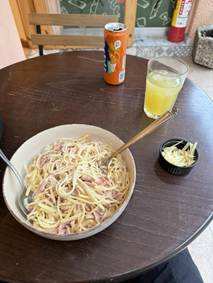
We have just finished a week in Cyprus, and it has exceeded my expectations completely; it has already been an incredible experience. There are three things I want to bring up about my first week in Cyprus and some advice I’d like to share. First, the city of Larnaca itself. I have walked around the city quite a bit, but I still haven’t seen all it has to offer. However, it is incredibly beautiful and has many streets to walk down. Numerous shops and kiosks offer a variety of items, including water, snacks, soda, and other treats, as well as a large grocery store that provides everything you may need for food and some essential toiletries. My advice would be to not buy too much when you go to the grocery store for the first time. If you don’t want to eat out, that’s understandable, but there are plenty of great places to eat near the hotel. My advice would be to get lunch meat, such as salami, some cheese, any condiments you’d want, and bread. Then, pack a bottle of water and any soda or other drinks, as they are often sold in packs at a lower price. Snacks are also affordable there, but I found that unless you’re extremely hungry, you don’t need many snacks. Next, as for eating out, there are several great options available. Some of these include Pizza Mia, they have delicious pizza that is easy to share as a group. My personal favorite so far has been Capodecina Pasta Bar, which is less than a block away from the hotel and offers amazing pasta that I’ve visited twice in one week. The prices at the pasta bar are also very reasonable, the carbonara I got was only 10 Euro.
There are also other great food options around; I personally have been and would advise walking around and seeing what interests you and stopping in. My other food-related advice is that after a dig, when you’re hot and sweaty, nothing beats the smoothies at Chris Juice Bar. It’s right around the corner from the Hotel and costs only 4-4.5 euros, making it definitely worth the price. They are some of the best smoothies I have ever had. My last piece is about the dig site and dig days. It is a lot of work, and you need to make sure you drink plenty of water. Before you go to the dig site, you will visit a bakery where you can purchase snacks and water if you don’t have enough to bring from the Hotel. The dig site can get very hot, so be sure to stay hydrated. I generally drink about 3 Liters of water on site, and you will sweat it out. The digging itself is incredibly fun and rewarding! Luckily, I haven’t been burned; with the times we have dug, I have only needed to put on sunscreen once or twice maximum. Lightweight boots are probably better than sneakers, I have been using sneakers, and you will get plenty of dirt in them. You will become more accustomed to the heat within a week but be sure to continue drinking water.
-
Typical Day at the Dig Site
By: Jackson Warner
Before you decide to come to Cyprus or even after you head to Cyprus, you might be asking yourself what a common day at the dig site will be like. You might want to know how to prepare yourself for the work at the dig site. In this blog, I will be telling you everything you will need to know and tell you what you will need to prepare for when you come to the dig site.
This is your guide to a typical day at the dig site.
Digging itself will be tough work; one thing that isn’t in the Survival Guide to buy are knee pads. I would highly advise investing in knee pads. Oftentimes, you will be working while on your knees, and knee pads are extremely helpful. Like the advice in the Survival Guide, even though it gets hot, pants and long sleeves are needed to protect you from the sun, and all you should need is sunscreen for your face.
A common dig site day will generally be a 5am to 12 am dig. This will mean you will want to wake up at 4am generally, but you can push the time if it doesn’t take you very long to get ready in the morning. You will need to be at the parking lot, where the vans are parked, which is a short two-minute walk from the hotel you are staying at, by the latest 4:55 am. My advice would be that it is not worth it to take a shower before you dig, even if it helps you wake up, as you will be getting plenty dirty during your dig days. On dig days in the morning, you will go to Zorbas Bakery before you head up to the site. Zorbas has a very wide option of food and drinks, so if you have forgotten to pack a lunch/second breakfast, it is a great place to pick up food, or if you prefer not to make your own lunches/second breakfasts, it is a good place to get something as the food there is cheap. You will want something to eat on site. Typically, you will get to the site at 5:30 am, and you will grab your supplies and set up the tents before getting in your EU (excavation unit).
Next, you will be digging until 7am in your trench until there is a 15-minute water break. The mornings are generally pretty nice as the sun isn’t out yet, and sometimes, there is a nice breeze coming in from the ocean. After your 15-minute water break, you will be digging again until 9 or 9:30, and that will be your 30-minute lunch break. After your lunch break is when the sun starts to hit, and it can get quite hot, but at that point, you are only working for about another two hours until 11:30 or 12, and then you will begin cleanup. Then, after cleanup, you head back to the hotel, and you will have the rest of the day to do whatever you want to do!
-
The Kourion Amphitheater
By: Jackson Warner
The Kourion Amphitheatre was first built in the second century BCE, but the remains we saw at the ancient site in Kourion were from the Roman period in Kourion, dating to the third century CE. It was a large amphitheater that could seat three thousand five hundred. At the peak of Kourion, there were around twenty thousand civilians, meaning close to twenty percent of the citizens in the city could come and enjoy their time in the amphitheater. The amphitheater itself rests on a hill overlooking the sea, and it has a stunning view of the ocean. The theater, like much of Kourion, was likely damaged and destroyed in the earthquake that affected Kourion in the fourth century and was subsequently abandoned. Standing in the middle of the amphitheater that has been restored gives you a great image of the scale of the structure and how a performance would go there. Listening to the reverberations of your voice in the center is quite exciting.

The Kourion Stadium, which is the only known ancient stadium in Cyprus, is also an impressive site. It would have been home to various games and athletic events, with a capacity for 6,000 spectators. The stadium is quite long but not very wide. The stadium is a total of 229 meters long and 24 meters wide. At the stadium, we ended up having a race with running half the stadium.
The Kourion Forum and Baths, in my opinion, are the most impressive part of the site at Kourion. The Forum was a large, very heavily developed area that would have been central to the city of Kourion during the Roman years. There were locations for private housing, a church, and an area for shops. It would have been the central area for public life in Kourion, where the majority of people would have congregated during the day. But most impressive were the public baths; at Kourion, there were multiple different areas with public baths. With one hosting five different baths that you would bathe in, successively going from warm all the way to the hottest and ending with a cold bath in the star-shaped bath. Although the baths might not look as impressive as other Roman baths in Europe that have survived in better conditions, you can still see how impressive the public baths would have been in its heyday.
The Kourion site is absolutely impressive, featuring numerous interesting and beautiful structures. It has a rich history packed into it, with multiple different habitations dating back to the Neolithic period and continuing through to the Roman Period, until the earthquake. There are also stunning views around the ancient city that will take your breath away. Kourion is an amazing place to explore with your friends on the trip, and it was extremely impressive. Kourion was highly anticipated by the leaders on this trip, and it completely exceeded the expectations set! The Amphitheatre, Stadium, and Baths were the three most impressive areas I saw at the site. However, there were even more interesting and amazing areas there as well.
-
Sarcophagus
By: Jackson Warner
Here in Larnaca and throughout Cyprus, we have been able to see many sarcophagi, some of which are quite unique. The sarcophagus burial custom was introduced to Cyprus during the Cypro-Archaic period (late 7th century/early 6th century BC). It was likely introduced during cultural exchange with the Persian Empire. In the Persian Empire, it was customary for those in power to be buried in a sarcophagus, thereby showcasing their authority, power, and wealth as leaders. In Cyprus, burials in sarcophagi are more commonly found on the eastern side of the island, leading to the belief that the influence came from the east rather than from Greece or other western Mediterranean cultures. In Kition and Amathous, the majority of early sarcophagi were found in Cyprus. Before the use of sarcophagi, the typical way that people in Cyprus would bury the dead would be with simple graves, tombs, and it was even found that they would bury their dead under their house floors. However, we observe the expansion of influences in the Mediterranean, as evidenced by the change in burial practices in Cyprus. Typically, sarcophagi in Cyprus were reserved for wealthier or more powerful individuals and families.
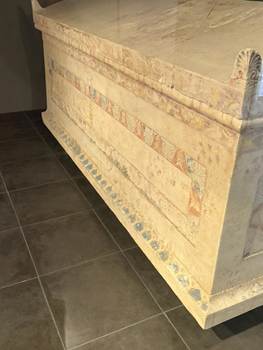
At the Larnaca Archaeology Museum, six sarcophagi are on display, whose designs showcase different cultural influences in Cyprus. Two sarcophagi exhibit obvious Egyptian influence; they are decorated with human features on top, a common motif in ancient Egypt. The most impressive sarcophagus at the museum is a painted white marble sarcophagus that was imported into Cyprus. It was discovered in Larnaca at the West Necropolis and dated to approximately 400-380 BC. The sarcophagus has a lid shaped like a Greek Temple, with decorative elements on each side. It was painted, and the paint is still well-preserved, so you can get a great look at it when you visit the museum. It is decorated with what could possibly be a scene from a play written by Euripides, Iphigenia in Tauris. It could be interpreted as the meeting at the grave of Agamemnon by Orestes and Electra. They found inside the sarcophagus a young woman and an infant. The skeletons were accompanied by jewelry and other small personal items. The sarcophagus is completely unique and is believed to come from an extremely skilled workshop in Greece. Through these sarcophagi, we can see how Cyprus served as a hub where the various cultures of the Mediterranean would converge and exert their influence on the island. They can also help you create a timeline of the history in Cyprus and the Mediterranean, as we can see who exerted the most cultural influence in Cyprus at different periods. In Cyprus, there is an abundance of sarcophagi that you can see. Over this trip, I have seen a few dozen, and each one is interesting in its own way. One thing to look forward to on your trip will definitely be the different sarcophagi you will see!
-
Cats of Cyprus
By: Jackson Warner
When you first arrive at the hotel after getting off the plane, one thing you will immediately notice is the large number of cats outside. In Cyprus, there are more cats than humans; there are around 1.5 million cats living on the island. The majority of these cats are stray cats, and they can be found on every street in Cyprus. You will often see them around restaurants, where they will walk around your table, looking for food or hoping you will give them some. You might ask yourself why there are so many cats in Cyprus, as I did when I arrived.
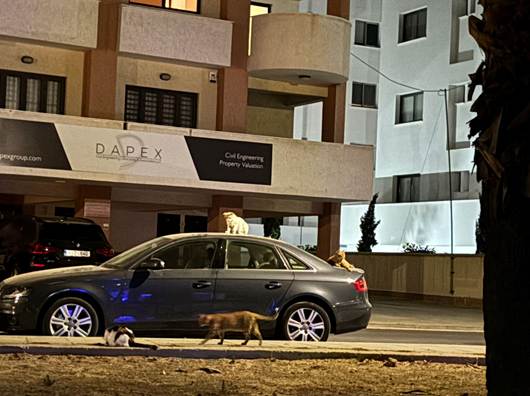
The earliest known written records and a legend in Cyprus suggest that the arrival of cats on the island dates back to the 4th century AD. It is a story of Saint Helen of Constantinople, in the 4th century AD sent two boatloads of cats from Egypt and Palestine to deal with a snake infestation at a monastery. The monastery would become known as the “cat monastery,” where cats could roam freely and were well cared for. However, it is just a legend; there hasn’t been any conclusive evidence showing that two boatloads of cats were received in Cyprus. However, the legend suggests a possible bleedover into the cultural acceptance of stray cats, which is evident in modern Cypriots. Often, you will see food on the side of the street for stray cats that locals have left out, and they will often care for them as they are viewed as companions in Cyprus. For instance, in Lefkara, a shop owner was taking care of four stray cats and told us how he loved them as his own. The cats were hanging out in front of his shop with food bowls there for them to eat. However cats have been in Cyprus much longer than the legend of the “cat monastery”. In a 9,500-year-old grave, cat remains were found alongside human remains, indicating that people in Cyprus had cats in close proximity for much longer.
In Cyprus there is a complete lack of spaying and neutering programs for stray cats and the government has insufficiently addressed the issue of stray cats. With locals feeding and taking care of stray cats, and no programs to control their population size, these factors compound the issue. Cats have large litters of kittens and can produce those large litters multiple times a year, resulting in significant population growth of cats in Cyprus.
The cats in Cyprus are generally very friendly and are extremely cute! But be careful they do have claws and can definitely scratch you. Also, when you go to a restaurant and eat outside, you can definitely be swarmed by a group of cats looking for a meal. It will be extremely hard to miss seeing cats out and about in Larnaca and Cyprus and you will have plenty of opportunities to take pictures of cats.
-
Cats of Cyprus
By: Augusta Tate
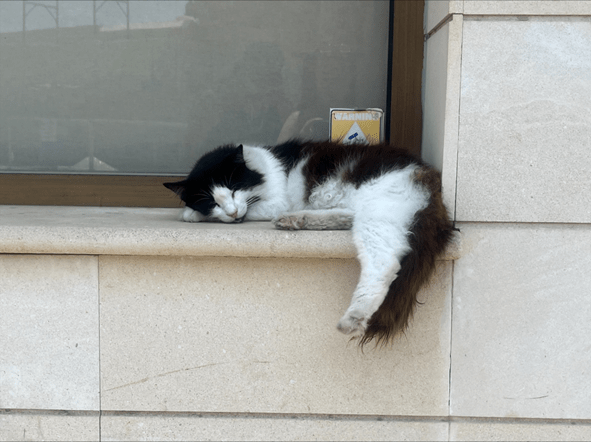
Cyprus is known as the “island of cats” due to its large population, which outnumbers the human population by just a few thousand. There are an estimated 1.5 million cats on the island, which seemed unbelievable to me at first. Before the trip, when I was researching online, people had raved about the cats in Cyprus, so I knew what to expect. However, I didn’t fully realize just how abundant the cats really are here, especially in Larnaca.
Upon my first arrival, I could tell that most of the cats here are friendly and can be pet (with caution, of course), some are skittish and keep to themselves. Some just cannot be bothered as they are too busy basking in any available shade to keep away from the extreme sun. If you do pet a cat, it’s best to have a small bottle of hand sanitizer with you to protect yourself from any germs they may be carrying.
The cats in Larnaca live both on the streets and with people, but even the street cats seem to be taken care of,. In front of shops, the workers will place small water and food bowls for them. Or they will hang out around certain buildings and reside there,, much like bodega cats. Then they are also taken care of by the kindness of strangers, even tourists who will buy cat food from any kiosk and feed them. During the daytime,, the cats will make themselves scarce due to the heat, but will be more frequent in the streets at nighttime.
If you are wondering if they can be taken back home, the short answer is yes. However,, the process of bringing a cat from another country is a lengthy one, as they need to be checked by a veterinarian, and then quarantined for a few weeks before being flown to the U.S. It’s not impossible,, but itefinitedefinitely require be a lot more effort than most people would think.
It’s obvious how much the people of Larnaca, and indeed all across Cyprus, take pride in their cats,, or at least they are aware of their popularity with tourists. At every souvenir shop, you’ll find cat-themed tote bags, mugs, towels, shirts, and many other cat-related gifts for sale. However, the people here also have a genuine affection for the cats,, as it is a cultural practice to feed and care for them, even if they don’t own them. Several organizations and shelters help rehome stray cats, whose population size is growing at a high rate. A rising issue in Cyprus is keeping the cat population sterilized;; however, the government has been making stridesstrides by funding 100,000 euros a year to help with the problem. Sanctuaries have also been established to help house the hundreds of cats on the island, such as Malcolm’s Cats, located in Limassol.
-
The Zenobia Wreck Experience
By: Augusta Tate
Larnaca offers many great tourist attractions, and one of them is a diving and snorkeling experience that explores the remains of a sunken shipwreck. The Zenobia was a Swedish ferry boat that sank just outside Larnaca in 1980 due to a pumping system failure carrying many vehicles and large shipping containers. This shipwreck site is considered one of the best diving sites in the world and the top in all of Cyprus.
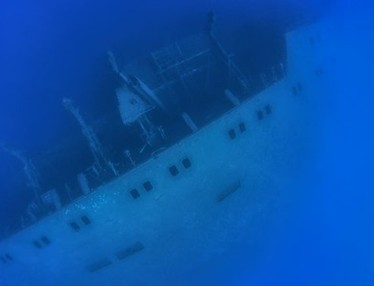
Many expert divers visit this site to explore the ship’s ruins, as it is easily accessible, and even beginners come here to practice and complete their diving training.
Reaching the boat that took us to the site was very easy, especially if you’re in downtown Larnaca, located right next to the beach. The walk from our place to the Blazer Hotel was about 30 minutes, maybe a little under, and all you do is follow the beach past Larnaca Castle to the port. The walk is very pleasant, as it is right along the water, and the cool ocean breeze helps alleviate the heat. There are an array of seafood restaurants along the way, although I haven’t been to any. I’ve heard from other students that the seafood restaurants get better the further away you get from the main beach.
When you arrive at the port, the Zenobian tour guides are very welcoming and nice. However, I recommend planning to go on a calm weather day, when the weather is relatively calm, which is most days. This is because they will reschedule the trip if it is too windy outside, ensuring the safety of swimmers and divers.
Many people from all over the world come to this spot to dive, and you can have the opportunity to meet interesting people and new faces during this experience. During my boat ride, I had the chance to meet an English gentleman who had been diving in the Baltic Sea for many years and a younger man that happened to also be from the States. The crew also offers a variety of drinks; however, if you prefer coffee or tea, you will need to make it yourself using the instant coffee available.
Once you are driven to the spot on the boat, there you can see mini buoys in the water, and the boat will stop right in the middle of a line of three. This is how they can determine the ship’s location. You will be given the option to have food flippers fitted to your size if you need extra help while swimming. However, if the water is relatively calm, you won’t need them.
If you are afraid of deep water, this experience can help alleviate that fear in a way. I only went snorkeling, so I can’t say what the experience is for those who want to scuba dive. But they do provide snorkeling goggles with a tube, so you don’t have to bring your own, and they are great quality.
Once you get into the water, you can immediately see the ship directly down, still fairly deep, but it is a comfort that you can see the ship on its side. There isn’t a guide to follow or someone giving a tour; it’s a very much a do-it-yourself experience, which, in my opinion, was very nice because it gave us a chance to explore the area freely. You can follow the entire length of the ship from above. It’s very easy to see, and there are mini buoys, like I mentioned earlier, to help guide you a bit. You’re able to get a clear view of the starboard side of the ship or the left side and an even more clear view as you swim towards the front, as that’s where the seafloor rises. Even from the surface of the water, you can see an array of life. Schools of fish hang out around the nearby boats. And they will swim right underneath you disturbingly, which is fascinating and wondrous to see. Apparently, the divers who came with us saw a sea turtle that blended in very nicely with the colors of the rocks at the bottom.
I cannot stress enough how beautiful and clear the Mediterranean Ocean is. It’s truly breathtaking just how deep blue it’s, especially once you move away from the main beach. The Zenobia Wreck is definitely an experience worth having, and I would absolutely do it again, given the chance. I would encourage those seeking adventure that’s not too far away from the main part of Larnaca.
-
Armenian Dance Festival
By: Augusta Tate
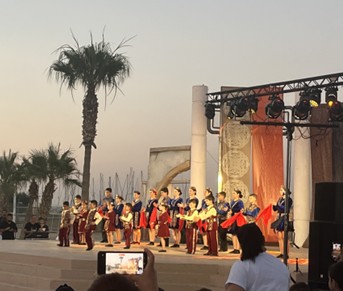
During my time here in Larnaca, I got the pleasure of seeing a live dance performance right in the middle of the boardwalk on Larnaca Beach. I learned about the festival through word of mouth and by seeing signs posted in the surrounding area.
They performed on June 27th at the Municipal Amphitheater right against the beach during the early evening hours. Plastic chairs were lined up in front of the stage, allowing anyone to sit where they liked, as it was a free, public performance. Older people and people with young children were the first to be seated, maybe because they were related to the dancers.
The Armenian Dance Festival 2025, presented by the Hamazkayin Dance Committee, showcased dances from multiple dance studios, including Prof Art Dance Studio, Aera Art Studio, Sipan Dance Group, Ani Dance Group, and Nanor Dance Group. These are all different dance studios located nationally. According to their website, they seem to perform all across the globe, including Cyprus.
The Hamazkayin Dance Committee operates under the Hamazkayin Armenian Educational and Cultural Society, a non-profit organization dedicated to educating younger generations about Armenian culture and history, as well as preserving it. The organization was created in the late 1920s after the Armenian Genocide. This time displaced many of the Armenian people and dispersed them throughout the world, specifically too many Middle Eastern countries. A group of intellectuals gathered to create the Hamazkayin group, which has operated numerous educational institutions and programs for the past 70 years, with some even located in the U.S.
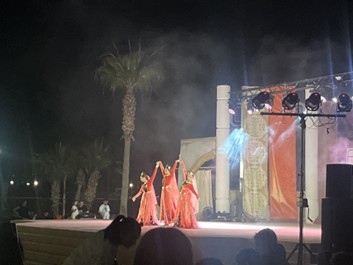
I was pleasantly surprised to discover that all the performers in the show were children, ranging in age from approximately 5 to 15 years old; no adults were performing the dances. I had seen smaller children sitting in the front with their dancing attire on, but I didn’t realize until the show started that all the performers were so young. It made me appreciate the dedication that the Hamazkayin organization has for teaching and preserving their culture, especially for younger generations.
The dances were incredible to watch, and I was very thankful that admission was free. However, I would have paid to see it anyway. Each performance was typically separated by age group, which made sense since that would probably correlate with skill sets and abilities. They came out wearing beautifully vibrant-colored costumes and sometimes used props, such as pieces of cloth or batons, which were integrated into the dances. The dances could be divided into a few different categories, one being a large group dance in which both girls and boys dance together in a fast-paced manner with energetic music and dance movements. These always seemed to end with everyone joining in a circle in the middle and spinning around, creating a very exciting energy. When this happened, a few people in the audience would start clapping along to the beat, eventually getting the whole crowd to join in.
Then, there were more slow-paced dances that usually featured girls in smaller groups dressed in elegant, beautiful dresses that really made them look like princesses. However, most of the performances were high-energy. The dance festival was a fantastic experience and a great way to see and appreciate a part of Armenian culture.


Study Abroad in Cyprus
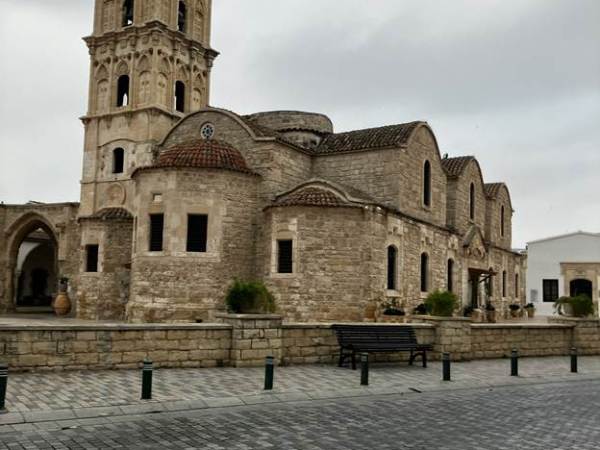
By: Arthur Pino Coming to the Old World is a new experience for me. I can say that, besides the luxuries and brands similar to those in America, it is quite different. This land has been inhabited for at least 4,000 years, according to the sign outside the Agio Lazaros (The Church of St. Lazarus).…

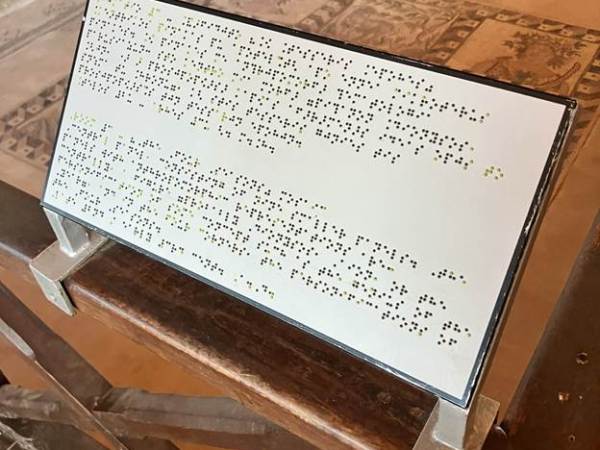
House of Dionysus
By: Arthur Pino On a field trip, we went to Paphos, where we were able to visit a “World Heritage Site.” This would be the second opportunity I have had to see one in my life within the last year; the other was Chichen Itza in Mexico. It was a very hot day, and walking…

A Big Discovery!
By: Arthur Pino Today was another hard but rewarding day. It was the first time I had worked in the trenches three days in a row, and I felt it. This day, in particular, revolved around hands. My hands themselves, and an accessory for hands. As usual, I did not wear gloves to start…

