By: Jackson Warner
Here in Larnaca and throughout Cyprus, we have been able to see many sarcophagi, some of which are quite unique. The sarcophagus burial custom was introduced to Cyprus during the Cypro-Archaic period (late 7th century/early 6th century BC). It was likely introduced during cultural exchange with the Persian Empire. In the Persian Empire, it was customary for those in power to be buried in a sarcophagus, thereby showcasing their authority, power, and wealth as leaders. In Cyprus, burials in sarcophagi are more commonly found on the eastern side of the island, leading to the belief that the influence came from the east rather than from Greece or other western Mediterranean cultures. In Kition and Amathous, the majority of early sarcophagi were found in Cyprus. Before the use of sarcophagi, the typical way that people in Cyprus would bury the dead would be with simple graves, tombs, and it was even found that they would bury their dead under their house floors. However, we observe the expansion of influences in the Mediterranean, as evidenced by the change in burial practices in Cyprus. Typically, sarcophagi in Cyprus were reserved for wealthier or more powerful individuals and families.
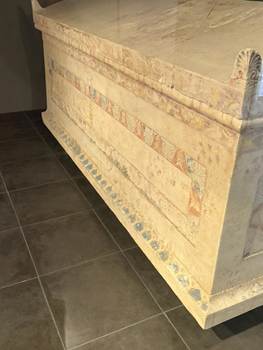
At the Larnaca Archaeology Museum, six sarcophagi are on display, whose designs showcase different cultural influences in Cyprus. Two sarcophagi exhibit obvious Egyptian influence; they are decorated with human features on top, a common motif in ancient Egypt. The most impressive sarcophagus at the museum is a painted white marble sarcophagus that was imported into Cyprus. It was discovered in Larnaca at the West Necropolis and dated to approximately 400-380 BC. The sarcophagus has a lid shaped like a Greek Temple, with decorative elements on each side. It was painted, and the paint is still well-preserved, so you can get a great look at it when you visit the museum. It is decorated with what could possibly be a scene from a play written by Euripides, Iphigenia in Tauris. It could be interpreted as the meeting at the grave of Agamemnon by Orestes and Electra. They found inside the sarcophagus a young woman and an infant. The skeletons were accompanied by jewelry and other small personal items. The sarcophagus is completely unique and is believed to come from an extremely skilled workshop in Greece. Through these sarcophagi, we can see how Cyprus served as a hub where the various cultures of the Mediterranean would converge and exert their influence on the island. They can also help you create a timeline of the history in Cyprus and the Mediterranean, as we can see who exerted the most cultural influence in Cyprus at different periods. In Cyprus, there is an abundance of sarcophagi that you can see. Over this trip, I have seen a few dozen, and each one is interesting in its own way. One thing to look forward to on your trip will definitely be the different sarcophagi you will see!
 Vigla Archaeological Project
Leave a comment