By: Augusta Tate
One of the many field trips we took as a group was to the ancient city of Kourion and the temple sanctuary of Apollo and Hylates. Both sites were very fascinating to explore, the ancient city being the most interesting. The city had large floor tile mosaics that would have been found in elite houses, most of which were fully intact and still in their original context. The city was also fully equipped with classic Roman bath systems, utilizing a series of stacked bricks below the baths to push hot air underneath, thereby heating the water above. There were both hot and cold baths, as well as elegant pools. Remnants of an early Christian basilica can be seen right in the middle of the city, dating back thousands of years to the very start of the religion. It also seemed to be an active site, as parts of it were still under study and excavation. Buckets and tools similar to those used at Pyla Vigla were stored under walkways and in shaded areas.
But to me, the most interesting part of that trip was the museums associated with Kourion. The Local Archaeological Museum of Kourion is situated in a small village outside of Limassol, approximately an hour’s drive from Larnaca. The museum is very small, consisting of only two rooms, and is located in what appears to be someone’s summer house. Despite first impressions, it was probably the best museum I’ve visited during my entire time here in Cyprus. After visiting the large archaeological museums in Paphos, Nicosia, and Larnaca, this one had both the best displays and the best location. Part of a museum experience is more than just expanding your knowledge and looking at artifacts through a glass, it’s also about the overall atmosphere. This museum had a unique charm that the others didn’t.
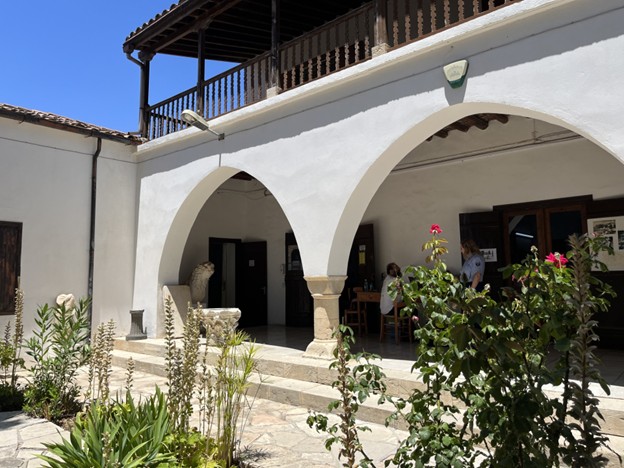
The museum is in a traditional Cyprus-style house, with a small courtyard in front. The building is a brilliant white, with swooping arch doorways that invite you to come in closer. You can tell that the building is old just by seeing the wear on the wooden shutters, doors, and stairs. Tall bushes of flowers surrounded the courtyard, almost enclosing it in this small space.
The admission was also free, making it a very cost-effective option to visit here. The artifacts inside were items found at both the city of Kourion and the Sanctuary of Apollo. The room to the right housed smaller items, such as metalwork and jewelry. Small figurines, stamps, and molds were also shown in this room, along with older clay figurines that dated back to Neolithic times. And one marble bust that was quite worn, but the form was still discernible.
A bigger room to the left is bigger and holds more artifacts. There are a few marble busts and full statues, all of which are a little worn and torn due to time. Some more jewelry and metalworks.
But the main spectacle for me was the collection of bones they were displaying. There were some animal bones on display, including small fragments of bones from smaller animals, such as dogs and birds.
Human and mule bones were also found at the same location. Archaeologists determined that they had died during an earthquake that happened in the late 4th century AD. A girl was leading her mule into the house for safety, but unfortunately, she passed when the roof collapsed onto them both. However, because the roof fell over them, their remains were remarkably well-preserved from outside elements. In the same house was a family of three: a mother, a father, and their young baby. They passed under the same circumstances. Their remains, however, are incredibly well-preserved and infamous because of that.

 Vigla Archaeological Project
Leave a comment