By: Douglas Pearce
Just 30 minutes northwest of downtown Larnaca sits the picturesque village of Choirokotia. Nestled at the southern end of the Troodos Mountains in the White Mountains area, the village is home to one of the most unique experiences in Cyprus. A brief walk up winding cobbled streets leads to the Petros Nikolaou Basketry Workshop & Museum. Here, visitors are given a front-row seat to demonstrations of two of Cyprus’s most renowned traditions: halloumi and basket weaving.
Upon entering the museum, guests are greeted with an array of traditional, colorful baskets lining the walls of the foyer. After surveying the baskets, guests will cross a narrow bridge with blue wrought iron railings that straddles a small pool with large coy fish. Now visitors will be in an open courtyard with small dining tables, surrounded by greenery and flowers, with a natural canopy of grapevines above.
The true treasure of the museum, however, is not the baskets and beautiful courtyard, but Petrous himself. Petrous Nikolaou is a modern-day renaissance man. He has been able to combine his passions to create something truly special for himself, his village, tourists, and his home country. Each day, Petrous plays many roles; He is a skilled farmer, chef, basket weaver, and entrepreneur. Petrous is one of only three people left in Cyprus who still do traditional basket weaving. He believes the practice will become extinct within the decade.
Petrous begins with an explanation of the long history of traditional basketry in Cyprus, handed down for generations, just as he acquired the skill from his grandparents. He displays the various reeds and straws used by skilled artisans to create these functional yet artistic pieces, describing the process of how they are softened and dyed. He notes that the museum contains two original baskets from his grandparents, which demonstrate the old way of adding color to baskets before the dying of reeds: they would weave thin strips of fabric from old clothing into the baskets. Traditional baskets had no color as they were more utilitarian. Common uses were for carrying vegetables from the field, such as potatoes and watermelons. He also showcases a small basket called a “talari,” which is used in the haloumi-making process.
Then it’s time for a traditional basket weaving demonstration. Petrous methodically exhibits the steps in creating the layered rings, showing how they are secured to each other and how color accents are added. He explains it so thoroughly that visitors may think they can easily replicate it at home.
After the basket demonstration, it’s time to make haloumi. Although legend attributes the origin of halloumi to Cyprus, it is unclear if it was first produced there; records of it on the island date to around 1554. Whether haloumi originated in Cyprus is debatable, but its inextricable connection to the island’s identity is not. Haloumi is one of Cyprus’ major industries, accounting for over 13% of its exports and $500 million in global sales. Trademark law ensures that cheese produced in Cyprus must be called “haloumi.” Its high melting point allows grilling, making it a popular protein alternative for vegetarians.
Petrous explains the process of milking the goats in the morning, then heating the milk to body temperature after adding rennet. He uses vegetable rennet in his cheese to accommodate religious traditions that prohibit the mixing of animal products. Next, the milk coagulates and turns into cheese curds, which are then cut into pieces and placed in the talari basket. The curds are pressed to strain, and the liquid that comes out separates the whey. Then it is reheated with the addition of more milk, which will be congealed again, and anari will be formed. When it is dried, anari is stored. To separate the anari from the whey, he uses the talari basket to press it and strain it. The whey is heated, and the halloumi is cooked on low heat for about an hour. For the finishing touch, Petrous adds salt and fresh mint before folding in two, which resembles an omelet.
A small brunch buffet is then presented to guests, offering traditional Cyprus delights, including the haloumi used in the presentation. There is also Koulouri, a traditional Cyprus village bread covered in sesame seeds, and soutzoukos, a traditional Cyprus sweet which Petrous makes with carob syrup and mixed berries, rather than the traditional boiled grape juice. Olives marinated with coriander seeds, cucumber, tomato, ham, and hard-boiled eggs are also available, accompanied by tableside coffee service.
After brunch, guests are encouraged to explore the museum, which features traditional baskets from the island as well as a traditionally furnished Cyprus home, dating back to the 1850s. Visitors can also purchase haloumi and baskets to take a bit of Cyprus tradition home with them, thereby supporting traditional basketry and hopefully keeping the tradition alive.
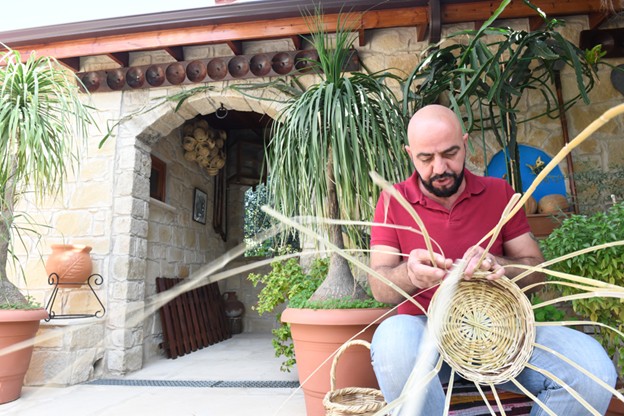
Petrous is demonstrating a weaving technique.
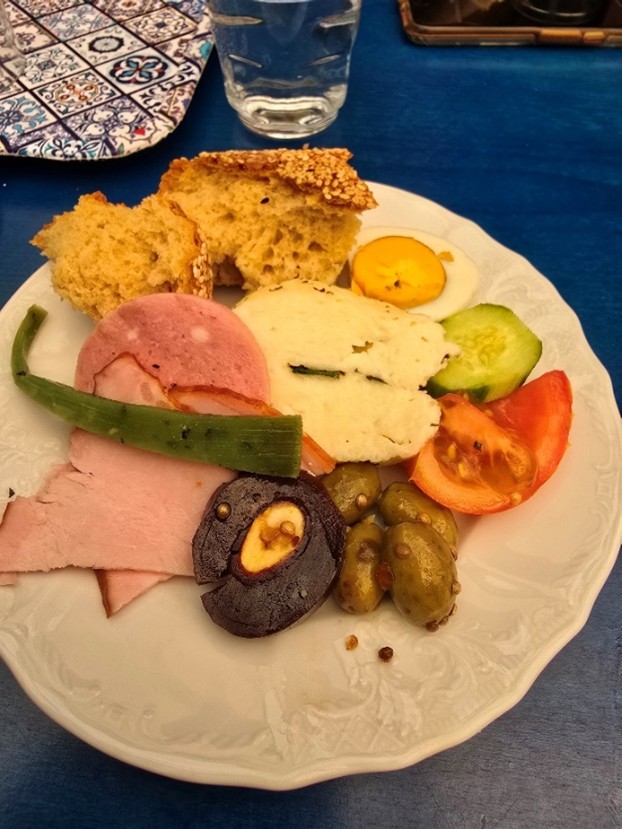
Brunch offerings
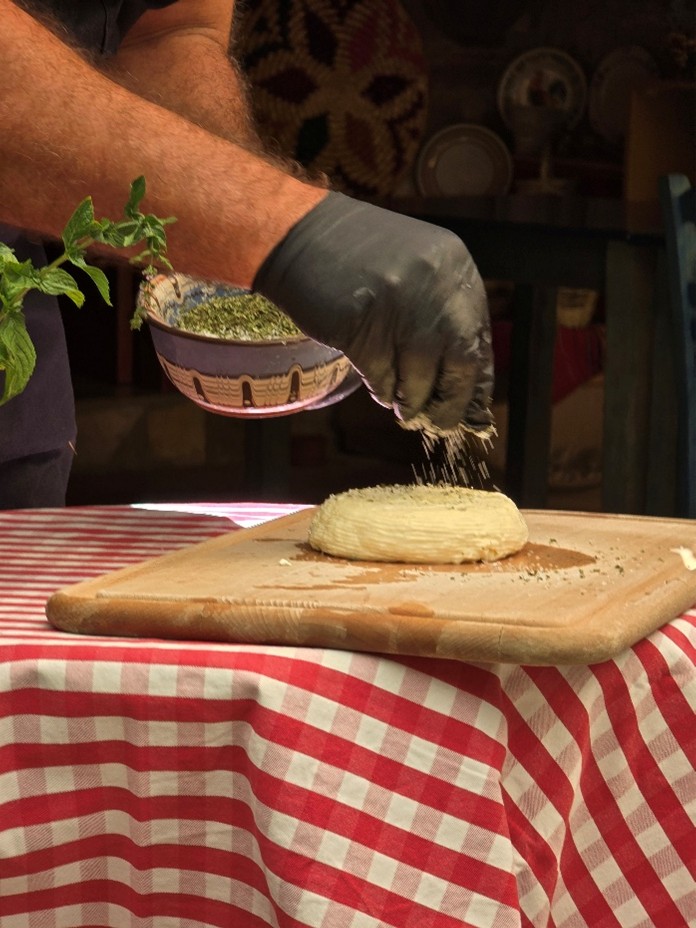
Petrous is applying the finishing touches to fresh haloumi

Coy pond in the courtyard
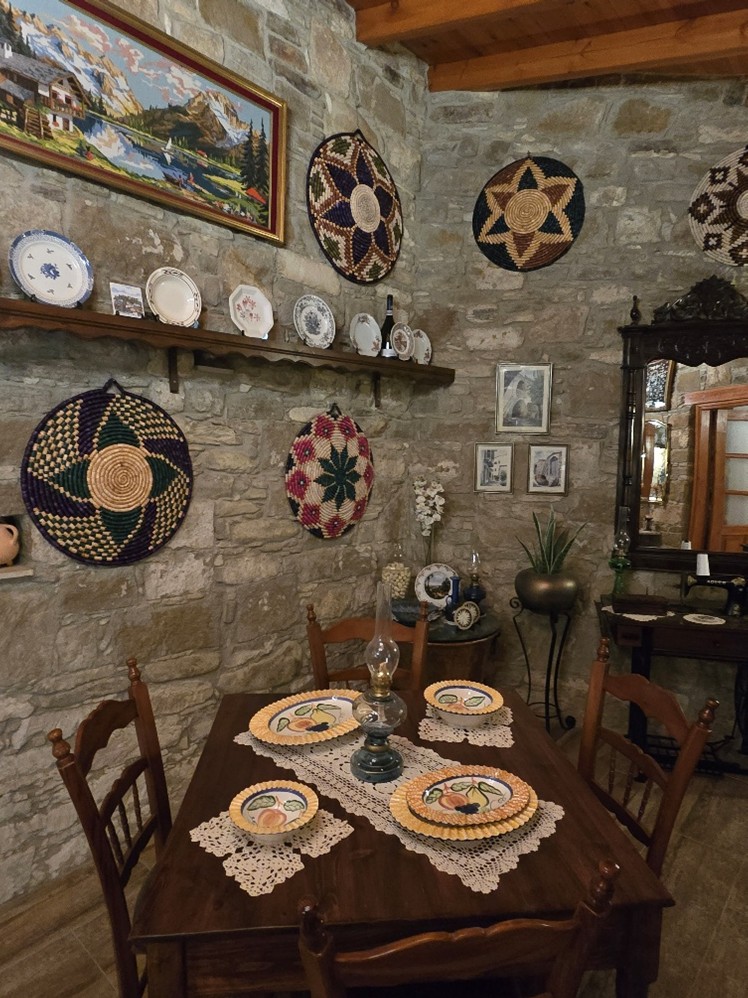
A traditionally furnished Cyprus home in a museum
 Vigla Archaeological Project
Leave a comment