By: Douglas Pearce
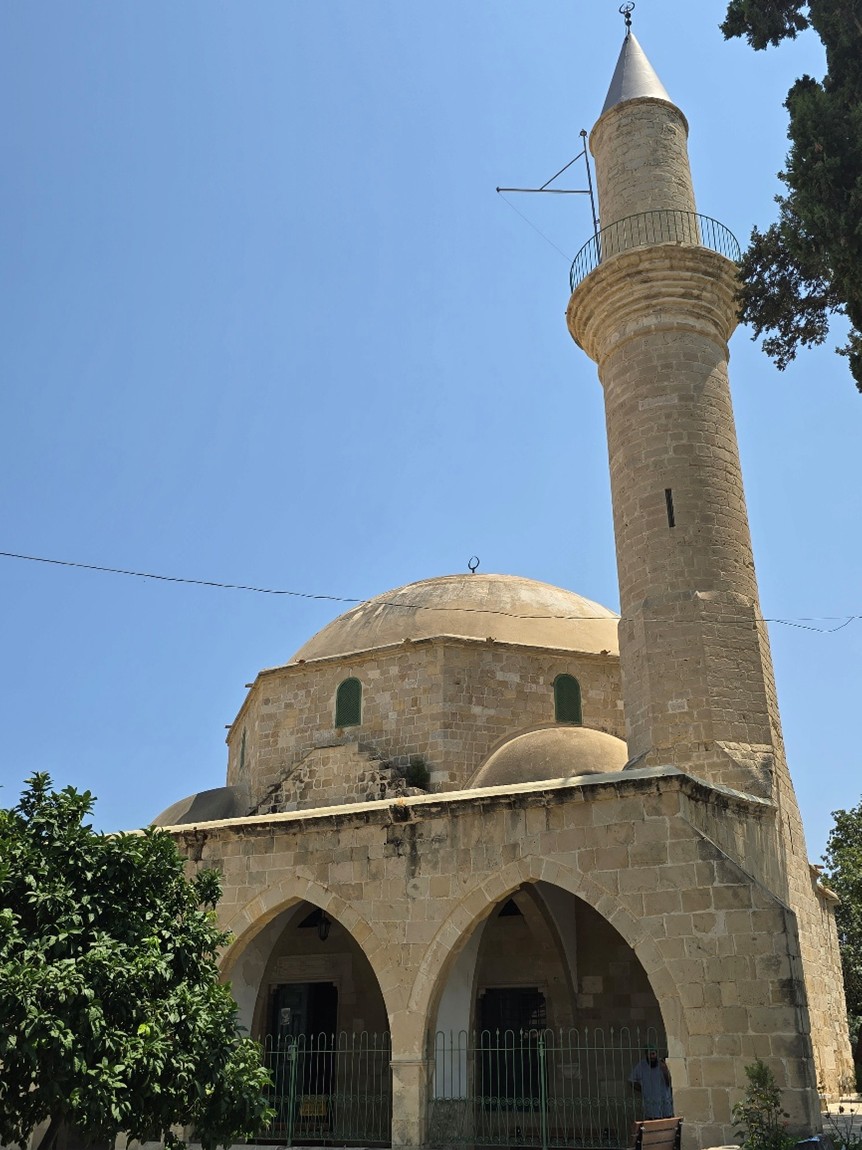
If you’re looking for a unique experience to fill a free day in Cyprus and want to visit a mosque, Hala Sultan Tekke is the perfect destination. Located on the west bank of Larnaca Salt Lake, it is about 6 kilometers west of central Larnaca. The Mosque has great significance in Islam, and it is a nice walk that offers other points of interest along the way.
Hala Sultan Tekke (also known as the Mosque of Umm Haram) is an Islamic worship place located on the bank of the Larnaca Salt Lake, built during the Ottoman period. Hala Sultan is the Turkish equivalent of Umm Haram, and a tekke is a monastery of dervishes, especially in Ottoman Turkey.
Hala Sultan Tekke is not just the most significant mosque for Muslims in Cyprus; it has also been called the third-holiest place in Islam, outside of Mecca. This distinction is due to Umm Haram, known as Hala Sultan in Turkish tradition. She was the wife of Ubada bin al-Samit, one of Muhammad’s companions. She was also a foster sister of Muhammad’s mother, Amina, and Muhammad often visited their house. Her brothers, Haram bin Milhan and Sulaym bin Milhan, participated in the Battle of Badr and Uhud, where she served as one of the wartime nurses who cared for wounded soldiers during the battles of Uhud and Hunayn. She was married to ‘Ubadah ibn al-Samit, a companion of Muhammad, who was one of the first Ansari men to take part in the Pledge of al-Aqabah. She was one of the Muslims during the Cyprus expedition, when she sailed on the sea under Mu’awiya in the caliphate of Uthman (r. 644–656. According to accounts, Umm Haram had fallen from her mule and had died during a siege of Larnaca. She was later buried where she died. According to Shia belief, her grave lies within Jannatul Baqi cemetery in Madinah, Saudi Arabia.
Most accounts establish a connection between the site and the death of Umm Haram during the first Arab conquest of Cyprus under the Caliph Muawiyah, between 647 and 649, which was later pursued throughout the Umayyad and Abbasid periods. During the Ottoman administration of Cyprus, a mosque complex was built in stages around the tomb. In another account, Giovanni Mariti, who visited Cyprus between 1760 and 1767, wrote that the Cyprus governor built the shrine he names as Ali Agha. According to Mariti, until 1760, they used the stones from a standing church in a nearby ruined village as construction materials. According to another source, the construction of the mosque was initiated by the Cyprus governor, in the classical Ottoman style, and it was completed in November 1817.
The entry gate to the Tekke garden displays an Ottoman inscription from March 4, 1813. The inscription reads: “Hala Sultan Tekke was built by God’s beloved, the great Ottoman governor of Cyprus.” The garden was designed by a “pasha,” which is a high-ranking official in the Ottoman military and political system, such as a general or governor. Thus, it came to be known as “Pasha garden”. The grounds also contain buildings that served as guesthouses for both men and women. It was a custom for visitors to take the oath of dedication to serve the Hala Sultan Tekke, promising to fulfill their wishes.
There is a courtyard with an ablution area, where cats will gather for water and food. Dozens of cats roam freely, and the people at the mosque ensure that they are well cared for.
The mosque was constructed in a square shape with yellow stone blocks. The mosque features a single minaret, which was repaired in 1959. Upon entering the prayer area, visitors are met with a simple yet elegant space. The rugs are burgundy with tan leaves that match the stone of the building, and the wooden fixtures are painted green. Opposite the mosque, there is an octagonal fountain, which was built around 1796-1797 by the governor of Cyprus, Silahtar Kaptanbaşı Mustafa Agha.
Umm Haram’s tomb is located behind the mosque wall of the qibla (in the direction of Mecca). A further inscription dated 1760 is found here. Aside from her, there are four other tombs, two of them former sheikhs. Another important tomb is a two-level marble sarcophagus, carrying the date 12 July 1929. The tomb belongs to Adile Hüseyin Ali, the Turkish wife of and a member of the Hashemite House, himself a grandson of the Ottoman grand vizier Koca Mustafa Reşid Pasha and a descendant of Muhammad. At the eastern corner of the mosque and the Tekke, a cemetery is located, which was closed to burials around 1899. Several past Turkish administrators are buried here.
While Hala Suktan Tekke is acknowledged as a holy site for Turkish Cypriot Muslims, contemporary sources have also described the mosque as revered by all Muslims. As a result of the site being in the Greek non-Muslim sector of the divided island, pilgrimage visits to the site are infrequent.
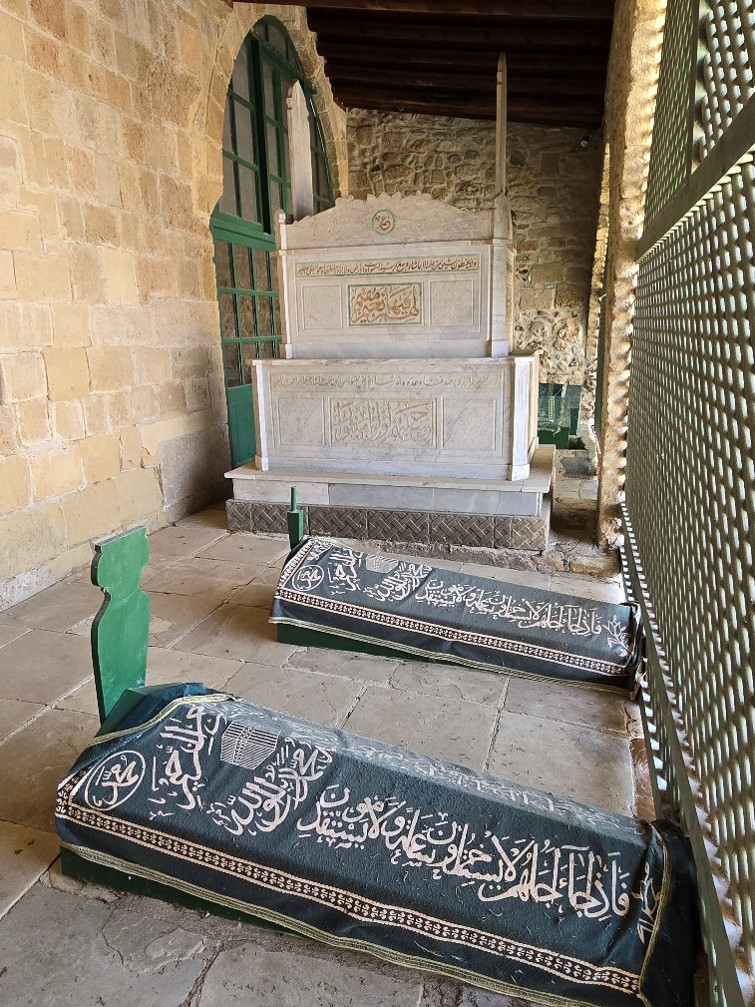
Umm Haram’s tomb
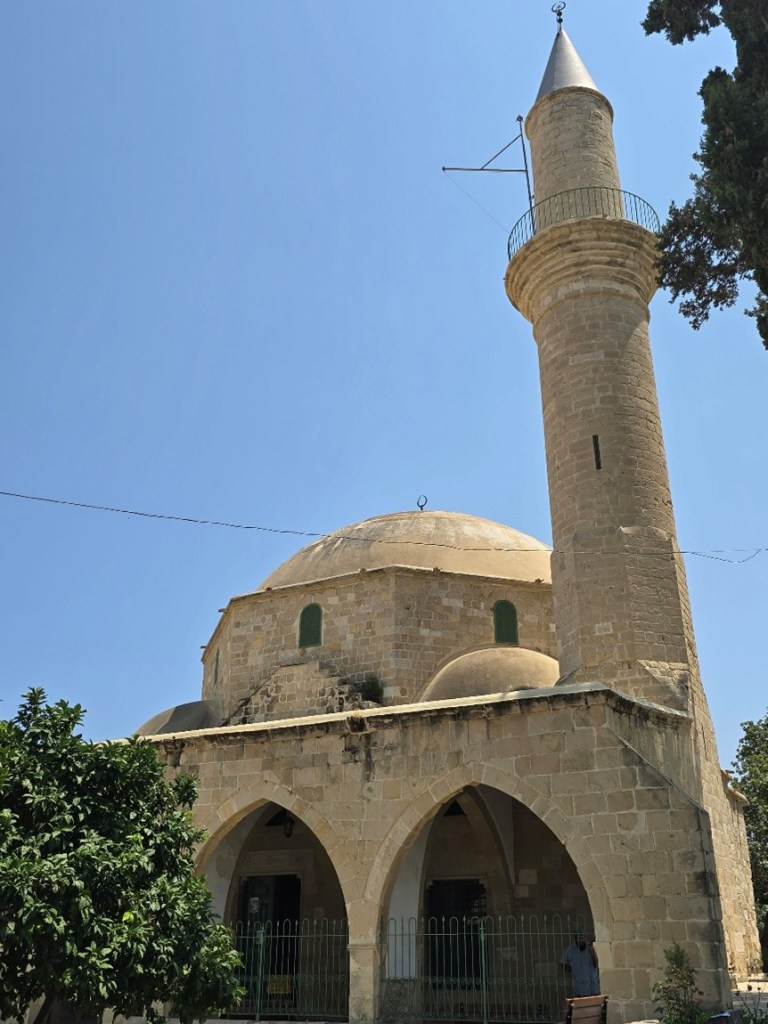
View from inside mosque walls.

More tombs
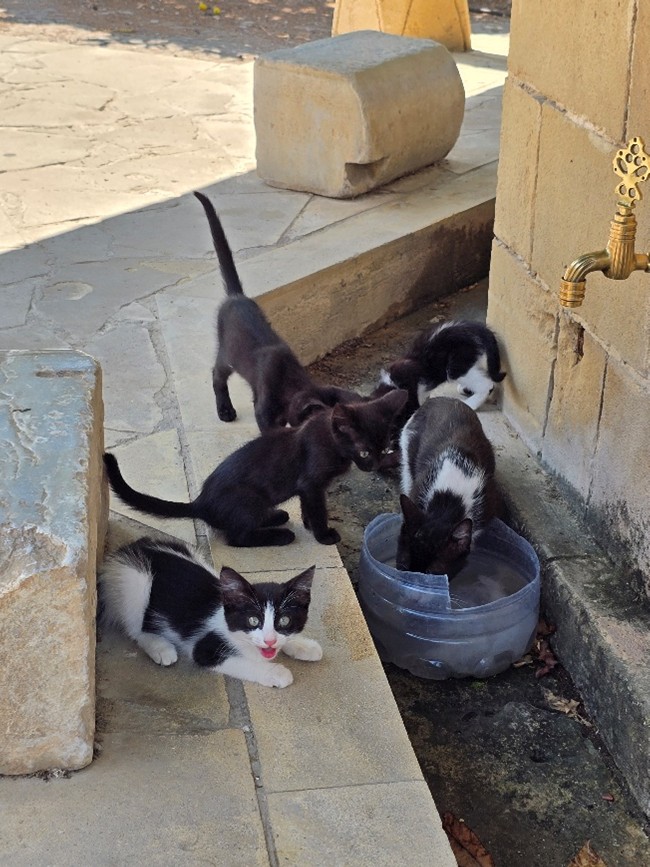
Some of the many mosque cats

Cemetery behind the mosque
 Vigla Archaeological Project
Leave a comment