By: Douglas Pearce
Cats will greet visitors to the island of Cyprus within a short order of their arrival, as cats outnumber people on Cyprus by a ratio of nearly 2:1. An estimated 2 million cats inhabit the island. In contrast, only 1.3 million people call Cyprus home. The felines can be seen everywhere in the cities and towns throughout the island: lounging on walls, taking up residence at places of worship, begging at restaurants, scrounging for food, or just doing typical cat things.
But how and when did domesticated cats first arrive in Cyprus?
It has been speculated that cat domestication in the Levant region began around 10,000 years ago. It is believed that this occurred around the time humans began forming permanent settlements in the region, adopting an agricultural lifestyle. With an abundance of stored grain came rodents, which in turn, attracted wild cats. The benefit of cats’ natural rodent control made their presence desirable to humans. Over time, cats and humans developed a symbiotic relationship that greatly benefited both.
A Neolithic excavation at Shillourokambos, near Khirokitia, in 2004 revealed a cat buried with a human. The proximity in burial suggests a deep bond between cats and humans by this time. The site has been dated to 9,500 years ago, which predates the known domestication of cats in Egypt by nearly 4,000 years. Other Neolithic sites on the island have also yielded skeletal remains of cats. While there isn’t enough evidence to prove the domestication of cats, skeletal remains found at various Neolithic sites on the island provide irrefutable evidence of their presence and a beneficial relationship. Moreover, because Cyprus is an island with no known native feline species, we also know that people had to bring them there.
Although we now have archaeological evidence of cats in Cyprus during the Neolithic period, popular legend still prevails. The lore holds that cats were brought over by Saint Helena, mother of Constantine, in the 4th century to control a snake infestation at a monastery. As the legend goes, St. Helena was on her way back to Constantinople after finding the True Cross in Jerusalem, when she stopped in Cyprus. She had intended to fund a monastery there and leave them a piece of the true cross, but she encountered an island in crisis.
The island had been experiencing drought for many years and was suffering from the externalities of the drought. Not only were people starving, but they also had to tend to starving snakes. As water became scarcer, the snakes that inhabited the island converged on populated areas, where water was more readily available. These venomous snakes became such a problem that many residents fled the island, which further exacerbated its woes. Seeing a monastery, as well as an entire island teeming with venomous snakes and a declining human population, St. Helena felt compelled to act. She consulted with the locals, who may have included St. Nicholas, who founded a monastery on the island before he went to Myra. St. Helena then ordered one thousand cats to be sent from Palestine and Egypt. The monks at the monastery took care of the cats, feeding them twice a day. They would ring a bell to call the cats to supper. When mealtime was over, they rang the bell again to send the cats out to engage with the snakes. The cats proved to be equal to the task, quickly bringing the snake population under control, which prompted people to return to Cyprus.
The monastery, later known as the Holy Monastery of St. Nicholas of the Cats, continued to care for the cats for over a thousand years. Their neighbors, who mostly worked as fishermen, helped support the cats of Cyprus by donating their entire catch on the Feast of St. Nicholas to the monastery. Even when the monastery was destroyed and rebuilt, the monks and the people never failed to care for their cats. Not until 1570, when the Ottomans destroyed the monastery and killed or enslaved all the monks, did the cats lose their human companions and providers. Once this happened, the cats were dispersed, and the snakes returned.
In 1960, the Department of Antiquities renovated the Holy Monastery of St. Nicholas of the Cats, restoring sections of the original fourth-century monastery that remained, as well as parts dating back to the thirteenth century. A small group of nuns took up residence at the monastery in 1983, bringing cats with them. Once again, the cats drove the snakes away. Nuns who live at the monastery today still take care of their cats.
The cats of Cyprus today have migrated throughout the island, making them an inseparable part of the Cyprus experience. Cypriots and cats share a symbiotic relationship, just as their ancestors did thousands of years ago. Tourists who seek a unique souvenir are welcome to adopt a cat to take home with them.
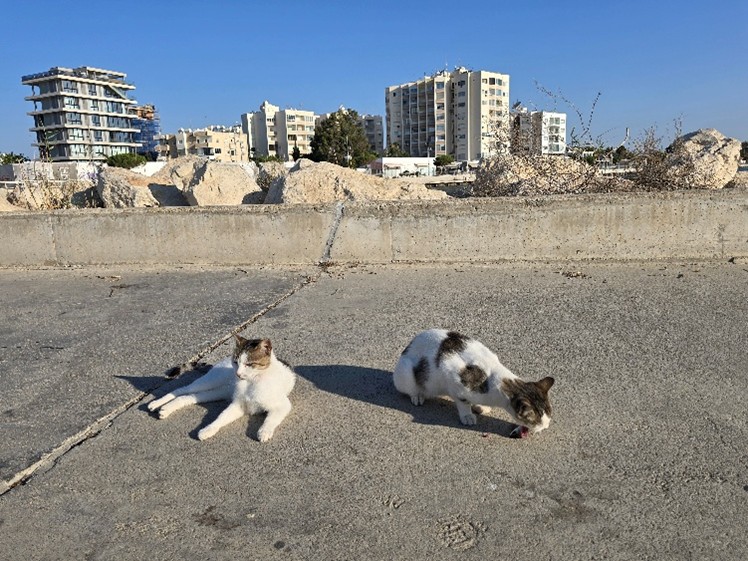
Cats on the pier receive fish heads from the local fishermen.
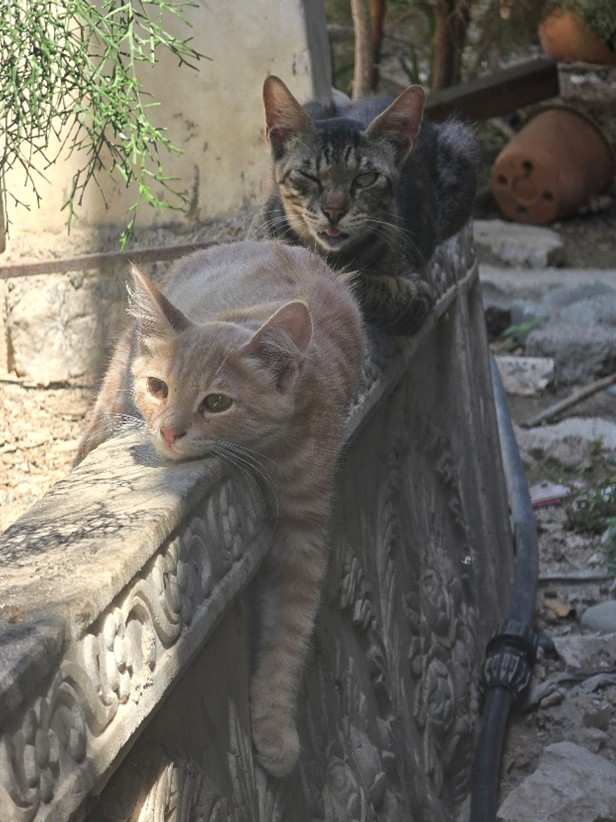
Cats lounging on a tomb at a mosque: Peak Cyprus.
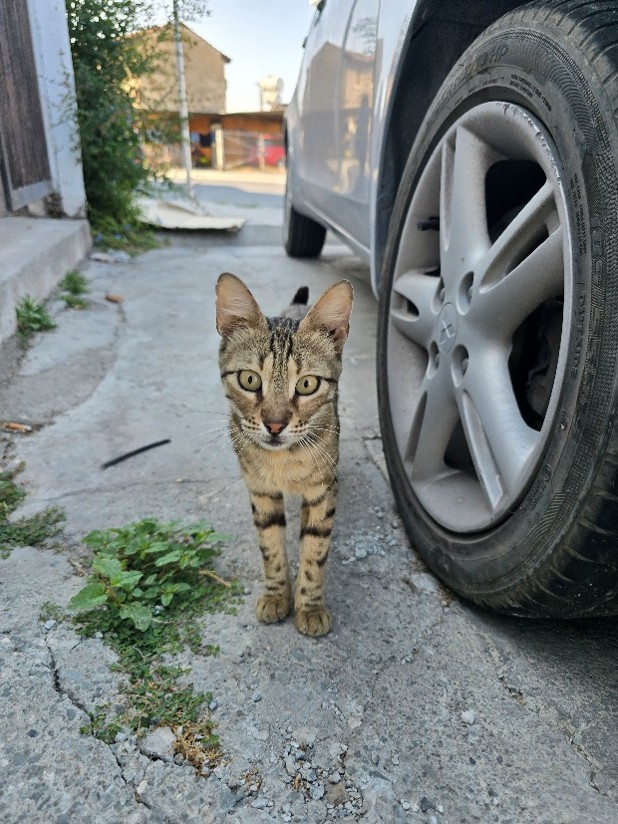
Many cats are friendly and approachable, often seeking human interaction.
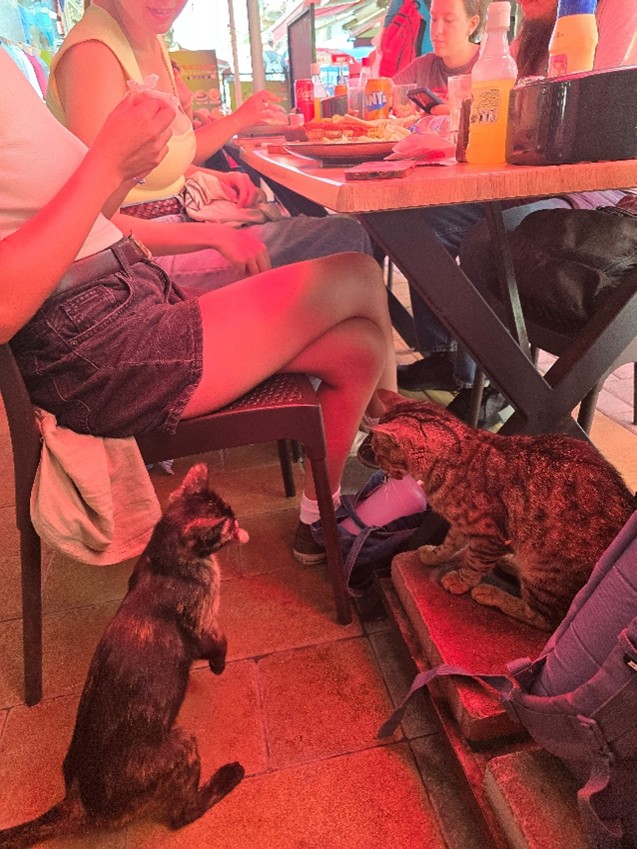
Cats are a common fixture of the Cyprus restaurant experience.
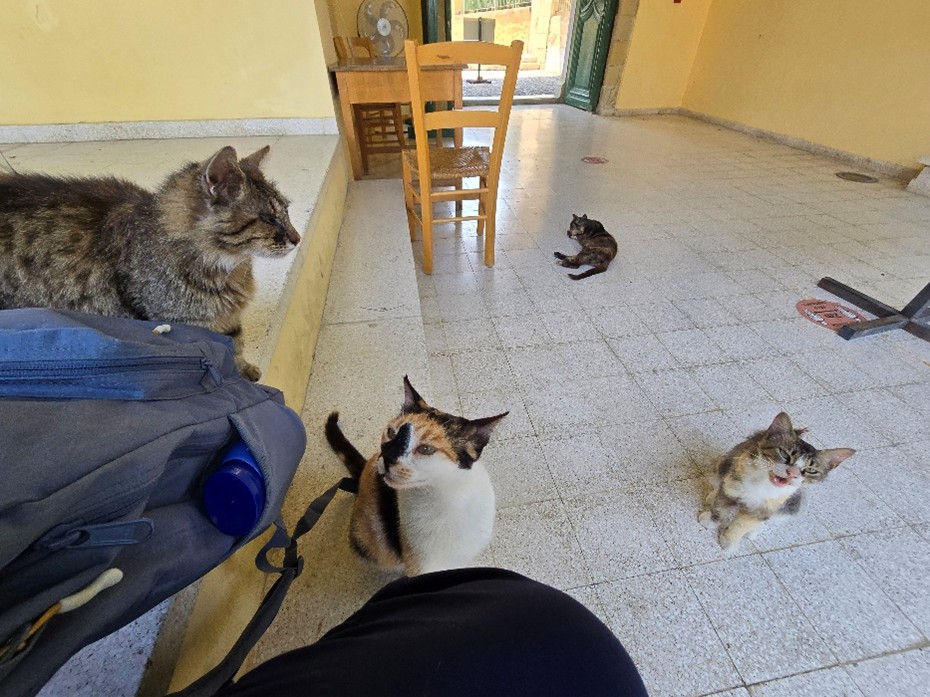
Hala Sultan Tekke welcoming committee
 Vigla Archaeological Project
Leave a comment