By: Augusta Tate
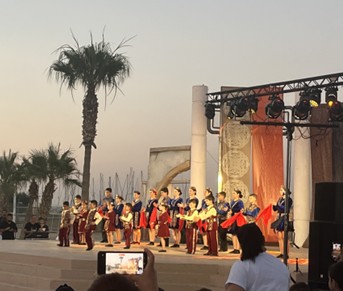
During my time here in Larnaca, I got the pleasure of seeing a live dance performance right in the middle of the boardwalk on Larnaca Beach. I learned about the festival through word of mouth and by seeing signs posted in the surrounding area.
They performed on June 27th at the Municipal Amphitheater right against the beach during the early evening hours. Plastic chairs were lined up in front of the stage, allowing anyone to sit where they liked, as it was a free, public performance. Older people and people with young children were the first to be seated, maybe because they were related to the dancers.
The Armenian Dance Festival 2025, presented by the Hamazkayin Dance Committee, showcased dances from multiple dance studios, including Prof Art Dance Studio, Aera Art Studio, Sipan Dance Group, Ani Dance Group, and Nanor Dance Group. These are all different dance studios located nationally. According to their website, they seem to perform all across the globe, including Cyprus.
The Hamazkayin Dance Committee operates under the Hamazkayin Armenian Educational and Cultural Society, a non-profit organization dedicated to educating younger generations about Armenian culture and history, as well as preserving it. The organization was created in the late 1920s after the Armenian Genocide. This time displaced many of the Armenian people and dispersed them throughout the world, specifically too many Middle Eastern countries. A group of intellectuals gathered to create the Hamazkayin group, which has operated numerous educational institutions and programs for the past 70 years, with some even located in the U.S.
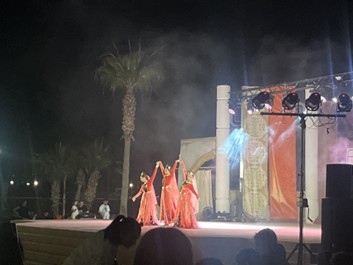
I was pleasantly surprised to discover that all the performers in the show were children, ranging in age from approximately 5 to 15 years old; no adults were performing the dances. I had seen smaller children sitting in the front with their dancing attire on, but I didn’t realize until the show started that all the performers were so young. It made me appreciate the dedication that the Hamazkayin organization has for teaching and preserving their culture, especially for younger generations.
The dances were incredible to watch, and I was very thankful that admission was free. However, I would have paid to see it anyway. Each performance was typically separated by age group, which made sense since that would probably correlate with skill sets and abilities. They came out wearing beautifully vibrant-colored costumes and sometimes used props, such as pieces of cloth or batons, which were integrated into the dances. The dances could be divided into a few different categories, one being a large group dance in which both girls and boys dance together in a fast-paced manner with energetic music and dance movements. These always seemed to end with everyone joining in a circle in the middle and spinning around, creating a very exciting energy. When this happened, a few people in the audience would start clapping along to the beat, eventually getting the whole crowd to join in.
Then, there were more slow-paced dances that usually featured girls in smaller groups dressed in elegant, beautiful dresses that really made them look like princesses. However, most of the performances were high-energy. The dance festival was a fantastic experience and a great way to see and appreciate a part of Armenian culture.
 Vigla Archaeological Project
Leave a comment