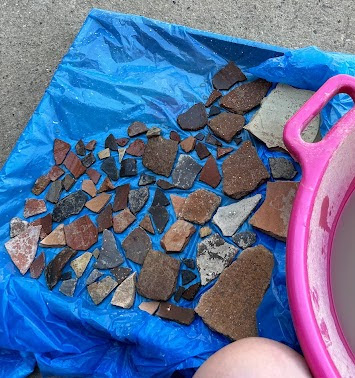
Since pottery is so important to chronology and periodization and is going to take up a lot of your life during your dig, let’s go over some technical jargon as an introduction to analysis:
- Potsherd: a pottery shard, or broken piece of pottery; also sherd.
- Diagnostic: sherds that reveal shape; handles; bases; toes; rims.
- These parts of the pot are more carefully made.
- Body sherds/ non-diagnostic: all the other kinds of sherds.
- Inclusions: stuff other than clay like tiny pebbles or organic matter
Once you’ve determined what kind of sherd you have, you look at the fabric. The fabric is the clay makeup of the pot– from the Latin fabrica, something skillfully produced (same root as the word “fabricate”; not just used in terms of textiles).
Fabric comes in four main categories:
- Fine or fineware: highest quality clay and surface treatment. Fewest inclusions in the clay itself, highly levigated, and fanciest. Thin, pretty, and delicate.
- Painted, glossed, or otherwise ornamented.
- Bowls, cups, decorative serving ware, things to bring out in social dining situations (like your grandma’s “fine china”).
- Cooking or cookware: ubiquitous across all class lines, like a modern cast iron pot.
- Thinner fabric with more small inorganic inclusions to help conduct heat.
- Kind of clinky when you tap on it.
- Often burned or blackened on the outside from being placed on a fire.
- Be very careful when washing this kind of pottery; you don’t want to scrub off this layer of burn.
- Coarseware: Everyday use pottery, usually connected to storage.
- Inclusions vary in size, but can be organic or inorganic and pretty obvious.
- Visibly less refined than fineware or cookware.
- Amphora: can be transport (the shipping vessel of antiquity) or storage, and often both. Everything from oil to wine to wheat was stored, carried, shipped, and otherwise moved in amphoras by land and sea.
- Finer made than courseware, a little “cleaner.”
- Very thick walls.
- Fired really hard.
- Distinctive handles.
- Toes!
- The handles and toes of amphoras indicate how an amphora was carried or stored. Could be stacked in hay, tilted on their sides, or the handles threaded with rope.
- If you’ve found something really big or thick, it’s probably an amphora.
Lamps get their own category because they are considered special use, or found in special use places like ritual sites. Lamps are also fired very hard and typically have a fine fabric.
Lastly, the level of levigation will determine exactly how fine the ware or fabric of a vessel is.
Levigation is the refinement process for clay.
- Water is added in a large pond to the clay and then the desired fineness is skimmed: finer from the top, where there are fewer inclusions, and coarser clay from the bottom of the pond with more inclusions.
- Very finely made clay fabric might go through levigation multiple times to achieve a uniform consistency with minimal, teeny tiny inclusions.
With that, you’ve got the basics of pottery analysis! There’s much more to learn, but having at least a passing familiarity with these terms and concepts will help get you going.
–Miki H.
 Vigla Archaeological Project
Leave a comment