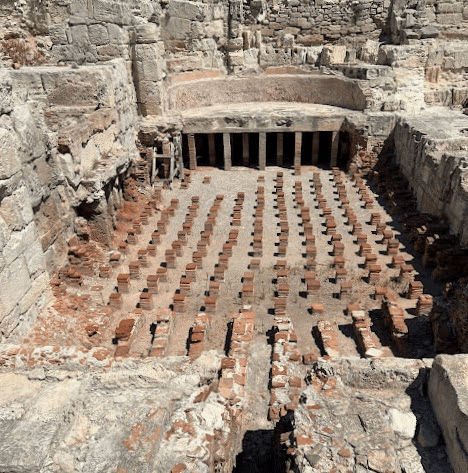
As we were touring the baths of Kourion, we passed a string of excavated underground rooms with short rows of what looked like stacked clay pillars.
“What,” someone asked our supervisor, “are those?”
It’s weird the things that stick in your brain. I studied Classics a decade ago, and am I any use at reading Latin? Nope. Do I have a handle on the dates of the Peloponnesian Wars? Nope. Can I name more than one of the Five Good Emperors? Nope. Do I remember what these weird stacks are? Absolutely.
“They’re copper plates,” I interjected before the supervisor could even get a word in. “They’re heated from below and the copper conducts the heat to the bath. It’s a caldarium. Like a hot tub.”
Pretentiously, I remember what these are because I had the same question a decade earlier in Paris. The Cluny Museum, now the Musée National du Moyen Age, is housed in a mansion built into an older Gallo-Roman bathhouse. Imagine you’re young Miki, desperately searching for the famous Lady and the Unicorn tapestry, only to discover that it’s on loan to Tokyo. You’re disheartened, you turn a corner, and there it is: an underground pit full of stacked copper columns. Imagine you spend ten minutes finding the explanatory plaque in English and wonder why the one Roman historian at your small not-yet-university college failed to mention this bizarre sculptural art piece when they were covering a thousand years of Roman history.
But the caldarium underneath the museum in Paris is nothing like the one at Kourion. That was only one small room while the one at Kourion was easily three times that size– and there are two bathing complexes. The bath at Cluny, then, was a smaller balneae, while Kourion houses the much larger and grander kind of bath called a thermae. The baths were probably fed water by a complex set of waterworks, drawing from the nearby springs and transported by aqueducts and pipes to the bath, again a more elaborate and involved process than for a smaller balneae.
Roman bathing was central to social life. Roman patrons would meet their clients at home before heading to the baths. Ordinary people left their tenement homes to enjoy the baths. Baths were open to the public, providing a necessary sanitation need* and a place for discussion, gossip, and exercise. Baths were a sign of civilization, Roman superiority, and the generosity of whomever sponsored or maintained the facilities. The thermae at Kurion is, then, a political as well as practical structure.
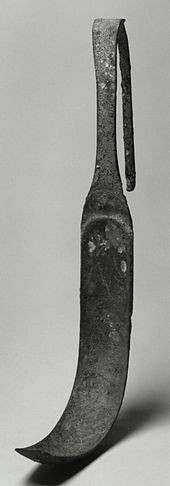
A visit to the baths went something like this: you arrived, changed, and then exercised in the palaestra. From there, a dip in the very hot caldarium, heated below by fires kept lit by slaves (a bath complex the size of Kourion’s must have required an immense amount of slave labor). After the caldarium, a good scraping down of the skin with a strigil, which removed dirt and sweat, and acted as a kind of rough exfoliation. Then the tepidarium, cooler water, and a final plunge into the frigidarium, full of extremely cold water.
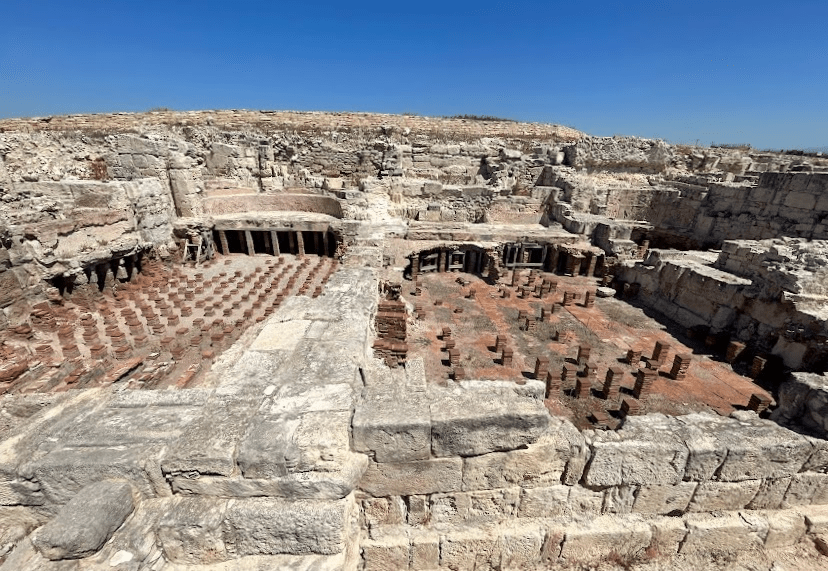
The copper that made this whole operation work was probably mined in Cyprus. The wealth of Cyprus has long been connected to the copper-rich Troodos mountains. Copper flowed down from the mountains through port cities like ancient Kurion, making them prosperous city-states and even petty kingdoms. The very word “copper” comes from Cyprus: cyprium aes, metal of/from Cyprus, became cuprum, became copor, became copper.
The copper plates at the Kourion baths are more than just curiosities, though the site is certainly peculiar if you’re not expecting it, but a window into the very role of Cyprus within the ancient and Roman world. Wealthy, civilized, and complex, Kourion boasted a central role in Mediterranean history.
–Miki H.
 Vigla Archaeological Project
Leave a comment