There are a lot of unglamorous tasks required on an archaeological dig site.
In my mind I had various movie portrayals of archaeology: beautiful and chic people crouching elegantly over bones that they gently dusted free of the earth with small, precise brushes. Our supervisors were chic, yes, and everyone on site developed a solid archaeology core aesthetic, and yes, we did get to use small watercolor paintbrushes to coax horsecow’s jaw out of the mudbrick, but for the most part, archaeology is a lot of basic hard work. In order to reach the kinds of things they show in movies, you have to move all of the stuff on top of it out of the way.
Our first day on site was a day of manual labor and wonderful surprises. Handfuls of (totally useless for chronology) pottery shards, a beautifully articulated wall, the barely visible clear curve of a basin. Some awful things as well: a scorpion bite, an enormous tarantula. The uncertainty of social dynamics. But everyone was on the same page that first day, everyone lifting and moving and scraping, getting tired and sunburnt and dirty. The movie archaeology, I thought, would surely come.
And that’s what I was worried about. I wasn’t trained for this– and that’s the point of Field School. With the exception of the graduate students and a few classmates, no one on site had done this before. These other students were my peers, and after the first day of moving things, I felt a lot of that impostor syndrome ease up. I was good at clearing debris and rubble, could turrae gracelessly but effectively, and even turned out to be wonderfully, aggressively good with a pickaxe. I could do this archaeology thing. When I went to my first pottery shift, I felt positive about my chances of clambering down to a spot in one of the trenches.
The next day, though, everyone had kind of hunkered down in a chosen trench. I tried not to feel left out. I defaulted, in a kind of blank reaction to not knowing where to go, where to be, to Restaurant Miki Mode and instead tried to make myself as useful as possible, doing laps around the site, familiar work phrases sounding in my head: “If you’ve got time to lean, you’ve got time to clean.” “How’s your sidework going?” “Hands in, hands out.”
This I could do. This I was familiar with. I hopped around each trench, a kind of chipper offer of “hands” if anyone needed anything. “Trout Amandine to table 32, fresh red buckets to EU 20.” “Table 54 needs bussed, trade someone out in EU 23.” “Check on drinks for 12, sieve some of the buckets from EU 24.” I could do this archaeology thing. I felt good about it. I felt sure that I’d get my turn the next day, or the next, to do some cool “real” work.
Until it was time for trench assignments.
Letting go of ego is rough. I wish I could say that I genuinely felt, when trenches were assigned, that I was just glad to be there. Of course this was an incredible experience, one that I’ll treasure for a lifetime, and one that I really was just glad to be there. But all that moving around, all that trench hopping, all that too many bodies for the spaces we had, meant that I was relatively unattached when supervisors were “picking out” their trench crews.
It felt like middle school gym class. Mel, I’ve cleared so much of the topsoil from EU23, I found that basin rim, pick me! Brandon, I pickaxed the hell out of your trench, I’m great at sieving, pick me!
But. Only so many people will fit in a trench, and most people had already settled in. So. I was not assigned a trench. I’d be working, I was assured, with Dr. Olson when he arrived, for sure, for sure I’d be in whatever trench he’d be digging. When he got here, I’d definitely, definitely be assigned a trench. In the meantime, I was Officially Trenchless.
I’d like to say I didn’t feel the sting of tears, the renewal of the fear that I had no business being there. I’d like to say that I jumped at the opportunity to just be helpful wherever help was needed. But ego is a hard thing to let go of.
But I wasn’t by myself. Like I said, only so many people can fit in a trench and work safely. I knew that Madi and Ren were probably feeling the same way that I was: back in gym class, last picked. Maybe they felt differently and I did a lot of projecting. I decided, almost panicking with my own hurt feelings, to make it into a kind of joke, a way of owning my sense of loss and rising self pity.
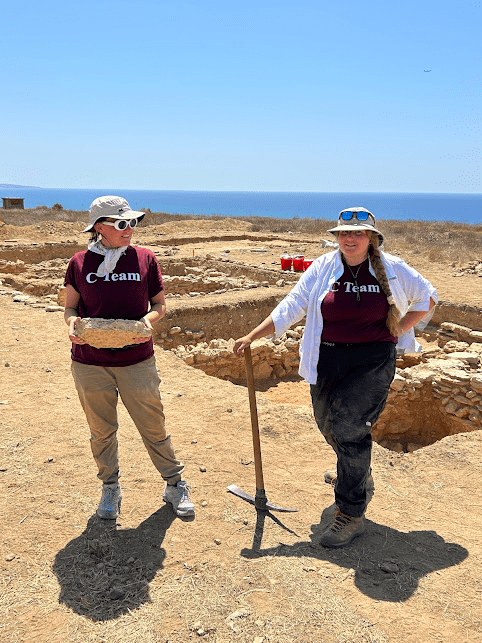
So what if we weren’t picked first, or even second? We might not be the A Squad, or even the Second String, but C Team was going to be the underdog story of digsite. We would be proud. We would be helpful. We would do the unglamorous jobs, and by god, we would do them well. We were C Team.
***
You haul a lot of dirt. You pick up stray stones. You swap out buckets. You make sure people are drinking water. You sift through buckets and buckets of dirt. You clear trash from the shade tent. You get sand in your eyes, dust up your nose. You’re swabbing dirt out of your ears with a qtip at the end of the day. You remind people to eat snacks, take a water break. You swap out on pickaxe duty when someone starts to wobble.
The further into the dig you get, the more realistic you, and everyone around you, becomes about their needs. At first you don’t know what your limits are. Are you just tired because this is the first time you’ve done anything like this, or are you tired because you are actually at your limit? Do you need to drink water? The answer is always yes, you do need to drink water. But can you push through for five more minutes? Or are you being stubborn? Are you feeling the raw newness or the raw tiredness of it all? It seems like every few days your body needs something different. You stave off headaches. You bring something different for second breakfast. You learn when to ask for help.
And then C Team jumps in.
C Team picked up rocks. We swapped out buckets. We swapped out people. We sieved. We encouraged. Someone always needs a water break. Something always needs to be carried from one place to another. There’s always a place for hands, and C Team was ready and happy to provide them.
This is important work, but it isn’t the kind of work I imagined when I thought about what I’d be doing when I started digging. Was I a movie star archaeologist? Sometimes. Was I more often an extra in the background? Absolutely. But that’s how the job gets done. Is everyone in a restaurant a chef, the bartender, headwait? No. Archaeology isn’t a one-person job either, and if you get hung up on what you think you’re entitled to — I should be articulating, I should be finding artifacts, I should whatever– you’ve doomed yourself and your team.
I’m really proud of C Team. I’m proud that we took something that could have been, even though it was never meant to be, disheartening and turned it around. I’m proud that we helped make the dig happen because what we were doing was important. I’m proud of my calluses, my sore back and arms and thighs and butt. I’m proud of everyone in the trenches, and every incredible find we unearthed. I’m proud that we didn’t sulk and didn’t let ourselves feel left out. Even if all of those worries were in my head and my head alone, I’m proud that I was able to get out of my own way to be part of something bigger than me.
–Miki H, C Team
 Vigla Archaeological Project
Leave a comment