I am not an archaeologist. Before coming to Cyprus, I never thought I’d have the opportunity to even pretend to be an archaeologist– aside from the time as a kid I buried some toys in the backyard one fall and then tried to find them all the next spring. I’ve never written a field report, never held a trowel, never sifted through buckets of dirt hoping to find artifacts.
Imagine, then, my supreme and surprised glee on our first day. Shown how to turrae, we started digging at the soil and churning up dozens of bits of what was clearly pottery. I thought it would be more ambiguous– all those pots I’d seen in museums reconstructed from a handful of fragments, I thought it would be more difficult to identify pottery.
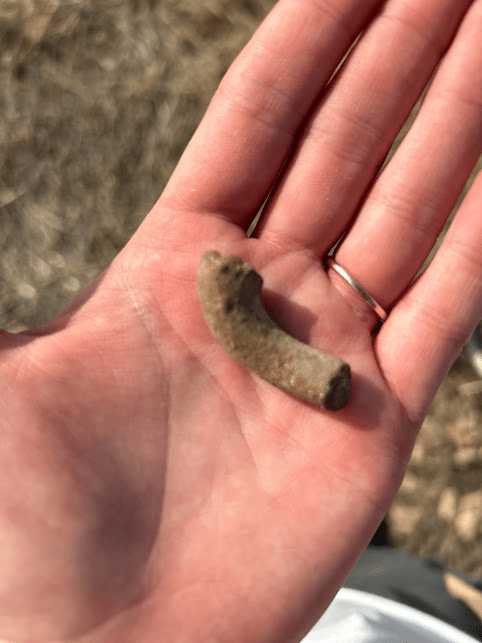
But here we were, a few inches into the soil, and unearthing what were undeniably pottery sherds. A handle the size of my thumb, the lip of a cooking pot, the sturdy toe of an amphora. I excitedly gathered one up after another, searching out one of our endlessly patient supervisors and with a childlike “look what I found!” And to my disbelief and alarm, after a quick identification, I watched my supervisor casually chuck it away.
This is all topsoil: these sherds are all worthless.
The “why” of this heartbreak comes down to the scientific rigor of archaeology and the basics of stratigraphy. Each layer you uncover is older than the one above it. You have to start digging at the top, which is newer, to get to the good stuff below. We were scraping through layers of time to reach our Hellenistic goalpost and documenting the finds that hadn’t already been moved. Because archaeology is by it’s nature a destructive science, once something is moved from the place you found it, you can’t just put it back. It messes with the timeline and provides bad data. Documenting where you find something is also part of documenting when it was put there and, generally, when it was made. The where is the when, in other words, when you’re digging.
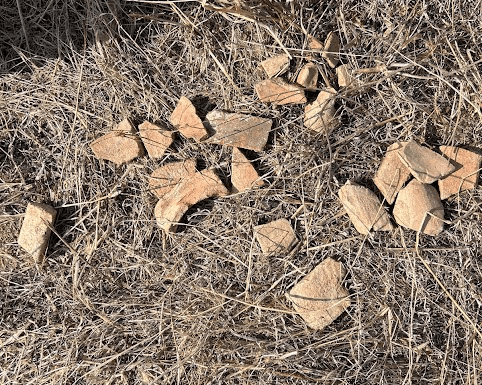
So everything I found that first day had already been moved from its when. The pottery pieces were identifiable as probably from a specific time and place of manufacture, but because they weren’t in situ, they couldn’t be used to help ascertain when they arrived, when they were buried, and what their relationship was to the site. Up in the topsoil– and sometimes just literally sitting in the grass– they had left their archaeological context. Sometime between being buried in the 200 or 300 BCE and now, they’d been moved up in the stratigraphic timeline because of human activity.
So to the next round of MSU diggers: get excited about what you find that first day. There are few feelings like picking up a piece of something ancient and holding it in your hand. But remember that not everything you find, especially when you’re clearing out the first few inches of a trench, is going to end up in documentation. It’s part of the process, and I promise you that you will find something incredible if you just keep digging.
-Miki Hollingsworth
 Vigla Archaeological Project
Leave a comment