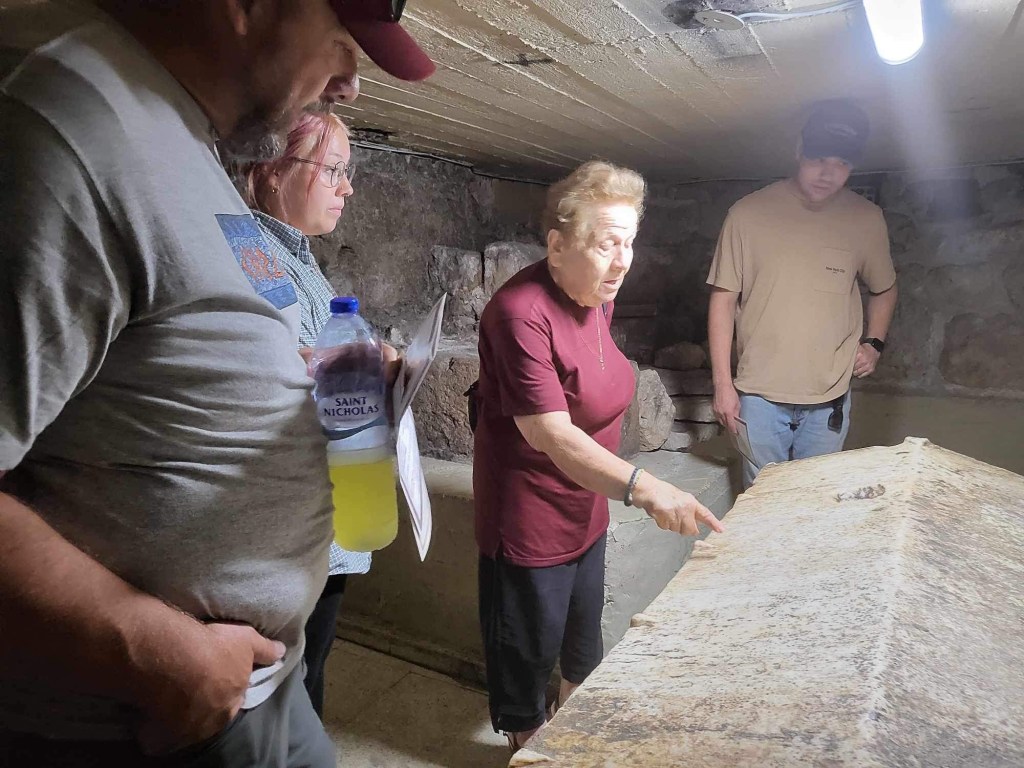
When we first went to the church of saint Lazarus, I was immediately intrigued. I love a good byzantine church (if you couldn’t tell), and I knew I wanted to return at some point along the trip. I was able to return with my family and while we were down in the tomb, we were stopped by a local who was asking us if she could tell us more about the church. She was an older woman, named Aspasia, who was born and raised in Cyprus her whole life. She was raised Greek Orthodox, and was actively practicing while we were there. She took us around the tombs and it was very interesting to hear her story of the church, and what her understanding of its history was, and how this history of the church is understood locally. She described how the department of antiquities discovered the tomb in chunks and at different times. The entrance of the tomb was discovered first, and then later when they wanted to extend the church for storage, they found the first sarcophagi with just a few bones. In another attempt to extend for space, is when they found the second sarcophagi with the inscription inside, which she says roughly translates to “the friend of Christ”. Which was later determined to be the bones of Saint Lazarus. Aspasia tells us that some of the bones were sent to Rome, but the bones found in the second sarcophagi were kept in Cyprus, and she took us upstairs to the box containing the “bones of Lazarus”. It was an ornate silver case adorned with intricate pictures of Saint Lazarus, gemstones and prayers. She gently kisses the box, and explained how lucky she is to have been in such a holy place. She then toured us around the frescos and explained to us each Saint, and their importance to the church. We thanked her for her time and as she walked us out, she taught us the importance of using the door that has the cross, with four smaller crosses in each quadrant. She says that this door is the entrance for all, and this symbol means that any religious denomination can enter, but only through this door. Once we were outside, she pointed out the missing domes from the church, and informed us that the domes were destroyed by the Turkish, as they felt it was too grand and didn’t need to compare with Turkish churches, which I thought was interesting to say the least. As we left she gave us some of the church cards depicting the blessing of Saint Lazarus. She was so excited to show us Americans around and said she was so happy that Cyprus was being appreciated. I told her about my fellow students and how much we all loved being here, and thanked her for sharing her history with us.
 Vigla Archaeological Project
Leave a comment