We’ve already talked about the cats. The cats in Cyprus are impossible to miss– weaving through legs on restaurant patios, sunning themselves in front of store windows, lounging on the roofs of parked cars– Cyprus is full of cats. The semi-feral feline denizens of Larnaca are unavoidable. Posts here have already covered the legend explaining their number, but the bookseller’s story was the first time I’d heard of St. Helena in Cyprus. Why was St. Helena, mother of Constantine the Great, in Cyprus?
I don’t know a lot about saints. I wasn’t brought up in a particularly religious home so my exposure to saints has been almost entirely academic. Usually I’ll learn about an interesting figure in the early middle ages and, almost as a side note, their sainthood will come up. Helena I knew as the mother of Constantine the Great (of Edict of Milan fame), who, sometime after her son became the Roman Emperor in 306 CE, traveled to Jerusalem looking for holy relics. According to both Catholic and Orthodox theology, Helena found the Tomb of Jesus, the True Cross, and other items directly associated with Jesus. This, along with her help converting her son to Christianity, is the basis of her sainthood. St. Helena left the True Cross in Jerusalem but took pieces of it, along with other relics, back with her to Constantinople.
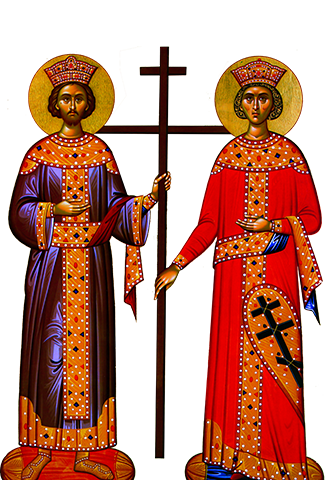
What does this have to do with Cyprus? According to one tradition, St. Helena and her crew were shipwrecked on Cyprus on their way back to Constantinople from Jerusalem, and took shelter on the island with the holy relics. As an inveterate church builder, Helena ordered the construction of many churches on Cyprus, just as she had ordered the construction of churches throughout the Levant and the eastern edges of the Empire. She also, as with the “Church of Cats” in Akrotiri (St. Nicholas of the Cats), oversaw the maintenance of churches throughout the island before returning to her son’s side in Constantinople.
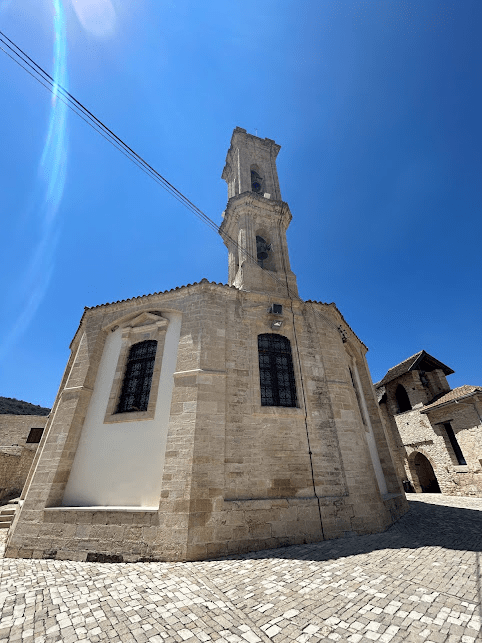
We were lucky enough to see one of the most important of St. Helena’s churches almost on accident. During one of our last days in Cyprus, a group of us went on what was primarily a pilgrimage to a famous halloumi-making workshop. We knew we would visit a winery and a monastery as part of the journey, but my primary focus was the cheese making presentation. After the halloumi brunch and a winery tour, our ITaxi driver, one of the minor saints during our time traversing the island, stopped at a village. We piled out of the bus, and for the first time ever he addressed our crowd.
The monastery we were visiting wasn’t just any monastery. It wasn’t one featured in pictures on the excursion pamphlets with pictures of stunning mosaics and well-appointed Orthodox bishops. What it did have was more important: two pieces of the True Cross and a strand of the rope tied around Jesus on the way to his crucifixion. These relics, our driver informed us, were brought to this monastery by St. Helena, who founded the religious site specifically to house them.
There’s a joke that if all of the pieces of the True Cross reportedly held by churches across the world were brought together, there’d be enough wood to make a ship– and it’s not my place here to address theological controversies or the legitimacy of relics. What was special about this monastery-turned-church was, for me, the fact that our very Cypriot driver needed us to know that it was a truly holy place.
-Miki Hollingsworth
 Vigla Archaeological Project
Leave a comment