You are going to have to get good at a game called “Is this a Rock or is this Pottery?”
You’re not going to be very good at it the first few buckets of dirt you sieve– and you will have to sieve. Whether you love it, hate it, or just accept the necessity of sieving, you’re going to have to prop up the legs of the sieve and shake a whole lot of dirt. It’s generally a two-person job: one person is the shaker and the other is the pourer. The frame of the sieve is wooden, and while there’s probably some duct tape for your hands, if you’re shaking I recommend wearing gloves. You’re going to get weird blisters in bizarre places anyway (mysterious calluses from cleaning pottery with a toothbrush, for example), so a little extra protection never hurts. One or two buckets of dirt freshly scooped from the trench are going to go right onto the mesh stretched across the frame. And then you shake. You’re going to get dirt on your face and in your eyes, so my second recommendation is sunglasses and a bandana. Pull that bandana right up to where your sunglasses meet on your nose, and shake. You’re going to shake a lot.
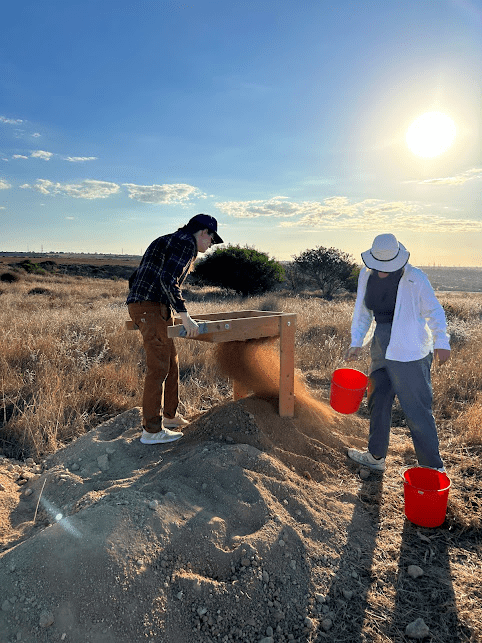
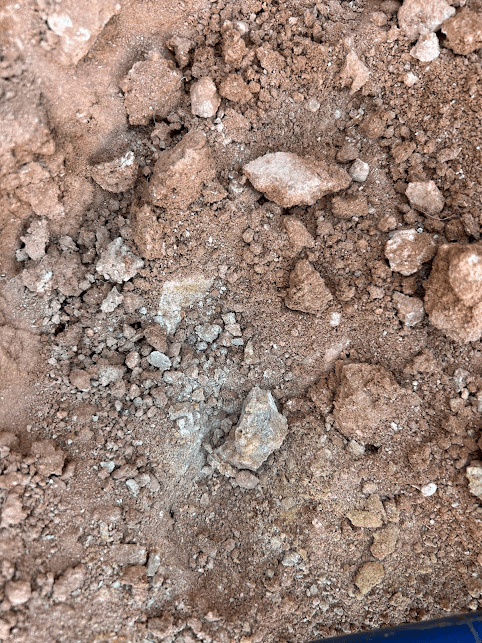
And then the real part of the game begins. The finer particles have flown in your face and in a cloud away from you and chunks of plaster, dirt, mudbrick, and rocks will sit on the sieve. Take off your gloves for this part, because it’s easier to tell by feel what’s what. The big rocks will be obvious, and those get thrown out. Plaster will typically be white with hard edges and points where it’s been broken, or be a nice conglomerate of smaller stones clustered together. Mudbrick will be a soft and crumbling clump that falls apart easily in your hand. Keep your eyes peeled for small, round bluish stones about the size of a fingernail– these will look like coins, and every time you pick one up your heart will leap for a moment. But it’s just a rock.
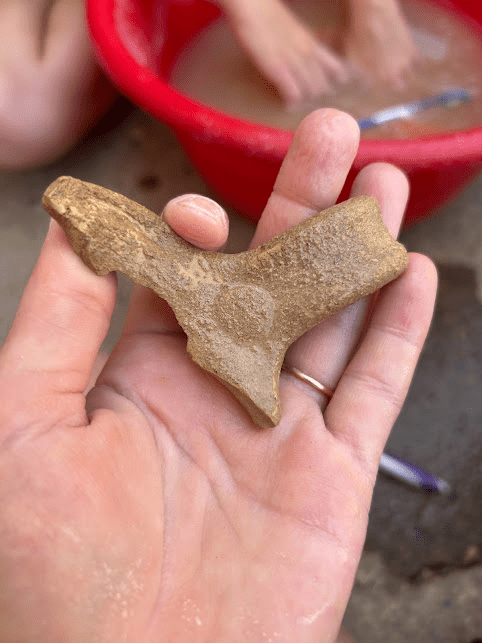
Pottery sherds, on the other hand, come in a few varieties. First, there’s diagnostic pottery. These sherds will be things like handles and rims, or, if you’re lucky, feet or bases. They’re called diagnostic because these pieces can be used to tell what kind of vessel you’re dealing with: a lamp, styles of cookwear, or great big amphora handles. Take a minute when you find an amphora handle to just enjoy holding it (nobody will mind if you pretend to be hefting up an amphora of oil or wine).
Then there’s non-diagnostic pottery, and these are all the other sherds that you’ll come across. The size of these sherds vary wildly. Some are the size of your hand and typically don’t even need to be sieved– you can just pluck those out and put them in the designated pottery bucket for your SU. Others are tiny, but typically anything smaller than a fingernail won’t be collected.
Thin sherds with visible fabric on at least one side are the easiest to spot. It’s the thicker coarsewear that requires skill in the Is this a Rock or is this Pottery. A nice chunk, maybe round, maybe not, will often be a dusty color that matches the dirt you’ve been sieving. You’ll pick it up and give it the once, and then twice, over, looking for telltale signs of pottery. Scrape a little of the dirt off what you think might be a broken end– do you see fabric below? Is the piece clearly curving in an intentional way? How heavy is it– is it lighter than you think a rock of that size should be? You’ll get the hang of it after a while.
But never, ever be afraid to ask your trench supervisor to double check your work. “Is this a rock?” was probably the most common question I asked my supervisor, at least a dozen times a day if I was doing a sieve-heavy dig day. With immense patience and a seemingly supernatural ability to discern rock from sherd, my supervisor would turn it in her hand, use her fingernail to give it a little scrape, and give the final prognosis.
Don’t be afraid to ask “is this weird?” or “is this something?” A lot of times it will be a rock. Maybe it will be an interesting rock, but still, alas, a rock. Sometimes, though, you’ll find a flaky piece of bone, a tiny perfect shell, a weird hunk of iron, or, if you’re very lucky, a small figurine.
As an MSU student on site, you won’t get the chance to try wet sieving, which is a specialized method of discovering floral or faunal remains. But by the end of your time on site, you will get really good at the game of Is this a Rock or is this Pottery?
–Miki H.
 Vigla Archaeological Project
Leave a comment