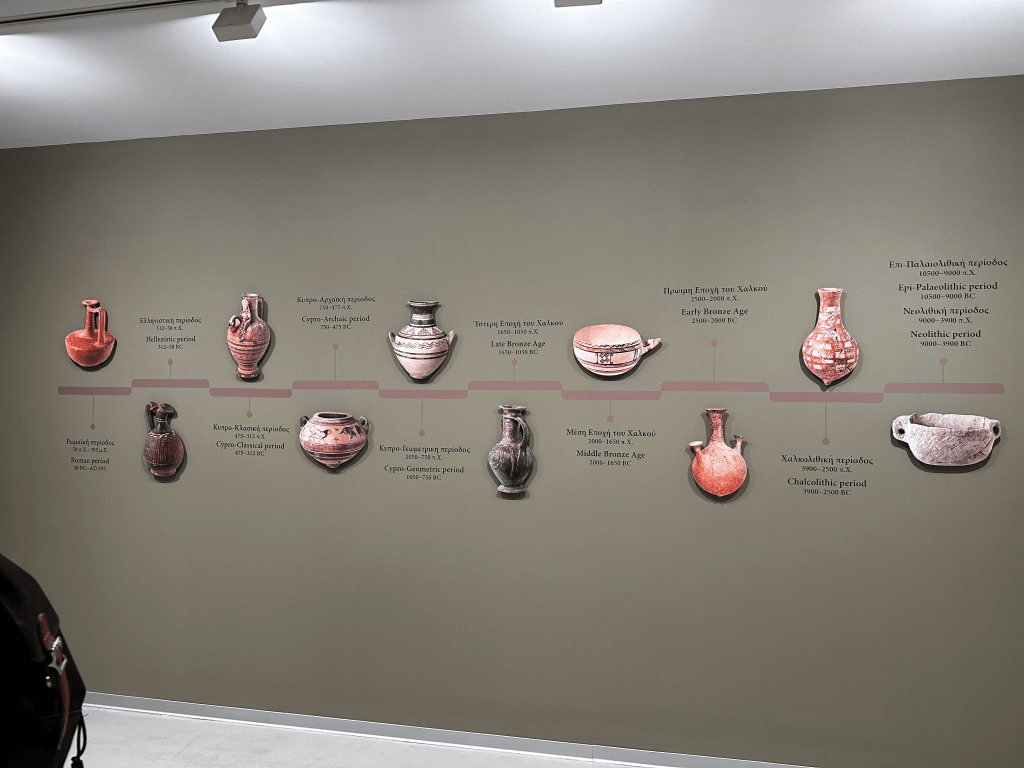
Anyone who worked at any point at Vigla during this season has pulled up and washed dozens of sherds of ceramics. Ceramics are the most common finds with most of them being non-diagnostic and difficult to read. I’m not going to pretend to know half as much about ceramic and ceramic dating as I would like to, but I have come to realize how vital ceramic dating is to dating the overall site.
Ceramic dating is complicated and seeks to understand ceramic trends in the Mediterranean and Aegean and connect them to archaeological sites. Dr. Mel likened it to water bottle trends in our day and age where a new type of water bottle gets popular in different time periods. You can take the waterbottles and trace a general chronology of the last few years with Nalgene being the oldest and Stanley Cups being the newest. Ceramics are also likely to be thrown out and be more accessible to lower classes, unlike metals like bronze or iron which would have been melted down rather than simply thrown away.
If we return to ceramics, how they are fired, what temperature they are fired at, how they are formed, how many times it is levigated, and the actual shape and form give us a basic chronology. The sherds of ceramics that seem to tell us nothing now can give clues about the chronology of a site. Paired with the position in stratigraphy and metalworks, the puzzle begins to come together. With our site specifically, there is a large amount of Late Roman and Byzantine in the topsoil stratigraphic layer that isn’t found deeper into the stratigraphy. This is the intersection of ceramic dating and stratigraphy and from this, we can conclude that Roman influence is nonexistent at Vigla
Beyond chronology, we can understand which groups came into contact with Vigla. This is also a difficult process as cultural exchange and overlap are hard things to track. Ceramics often bear clues to their original home with inscriptions but also the actual design of the pottery. Attic fine ware pottery, for example, is a very finely levigated pottery with a fine fabric and a black, glossy glaze. I have found a few pieces from our own site while washing pottery. Often, our pottery sherds at Vigla are domestic but eyeing the occasional imported good is important for determining the purpose, international connections, and importance of Vigla
I enjoy learning more about the ceramic sherds I pull up, even if they are not as exciting to me as they were at the start of this trip. I’m happy to be somewhat more familiar with ceramics even if I really don’t know that much. I know more than I used to so I’m satisfied with that.
audrey
 Vigla Archaeological Project
Leave a comment