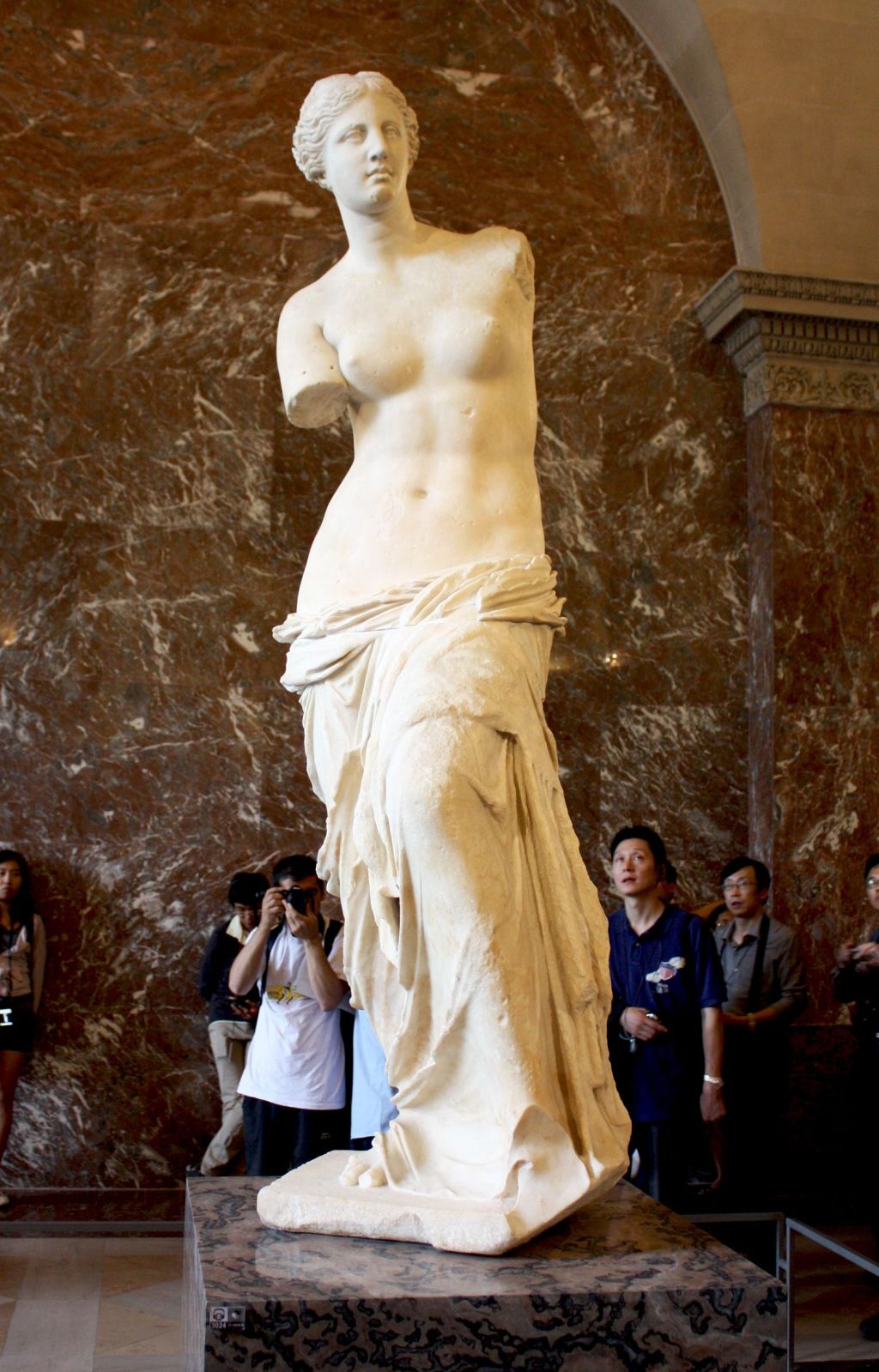
I have never appreciated Aphrodite nor had much desire to learn about her and the religion focused around her. I had only ever encountered a version of her which focused on love, sex, and beauty. Think Titian’s Venus of Urbino or Cabanel’s The Birth of Venus. This is a very limited and very modern view of Aphrodite. Her origins are much more complicated and layered. She has many faces and many aspects, and I would like to take the time to unravel these.
I’ll begin with one aspect of Aphrodite that we all many be familiar with: Aphrodite’s association with the sea. We often see Aphrodite depicted coming out of the sea with the sea foam curling around her strawberry blond hair. In Hesiod’s Theogony, Aphrodite is born from Uranus’s severed penis being thrown into the sea and the subsequent foam from it. Aphrodite is the Greek version of the Phoenician goddess Astarte who was sometimes associated with the sea. The Phoenician Temple of Astarte at Ancient Kition is located close to the where the ancient shore was and was likely a stopping point for sailors to stop at to gain protection for their sea voyage.
However, Aphrodite’s main sphere of influence would be fertility, and it would be the most consistent aspect with regards to Aphrodite. Fertility is a broader arena than we might think. It includes sexual reproduction which is obvious but, in the case of Cypriot Aphrodite, it extends out in the abundance of metal. There is a particularly statuette of Astarte that depicts her standing on a copper ingot. Beyond this depiction, the Temple of Astarte in Kition would have copper metallurgy as part the sacred space which further places copper in Aphrodite’s sphere of influence. In later Classical versions of Aphrodite, she would still be linked with metallurgy due to her marriage with Hephaestos who was the god of metalworking among other things. Despite this point far from being a major part of her sphere, Aphrodite has some connections to metalworking which tracks with her connection to Cyprus, a island known for its copper.

Aphrodite’s character is best described by the word war. As previously noted, Aphrodite is a goddess derived from Astarte and Ishtar who both would be associated with war. Egchelos, or “the goddess with the spear,” was another name for Aphrodite who had a deep ferocity to her character. She was never a mother goddess trending after her children, but a passionate and furious goddess. War, I think, describes Aphrodite well. Her control of the stormy sea and the crashing emotions of human sexuality can be best described to me as warlike. The notion of her sitting delicately on a sea rock, not a single blemish or hair out of place, completely contradicts Aphrodite’s associations and complexities ad a mythological figure. It is no wonder they call her “the Great Goddess” of Cyprus for she dominated their sea, controlled the fertility of their metal and sexual relations, and was one of their war deities. Most of Ancient Cypriot life would have been slotted under her control, so it’s no wonder she had three major sanctuaries on the island.
I have learned a lot about Aphrodite while I have been here in Cyprus. I am most fascinated by her furious nature and her deep connections to metal, war, and sea-fairing. None of these things I would associated with Aphrodite before this, and I have appreciated the nuance within her character.
audrey
 Vigla Archaeological Project
Leave a comment