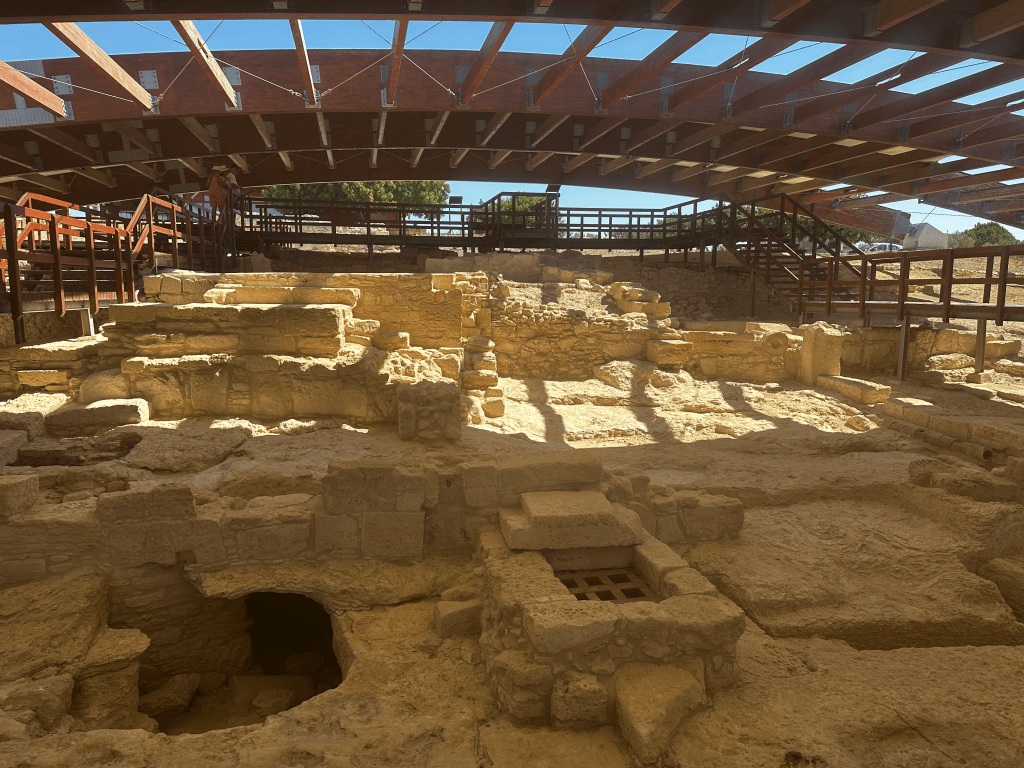
At the ancient site of Kourin there are a series of stunning floor mosaics that depict various geometric patterns and animals. They are part of a larger complex made up of a private house and a public bathhouse which were owned by a man named Eustolios. Eustolios’ complex would be remodeled during the reign of Theodoius II which was towards the end of the Roman Empire at 408-450 CE and a time of religious change. Prior to renovation, Kourion would be hit with a devastating set of earthquakes from 365-370 which would leave much of the city destroyed. These two factors would provide the backdrop for the mosaics: an empire slowly leaving behind its pagan past to embrace Christianity, and a city devastated by natural disasters.
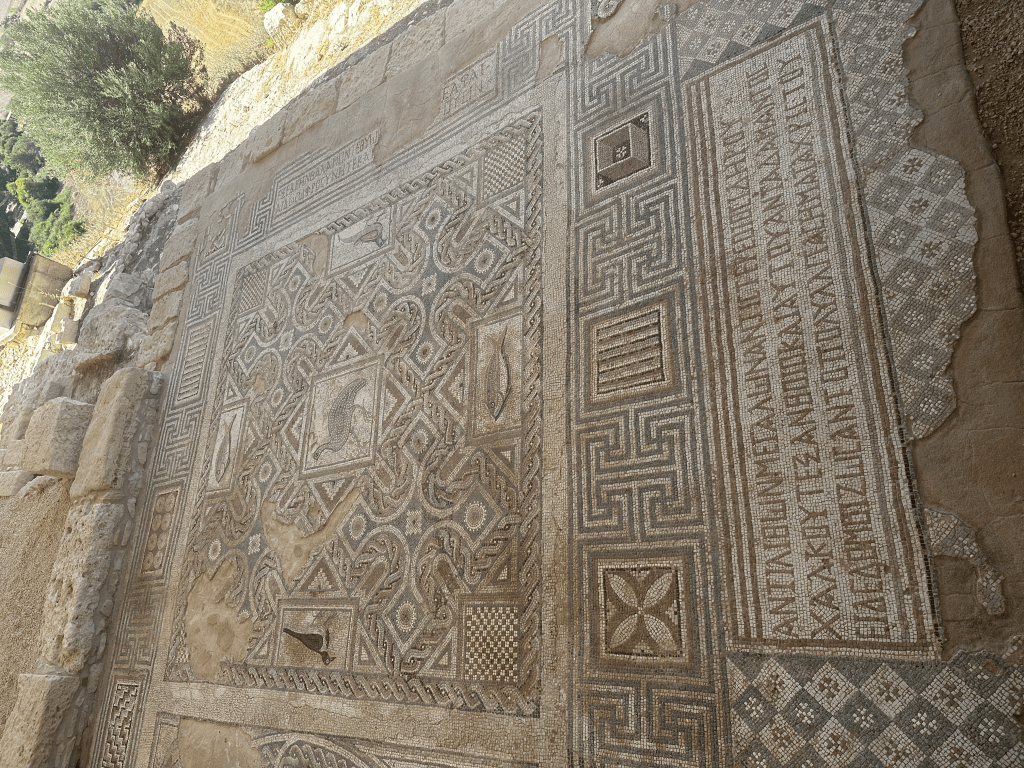
With an undertsanding of the background, let’s turn to the actual content of the mosaics. There are several Greek inscriptions within the mosaics that give us much of the context for them. One says,
“The citizens of the Kourion, who once had considerable wealth were now in abject misery. When Eustolios saw this he did not forget his land, but naturally remembered her with love, presenting the city with baths. He indeed took care of Kourion, and Phoebus had once done, by restoring calm in the earthquake-struck land.”
This inscription gives us the sponsor of the mosaics and the bathhouse (Eustolios) as well as his reason for creating them. It was a act of charity for the citizens of Kourion. This is tender context for the bathhouses; A private house that would converted into a public place of rest in trying times. There are other clues to be taken from this inscription, but there is an unexpectedly human act of kindness within it as well that I think should be acknowledged.
We will move onto a less sentimental note within the inscription: the mention of Phoebus Apollo. Although not surprising in a Greco-Roman city, it is surprising given the timeperiod. This is after the Roman Empire is Christianized, and paganism is slowly being shut out. The mosiacs become more perplexing when we consider another inscription from the bathhouse:
“This house, in place of its ancient armament of walls and iron and bronze and steel, has now girt itself with the much venerated symbol of Christ”
Eustolios had mentions of both Christianity and paganism in the mosiacs, not opposed to eachother but harmonizing. Despite the massive cultural shifts and the uprooting of pagan religions, paganism still had deep bonds with Roman culture. This is further shown by other mosaics built around the same time in Kourion that also depict pagan literary elements and culture. The mosaics at the complex of Eustolios give a stunning picture of the slow cultural transition from paganism to Christianity. Despite Christian emperors and the abandonment of pagan temples, pagan culture remained in the minds of the people.
I am reminded of a book I read last year (Shout-out to Dr. Stephens!) which had a section on Christian tolerance during Constantine’s reign. Constantine would be similar to Eustolios where he would uphold the Christian faith and support the Christian Church while also leaning on pagan symbolism. Christianity’s spread throughout the Roman Empire was remarkable quick but it was not a destructive wave that obliterated paganism within the Empire. Greco-Roman paganism would continue to permeate the minds of the Roman Empire and its successors, and it would never quite lose its grip.
audrey
 Vigla Archaeological Project
Leave a comment