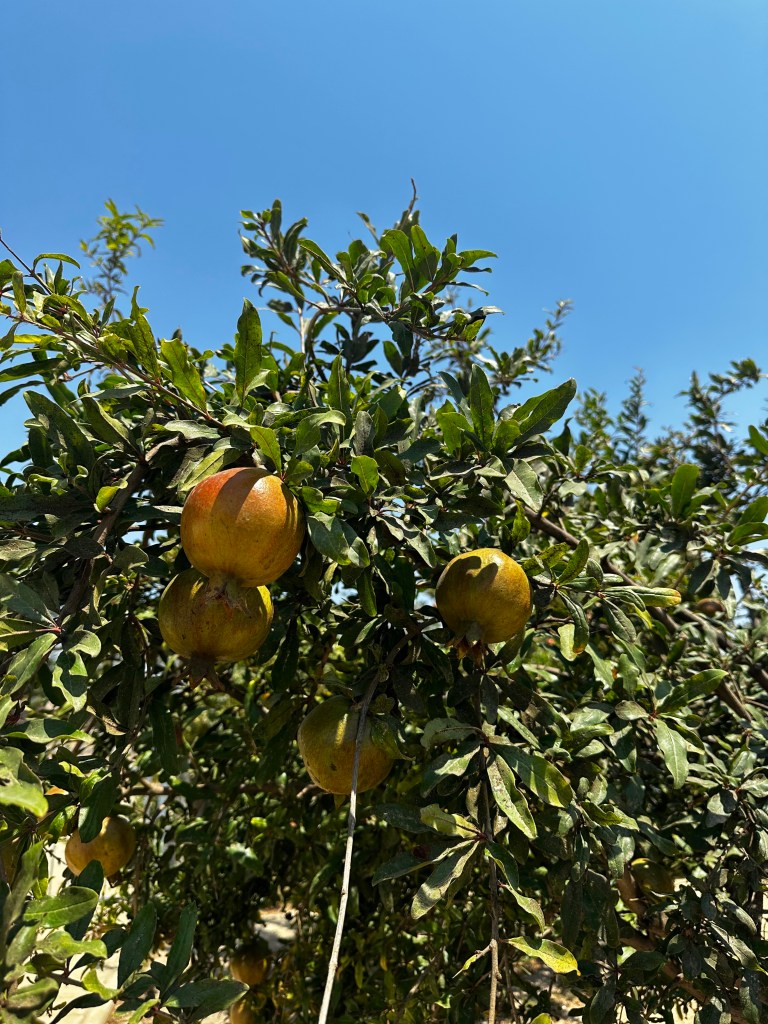
Pomegranate juice and pomegranate-based food are prominent across Cyprus. According to a new local friend named Christos, pomegranates are not only beloved for their flavor but for also for their cultural significance. Pomegranates in Cypriot culture are symbols of fertility. He demonstrated a sculpture of a woman’s torso where a pomegranate was placed where the uterus would be (I did not take a picture unfortunately). He also explained a tradition where a pomegranate would be broken apart after a wedding before the married couple move in. This tradition would bring the couple good luck and fertility in their marriage. Pomegranates are also symbols of both life and death with their blood-red juice and bone-like mesocarp being good pictures of our own bodies. They are often found both at modern weddings and in ancient tombs, or at your local gift shop as a small statuette.
While at the Ancient site of Kition, my classmate (Paris!) and I found several pomegranate trees planted around the site. According to the museum signs around the site, pomegranates would be a sacred fruit of Aphrodite and fertility by extension. Aphrodite would be the one to plant the first pomegranate trees on Cyprus, or so the legend grows. It is likely the reason why they were also planted at the Sanctuary of Aphrodite by the museum. The pomegranate’s connection to fertility is further demonstrated by it’s connection to Hera and Demeter who were also fertility goddesses, each control a slightly different aspect of fertility.
Pomegranates are not native to Cyprus rather they were brought over as a luxury good from modern-day Iran. It was an important cultural symbol for ancient India, Egypt, and Israel. The Greeks would incorporate the pomegranate into their myths (recall that Persephone ate the fruit of the Underworld which was a pomegranate) and follow in the death symbolism. The fruit would not only work its way across the Mediterranean but also up the Silk Road to China and Korea where it would also be viewed as a fertility symbol. Despite only being native to Iran, the pomegranate has traveled across the globe as a symbol of prosperity, fertility, life, and death.
Side note: I am not a huge fan of pomegranates and their flavor. Aesthetically speaking, they are beautiful fruits, but I am simply not the biggest fan of their taste or texture. I do enjoy playing eye-spy with them in Larnaca and seeing when I can spot this fruit.
audrey
 Vigla Archaeological Project
Leave a comment