Apollon Kitharoidos at Cyprus Museum
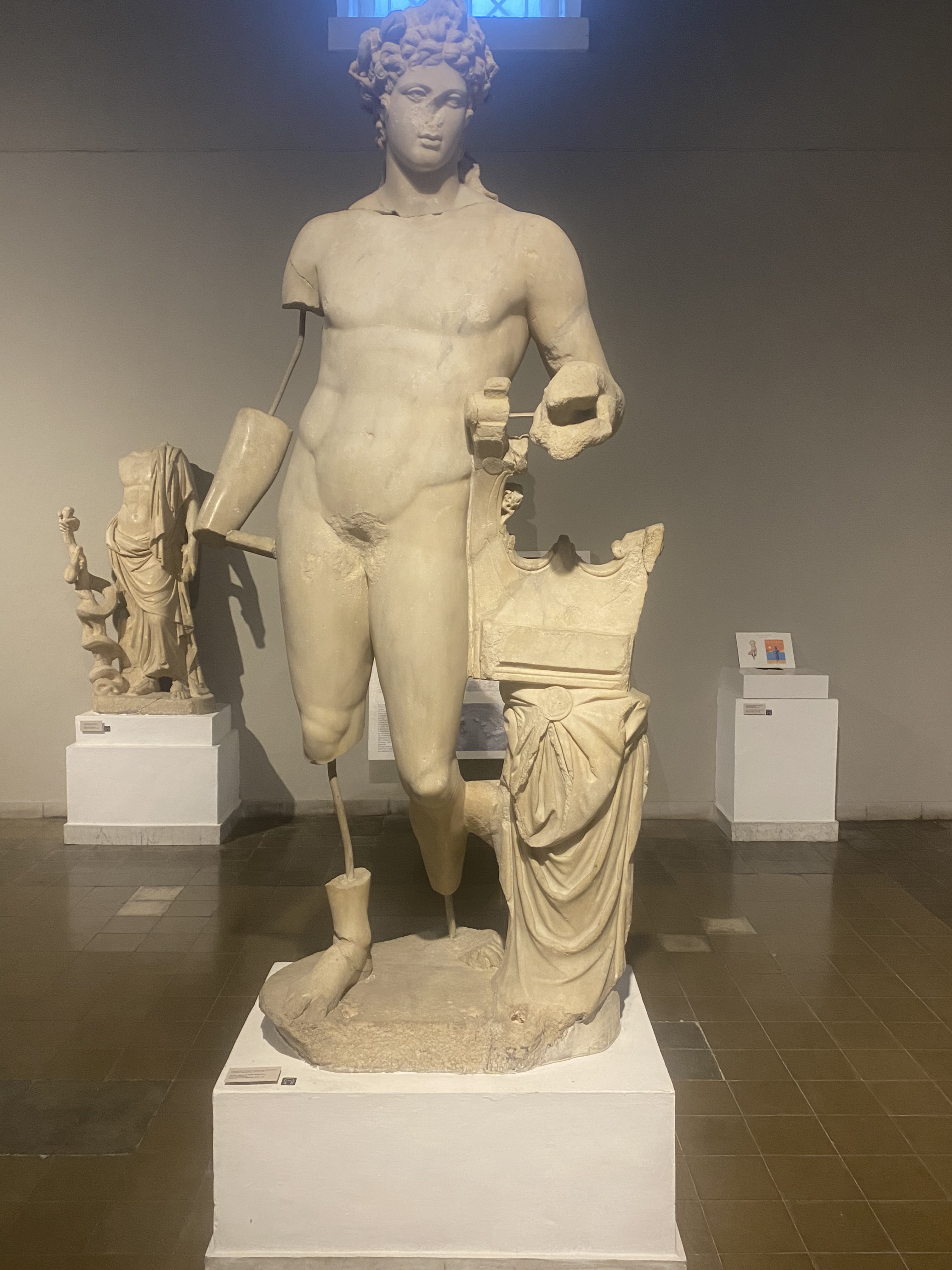
Last Saturday, as a school we visited the Cyprus Museum located in Nicosia. This museum is curated wonderfully as it takes you through the ages of Cypriot history and archaeology chronologically. There is even an exhibit entitled “Five” which introduces the visitor to the lives of five ancient people (this exhibit has already been written about by other students so I won’t go into too much detail). However, the room that stood out most to me was the room that focused on Greek deities.
Side note, Aphrodite was featured in various rooms and halls within the museum as she is important in Cypriot mythology and there have been many Aphrodite statues found in Cyprus. Other deities such as Apollo, Asklepios, and Zeus were only featured in one room.
The room’s feature is a statue of Apollo Citharoedus (Apollon Kitharoidos in Greek romanization). In the discussion of this statue I would like to touch on Greek mythology, the concept of titles and epithets, and, of course, the statue itself.
Firstly, the mythology of Apollo. There are two main misconceptions when it comes to the Greek deity Apollon. The first misconception is that he is the God of the Sun. There are very few attestations of Apollon being a sun god and they are almost always Roman additions. He is actually the god of light. The god of the sun is from the predecessors of the Gods, the Titans. Helios is the titan and personification of the sun. Apollon rules over much more than light. Plague, healing, music, prophecy, archery, and more. He is even the protector of young men, while his twin, Artemis, is protector of young women. Ruling over so many important domains, Apollon was certainly an important deity and is almost always considered one of the twelve major Olympians. The second misconception is that Apollo has the same name in both Roman and Greek, unlike many other Greek deities (i.e. Jupiter (Latin) versus Zeus (Greek)). His Greek name is more specifically Απολλων (Apollon) (please ignore that the Omega is capital, I guess wordpress doesn’t support a lowercase omega in this font) with an N at the end. The deletion of the N is the Latin spelling of Apollon. At this point in time, his name has widely been Americanized, pronunciation wise. In Ancient Greek, his name would be pronounced similar to ah-poh-lohn (IPA: [aˈpʰʌlʌn]). In the modern day, in America, his name is pronounced closer to ah-pah-loh.
Secondly, epithets. As you may’ve noticed the in title of this post, and the statue, Apollon has a second name. Apollon Kitharoidos. The second name is called an epithet; an epithet is an “adjective or phrase expressing a quality or attribute” of a person. Kitharoidos (Greek) or Citharoedus (Latin) means “of the kithara” which is now more commonly known as the seven-string lyre. Apollon has many epithets, likely due to the fact that he was a God of many things. His most important and most used epithet is Phoibos (bright) due to him being God of light. Titles and epithets can reveal much about deities we otherwise don’t know much about, as well as the direct translation of the deity’s name.
Fun fact: Apollon was not the creator of the lyre. Young Hermes was. The lyre was created from cow intestine and a turtle shell.
Thirdly, we should look back to the statue. The statue has clearly suffered some damage as we see the nose is missing, as well as parts of the arms and legs. This is typical for Greek/Roman statues as they are old and, obviously, somewhat buried in the ground, so these parts of the statue that stick out (like the nose) or are smaller/feeble (like the arms) break off. A statue of Apollon can be identified through his head. Specifically his hair/adornment. Apollo is represented as a beardless man/youth and his hair is often tied into a bow towards the front of his head. However, that’s not the case for this statue which brings us to the next step, head adornment. In this statue he has on a crown of laurel. This is an indicator of Apollon because he is actually the god of laurel. Another indicator that this is Apollon is simply the fact that he is leaning against his kithara. This is actually a Roman statue as it was found in the location where the gymnasium of Salamis was (city in Cyprus) and dates back to the 2nd century AD. Salamis was under Roman rule in the 2nd century AD. I can’t find any information on whether this statue is a Roman copy of a Greek original or if it is a Roman original.
Fun fact: Laurel leaves and Bay leaves are the same thing!
Well, I really hope everyone learned a thing or two about Apollonian mythology while reading this post!
Thanks for reading! – Hunter Powell
 Vigla Archaeological Project
Leave a comment