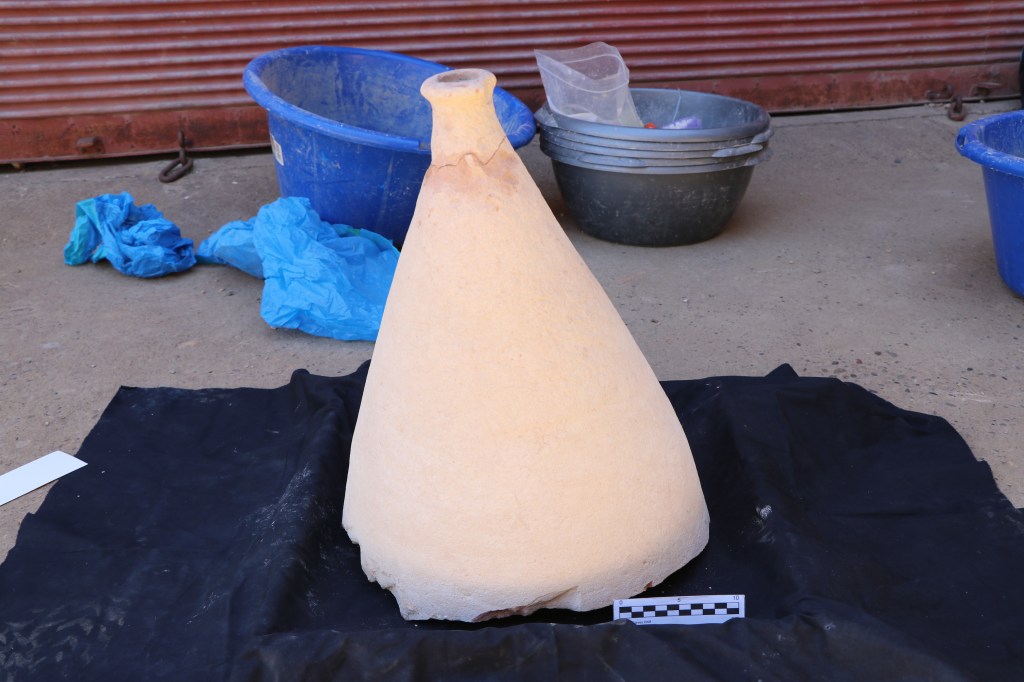
One of the special finds at Vigla is a partial amphora. This vessel was found in situ in the floor of the Eastern room. At the time of excavating this vessel, there was little to no ceramics being found in that trench. The inside of this vessel was excavated, but little came from this aside from mud-brick and a few shreds of ceramic. At this time, there isn’t an estimate for the date of creation. However, it’s assumed that this amphora can be dated back to around the same time as the wall it was abutting. Given the size and shape, this was likely a transport amphora. Transport amphorae were used for the transportation of various products such as, but not limited to, wine, olive oil, and dried cereals. These were used widely throughout the Mediterranean, so, it’s not uncommon to have found one at the site. It’s possible that the inhabitants of this home had multiple transport amphorae, given their ease in leaving it behind. Not much was found around the vessel aside from more, what can be presumed to be, collapsed mud-brick. Given the quality of this vessel, as well as the consideration of these being common throughout the Mediterranean, this vessel was likely created by an artisan. Travel amphorae are characterized by their large, angular, cone-like shape, as well as a more narrow foot. Taking into consideration the commonality of these vessels, they would’ve needed to be produced in great quantity which would require some kind of specialist to be making them.
 Vigla Archaeological Project
Leave a comment