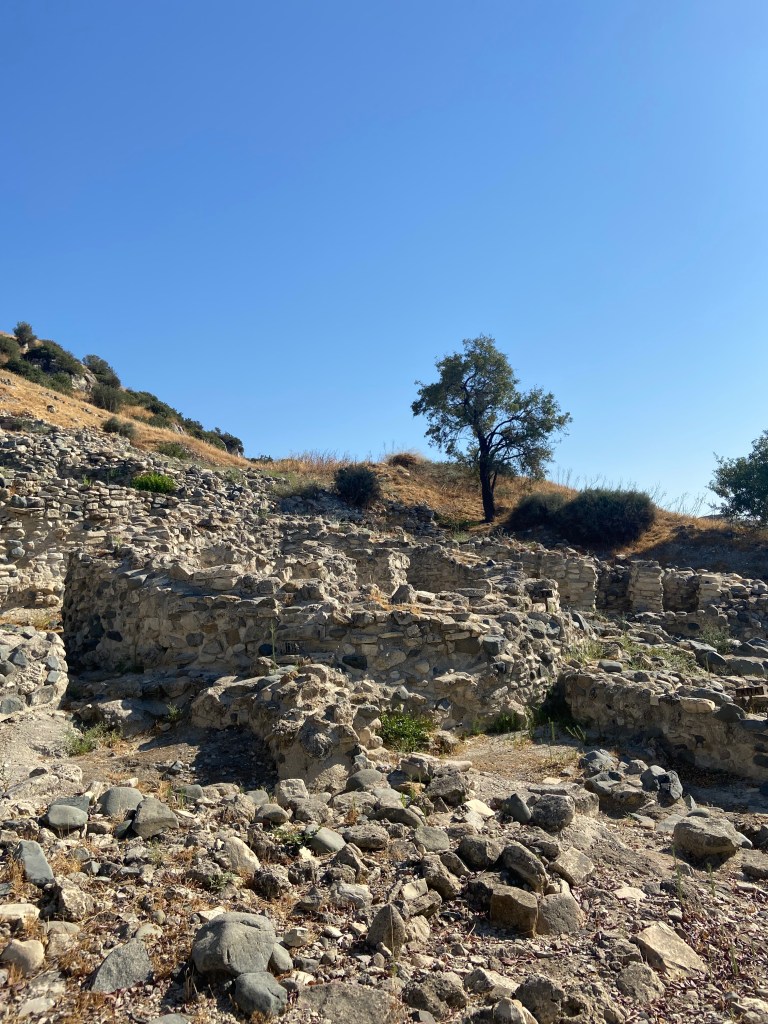
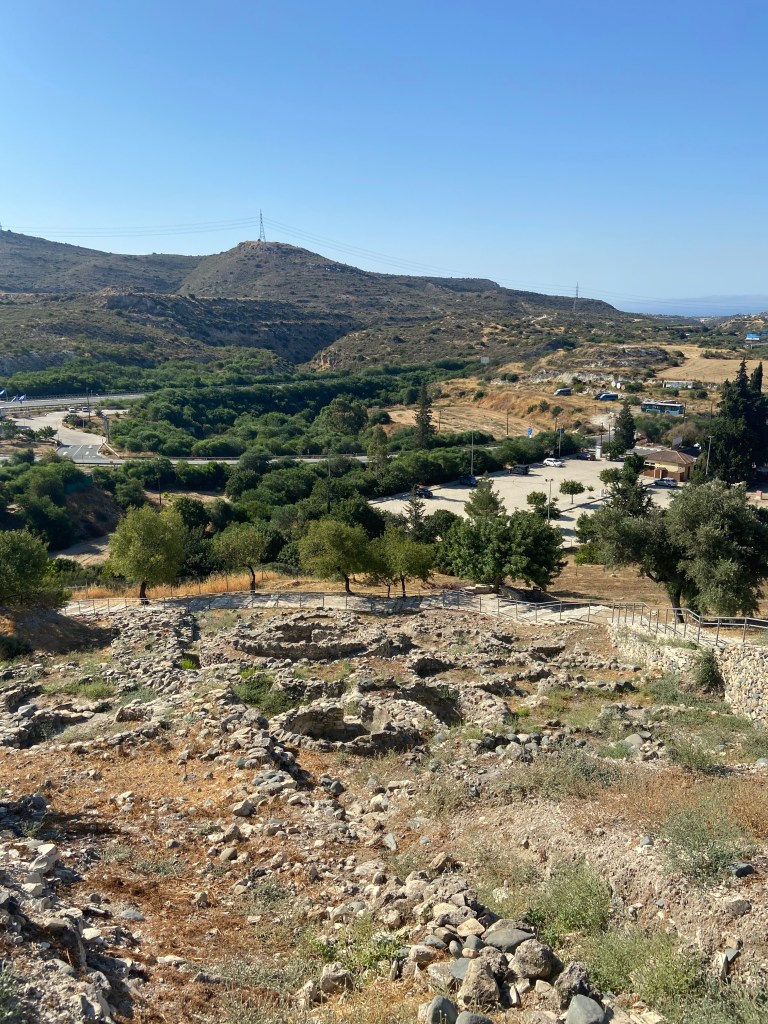
The Neolithic settlement of Choirokoitia is located in the Marconi valley. This settlement reveals the development of the Cypriot Aceramic Neolithic, an original civilization. The communities that settled here date back to the end of the 7th millennium BC. Upon settling here, inhabitants brought new plant and animal species with them, thus increasing the biodiversity of Cyprus. This site was discovered in 1934 by P. Dikaios; later in 1976, it was taken over by the CNRS. The collection of Neolithic homes present at the site appears to be part of an architecturally complex system. Taking into account location, the builders of these homes would’ve had to adapt them to hilly, rocky terrain. Additionally, this settlement was constructed in a location that provided natural forms of fortification- a deep bend of the river in the north, east, and southeast- in addition, to successive walls that were established in the west.
With guaranteed protection, control over the entrance to the village was given to its inhabitants. Multiple groups of homes, and house compounds, were discovered in this settlement. These compounds consisted of several buildings laid out in a circular shape. Within each compound is an inner, central courtyard. These courtyards were used for grinding, and likely other household activities as well. The building material of these homes included stone, pisé, and sun-dried mud-brick. These materials were both used individually, as well as in conjunction with one another. The flat roofs of the homes were constructed using a combination of branches, pisé, reeds, and earth. The impressive civilization living here vanished suddenly, and without leaving any type of explanation. The site was left uninhabited for some time until the emergence of the Ceramic Neolithic.
-Olivia R.
 Vigla Archaeological Project
Leave a comment