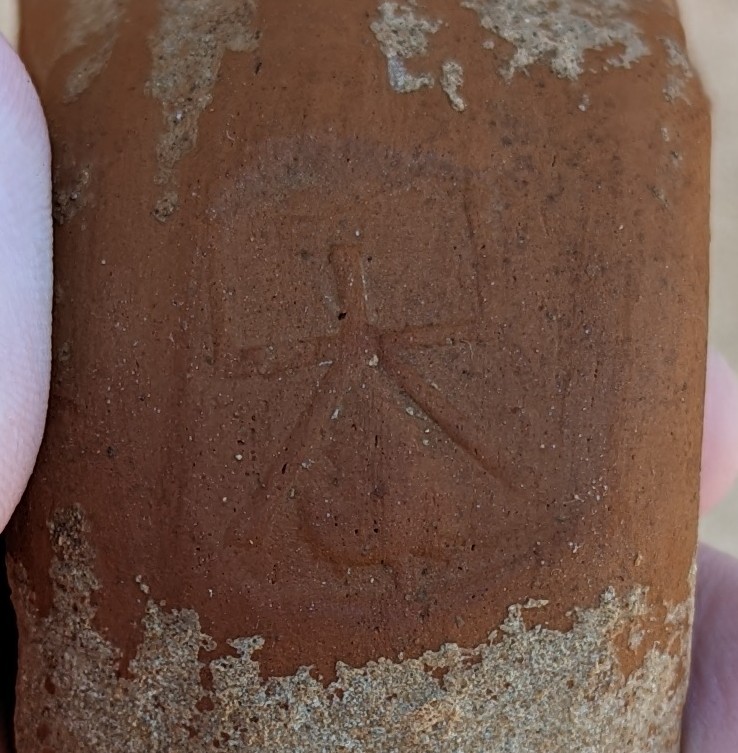
Not all discoveries are made during the dig. Sometimes artifacts are not examined much before they are bagged, tagged, and taken away to storage. Once the students start doing the tedious grunt work of pottery washing, some of the missed finds come to light. In 2019, a handle for a piece of pottery was placed in a bag with likely little consideration. In 2022, it was pulled out of the bag and began to get cleaned up. (It seems that is normal that previous seasons find get cleaned up by the next season students… we got through 2019 but barely touched our own finds). I began working on this rather innocuous pottery item and realized there was some marking on it. I showed it to the professors and they started discussing that maybe it was two different Greek letters. I spent more time scrubbing it clean and the image became more clear.
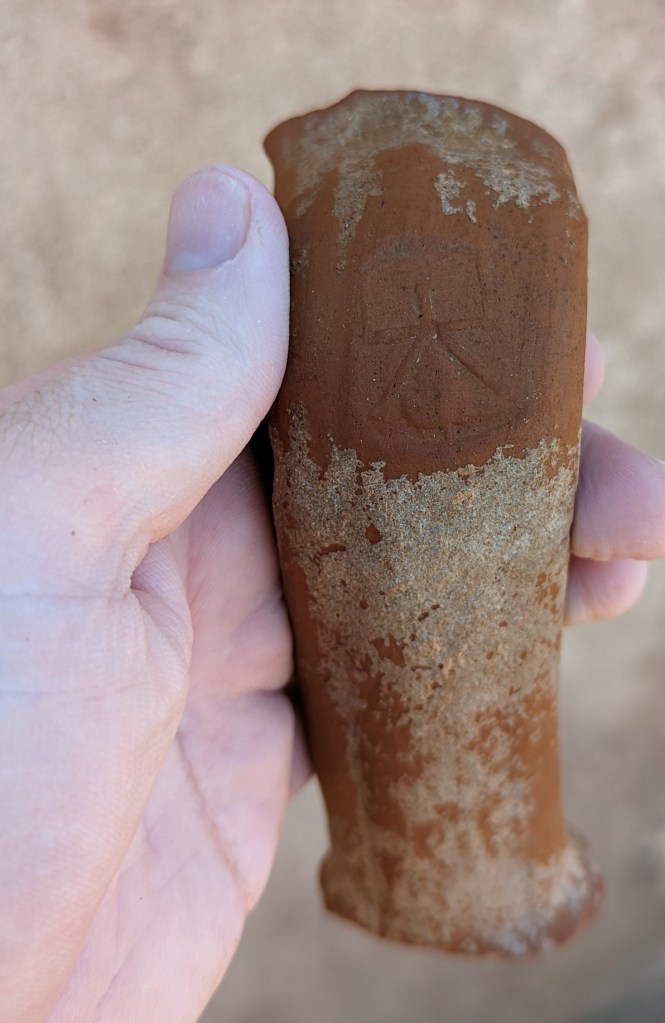
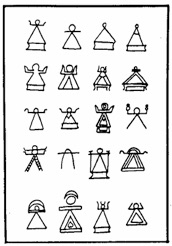
In the shade, it immediately reminded me of the symbol of Tanit. Tanit was a very important Phoenician goddess, the chief deity of the Carthaginians, who would have been in control of much of the seas in the western and central Mediterranean during the time period of our site. I brought it back to the professors and they saw it as well now too. One of the graduate students perked up to take a look and agreed. She seemed to have a specific affection for Phoenician history and I assume it was her area of focus as over the weeks she was able to refer back to her knowledge of Phoenicians on many different topics. Additionally, once it was in the light, there was a clear triangular shape inside the ‘skirt’ of Tanit. I thought it was a bell, but one professor was pretty sure it was a tree. The tree would make more sense, if you understand the historical and religious importance of the cedar tree in the Levant. All the way back to the Epic of Gilgamesh, the Sumerians wrote in Cuneiform tablets about Gilgamesh visiting the Cedar Forest which was a realm of the gods. It is believed by some this Cedar Forest was located in modern day Lebanon, which is where the Phoenician Empire took root in cities like Tyre. Cedar trees can have that bell like shape almost like that of a pine tree. Even today, the modern Lebanese flag has a cedar tree on it. The cedar tree is mentioned over seventy times in the Bible, most of these citations are found in the Book of Pslams. Needless to say, the importance of the Cedar Tree seemed to last for millennia and spread all throughout the Semitic peoples traditions and religions.
My professor described to me the practice of pottery manufactures sometimes having a branded makers mark on their wares, or the merchants who purchased wares and took them abroad to sell would store them in their own marked pottery. That was his assumption, and this jives with the idea of Cyprus being a nautical crossroads for much of the Mediterranean and Near Eastern civilizations at this point in time. Perhaps the troops at Vigla had merchants come to their gates offering goods, or the soldiers themselves acquired them from looting or purchase from local cities such as Kition (ancient Larnaca). This piece of evidence is no smoking gun in trying to figure out who built the military installation at Vigla, but it does help form a picture about daily life and the means of acquiring resources in the area.
Stay curious and remember the little details. It might turn a simple marking find into a bigger question.
-Adam E.
 Vigla Archaeological Project
Leave a comment