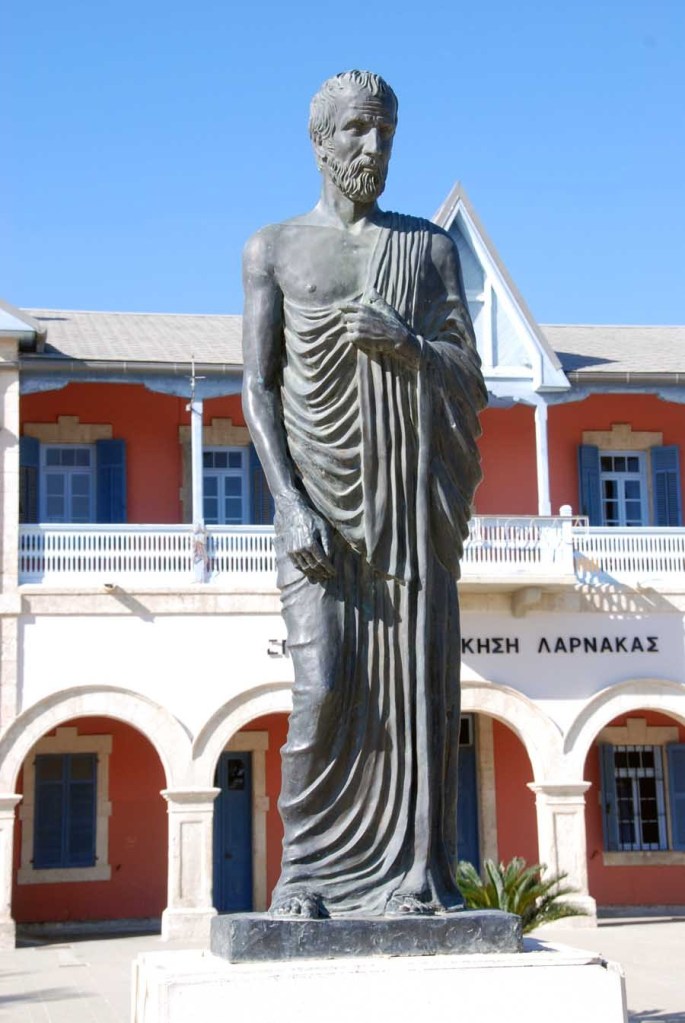
The very first group trip we took was a very short one around Larnaca, anchored around Finikoudes Beach. There we saw a Venetian castle later held by the Ottomans, the Church of St. Lazarus, the Jami Kebir Mosque, the statue of Cimo… but the very first site seen was the statue of Zeno.
Zeno was from Larnaca, then known as Kition, and followed in his fathers footsteps as a seafaring merchant. He managed to survive a shipwreck and found his way to Athens, and while passing the time he read a scroll discussing Socrates. He was immediate taken by the works of philosophy and asked the shopkeeper who owned the scroll where he could find these wise sophists. At that very moment one was walking by and the shopkeeper pointed Zeno over to this man. From that moment forward, Zeno devoted his life to learning the philosophies of the great Greek thinkers. He eventually came to form his own school of thought we call today ‘Stoicism.’
Now I am no philosopher. A lot of the great Greek tomes I confuse with one another and sometimes outright do not understand the point the author was trying to get across. However, Stoicism, when I do have the chance to absorb the philosophy, often speaks to me on a very personal level. Later stoic philosophers like that of Marcus Aurelius really honed in much of the details of stoicism that made it much more broadly applicable to the modern person. None of Zeno’s writings have survived throughout time, but those who succeeded him gave us enough of an understanding of Zeno’s original philosophies that we can attribute the new school of though to him.
Zeno’s philosophy was very Taoist, if we could compare it to a surviving religio-philosophic ideology. The balance and the ebb and flow of nature is what should be sought out to live a good life. The good life can only be found through virtuous actions and not that of pleasure or vice. Virtuous actions themselves were natural, thus to act naturally in accordance to nature, not to fight against it, was the way to achieve this good life. Again, I am not a philosopher, but Zeno often preached his ideas in a cyclical fashion. His chosen code of life to live by was effectively one of contemplation before acting and moderation in every pursuit of life. I think there is some solid ideas in taking a moment to ponder our words and actions before we respond and also making sure we are not underperforming or overzealously acting when we do chose to act. One of Zeno’s reported writings was one called ‘Republic.’ It had the same concept of Plato’s ‘Republic’ where it explored the idea of the perfect society, but Zeno’s was much more utopian. In fact, today we would call it outright anarchist. But it is a really good exploration of the philosophy of utopianism, to the point where virtue guides all human actions, thus laws are no longer needing to exist because everyone has figured out what they need and demand nothing more.
Zeno came to a very strange end according to a few ancient historians. Zeno tripped and injured his toe, hit the ground with his fist and cursed out loud as if he was acknowledging his own death, and according to different sources, he either held his breath until he died or strangled himself out right. Unlike the beautiful and poetic end that Socrates met, Zeno’s death was sudden, puzzling, and did not fit the image of a man so in control of his own mind and actions.
If you have the chance, read up on Stoicism. But if you feel stoicism is a little too detached from self-determination, you are more than welcome to join me in my other favorite Greek philosophical camp, the Cynics.
-Adam E.
 Vigla Archaeological Project
Leave a comment